by Prompt Personnel | Feb 27, 2025 | POSH Compliance
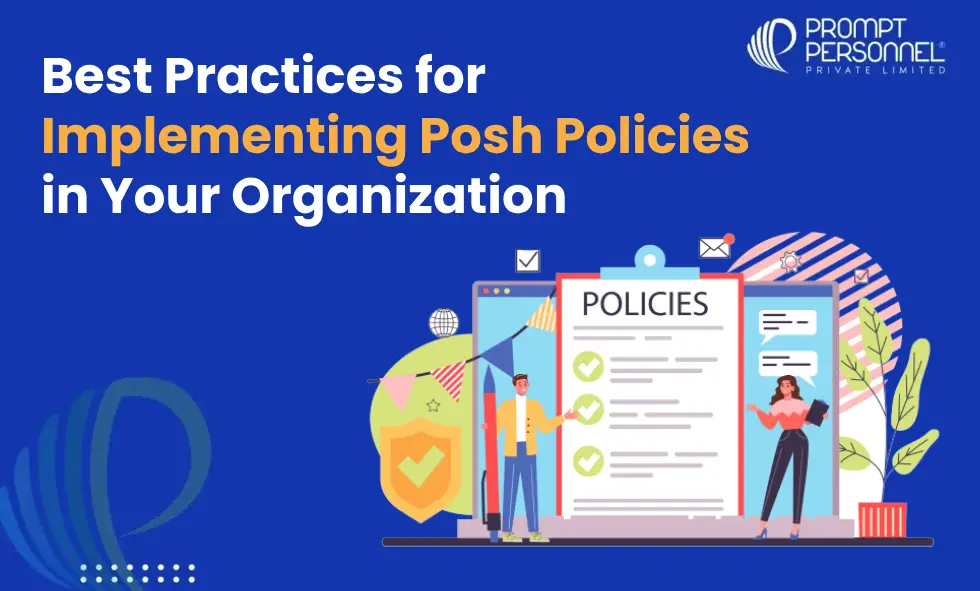
Developing a respectful and safe work environment for all workers is vital in creating a space where individuals feel safe, valued, and protected. Having strong POSH (Prevention of Sexual Harassment) policies is important in ensuring this is achieved. A well-structured POSH policy is a legal necessity and a powerful tool for promoting dignity, respect, and equality within an organization. This blog will discuss the best practices for implementing POSH policies, including the importance of POSH training for employees, compliance, and creating an environment where harassment is not tolerated.
Understanding POSH: The Basics
To effectively implement POSH policies, it’s essential to understand what POSH is all about and why it is needed. The POSH Act (Prevention of Sexual Harassment at the Workplace) was enacted to prevent and address cases of sexual harassment in the workplace. It requires employers to provide a safe and harassment-free environment, effective grievance redressal, and proper training for all employees.
Even as the POSH Act has formal requirements, the actual worth it provides is establishing a culture of respect and responsibility. A positive and detailed POSH policy establishes that all parties in the working environment are made aware of the behavior that can and cannot take place. The policy gives permission to employees to raise their voice against harassment and provides them assurance of a comfortable work environment with no fear of discrimination or misconduct.
Best Practices for Implementing POSH Policies
Implementing a POSH policy is not simply about creating a document and filing it away. To truly create a safe and respectful workplace, organizations must integrate these practices into the fabric of their culture. Here are some of the best practices to ensure the effective implementation of POSH policies:
1. Create Clear and Detailed POSH Policies
The initial action in adopting a POSH policy is to prepare an explicit and detailed policy document that defines sexual harassment, the procedures for reporting an incident, and the measures the organization will adopt to deal with grievances. The policy should be easy to understand and provide examples of what constitutes harassment. By defining clear guidelines, you eliminate ambiguity and help employees understand what behaviour is considered unacceptable.
The policy should also include the mechanisms available for reporting harassment, whether it’s through a POSH committee, human resources, or an external body. It should clearly outline how complaints will be investigated and resolved, ensuring confidentiality and impartiality throughout the process. A well-written POSH policy fosters trust and assures employees that management will take their concerns seriously.
2. Seek Support from Top Management
It is only possible to make a POSH policy successful if the senior management lends full support to it. Top leaders in the company need to lead by example and follow the POSH policy themselves. It conveys a strong message among the employees if the management not only supports the POSH policy but also proves committed to the prevention of sexual harassment. Involvement of the leadership can also ensure that there are the requisite resources, e.g., training and specialized personnel, to preserve the integrity of the policy. Senior management buy-in is effective in establishing a top-down response to the introduction of POSH policies. This guarantees that POSH is not perceived as an HR ritual but as part of the company culture and values.
3. Designate a POSH Committee or Officer
Appointing a POSH committee or officer is among the most successful means of making POSH policies work. Such a committee oversees the policy, addresses complaints, and makes sure that the company is compliant with the law. The POSH committee should be made up of representatives from different departments in the organization to ensure diversity and objectivity.
The committee should also be properly trained in dealing with sensitive complaints, providing a confidential and supportive environment for complainants. The officers or committee members should be capable of carrying out proper investigations and taking timely action when required.
4. Conduct Regular POSH Awareness Training
Regular POSH awareness training for employees is crucial for ensuring that everyone in the organization is aware of what sexual harassment is, how to recognize it, and how to report it. Training should cover the different forms of harassment, such as verbal, physical, and psychological harassment, and educate employees about the impact of such behaviour on both the victim and the workplace as a whole.
Training must also address reporting incidents of harassment, assuring employees that the process is confidential and that they will not be retaliated against for reporting. It is necessary to provide an environment in which employees feel at ease raising issues and assured that their concerns will be dealt with professionally and impartially.
5. Incorporate Online POSH Training for Employees
In today’s digital world, offering online POSH training for employees is becoming increasingly popular and essential. Online training programs provide flexibility and accessibility, making it easier for employees to complete their training at their own pace. This method is particularly beneficial for companies with multiple branches or a geographically dispersed workforce. It also allows employees to revisit the training materials as needed, reinforcing the lessons learned.
In addition, online training can be customized to fit your organization’s needs, giving it a more personal touch. For example, organizations can add case studies, quizzes, and interactive content to maximize employee participation and retention.
To explore a step-by-step guide on ensuring effective POSH awareness training and compliance, read our detailed blog on POSH Awareness Training: Steps to Ensure Compliance and Safety.
The Role of POSH Training in Building a Safe Work Environment
Successful POSH training is among the most critical weapons for developing a culture of respect and stopping sexual harassment in the workplace. This is why POSH training for employees is essential for the creation of a healthy and safe work environment:
1. Promotes Awareness and Understanding
POSH awareness training helps employees understand what constitutes sexual harassment and the different ways it can manifest. Many individuals may not realize that certain behaviours are considered harassment, especially when it comes to subtle forms like inappropriate comments or jokes. Training provides clarity on the issue, ensuring that everyone knows what is acceptable and what isn’t.
Through this knowledge, POSH training can avoid harassments from occurring in the first place. If an employee understands what is unacceptable behaviour, they are less likely to do it and more likely to call out someone who does.
2. Encourages Reporting and Transparency
One of the most important goals of POSH training is to get employees to report any cases of harassment without fear of retribution. If employees are trained in how to report harassment and are promised that their complaints will be dealt with confidentially, they are more likely to report. This transparency is vital for organizations to identify problems early and take corrective action before they escalate.
3. Fosters a Culture of Respect and Dignity
Regular training and awareness programs contribute to fostering a culture of respect where employees feel safe, supported, and valued. A respectful work environment leads to increased productivity, better employee morale, and greater job satisfaction. Employees are more likely to remain with an organization that prioritizes their safety and well-being.
Protect Your Workforce with Robust POSH Policies & Training!
Ensuring POSH Compliance in Your Organization
Compliance with the POSH Act is not a choice but an obligation for every organization. Compliance, however, is not merely following the law; it’s about having a safe and healthy environment where harassment is not accepted.
To ensure POSH compliance, organizations should focus on the following:
1. Create an Effective Reporting and Investigation Process
It’s important to have a well-defined procedure for dealing with harassment complaints. Employees must be aware of how to report an incident, whom to go to, and what will happen after a complaint is made.
The process must be fair, transparent, and confidential, ensuring that all complaints are treated seriously.
2. Conduct Regular Audits and Reviews
Organizations should regularly review their POSH policies and practices to ensure ongoing compliance. This includes conducting audits to check if the policies are being followed, whether the POSH committee is functioning effectively and whether employees are receiving the necessary training. Regular reviews can help identify gaps in the policy or its implementation, ensuring that any issues are addressed promptly.
3. Provide Ongoing Training and Refreshers
The training on POSH must not be done once. Workers must go through periodic training to keep them aware of any law or policy change within the company. Reminder courses also act as a refresher on how critical it is to have a workplace free of harassment and keep the workers focused and aware of their rights and responsibilities.
Enhance Workplace Safety with POSH Compliance
Having a wide-ranging POSH policy in place is an essential first step to designing a workplace that is secure, respectful, and inclusive. Organisations can ensure that everyone at work is safeguarded and treated with dignity by establishing specific policies, ensuring continuous training, and enforcing regulations. POSH training is pivotal to building understanding, avoiding harassment, and motivating workers to make a stand if they need to.
Expert POSH services may ease the process for organizations who are in need, ensuring compliance with POSH and developing quality training programs. Proper guidance and support can make your organization design a harassment free environment that everyone benefits from.
Prompt Personnel is a leading HR solutions provider, offering expert assistance in POSH compliance, training, and workplace policies to help organizations create a safe and inclusive work environment.
To learn more about our services, visit Prompt Personnel or contact us today!

by Prompt Personnel | Jan 25, 2025 | Learning and Development in HR
Businesses that actively work toward improving the knowledge, skills, and capabilities of their employees create a strong and competent workforce that can overcome challenges and achieve long-term success. In today’s fast-evolving business environment, employee training and development are no longer optional initiatives but strategic necessities. A well-planned learning ecosystem enables organizations to remain agile, innovative, and competitive while supporting employees in reaching their full potential.
This is where learning and development in HR plays a crucial role, aligning people’s capabilities with organizational goals and future workforce requirements.
Learning and development: what is it?
So, what is learning and development in HR? Learning and development (L&D) is the systematic process of enhancing employees’ skills, competencies, and knowledge through structured learning initiatives, enabling improved job performance and career growth.
Learning and development in human resource management is a core function that supports talent acquisition, retention, and performance management. It is a critical component of an organization’s people strategy, helping to attract top talent, strengthen company culture, boost employee motivation, and ensure long-term business sustainability.
When implemented effectively, learning and development initiatives benefit both employees and employers by creating a workforce that is capable, engaged, and future-ready.
What’s the Difference Between Learning and Development?
Although closely related, learning and development serve distinct purposes within learning and development in HRM.
Learning focuses on acquiring knowledge, skills, behaviors, and attitudes needed for current job performance. It often occurs through workshops, seminars, reading materials, conferences, online courses, and hands-on practice. Learning is typically immediate and task oriented.
Development, on the other hand, is a long-term process aimed at expanding an individual’s capabilities in alignment with future career goals. It prepares employees for greater responsibilities and leadership roles. Development activities may include mentoring, coaching, leadership programs, stretch assignments, and work shadowing. Unlike learning, development is often self-driven and career focused.
Both learning and development are essential for employee growth and organizational success.
Learning vs. Training: Understanding the Difference
While the terms “learning” and “training” are often used interchangeably, they differ in approach and scope within learning and development in HR.
Learning is a continuous process of gaining and retaining knowledge over time. It enhances understanding, adaptability, and long-term capability, preparing employees for both present and future challenges.
Training, however, is a structured and focused intervention designed to teach specific skills or tasks required for a particular role. Training programs are usually delivered to groups and may be conducted online, on-site, or off-site. Examples include onboarding sessions, product training, customer service workshops, and safety training programs.
Together, training and learning form the foundation of effective learning and development in human resource management.
Why Learning and Development Are Crucial
Most firms’ leadership decides to engage in an L&D program because they recognize the need to enhance employees’ knowledge and abilities. This investment yields numerous benefits, such as the following:
- Employee Attraction and Retention
Modern employees seek workplaces that support continuous growth. Many professionals now evaluate job opportunities based on access to learning and development initiatives. Studies show that employees are more likely to stay with organizations that provide ongoing upskilling and career advancement opportunities.
- Improved Engagement and Employee Experience
Employees who participate in learning initiatives feel more confident, motivated, and empowered. This leads to higher engagement levels, improved morale, and greater job satisfaction.
- Promoting Diversity, Equity, Inclusion, and Belonging (DEIB)
Embedding DEIB principles into learning and development in HRM helps create inclusive growth opportunities. It fosters a sense of belonging and encourages collaboration across diverse teams.
Rapid technological advancements and evolving business strategies require employees to continuously reskill and upskill. L&D programs ensure the workforce remains adaptable, innovative, and prepared to meet future business demands.
Learning and development in human resource management plays a vital role in nurturing future leaders. By offering leadership and management training programs, organizations build a strong internal talent pipeline and ensure business continuity.
Methods of learning and development
There is no single learning method that works for every organization or individual. Different learning styles and business objectives require diverse approaches.
One widely recognized framework is the 70/20/10 model, which suggests:
- 70% of learning occurs through on-the-job experiences and challenging assignments
- 20% through social interactions, mentoring, and peer learning
- 10% through formal education and structured training
Organizations can combine and customize learning methods based on their needs.

Popular Learning and Development Approaches
Some commonly used L&D methods include:
- Formal Classroom Learning: Instructor-led sessions conducted in-person or virtually
- Informal Learning: Self-directed learning through workplace experiences and collaboration
- Experiential Learning: Hands-on learning through simulations, internships, and role-playing
- Coaching: Performance, peer, or AI-based coaching to support individual development
- Mentoring: Knowledge sharing through structured or informal mentoring relationships
- Skill Building: Activities designed to address specific skill gaps
- Targeted Training: Customized programs aligned with critical business needs
- Cross-Training: Preparing employees to perform multiple roles
- Remote Training: Online and asynchronous learning formats
- New Employee Training: Role-specific onboarding programs
L&D Program Examples
Learning and development in HR spans the entire employee lifecycle, including:
- Job orientation and onboarding
- Technical skill development
- Product and service training
- Health and safety training
Each program supports performance, productivity, and compliance.
Skills Required for Learning and Development Professionals
Professionals working in learning and development in HRM require a blend of strategic and technical skills, including instructional design, facilitation, adult learning principles, LMS expertise, and project management. These competencies ensure L&D initiatives align with business goals and deliver measurable outcomes.
Conclusion
In today’s competitive landscape, learning and development in human resource management is a strategic investment rather than an operational expense. Organizations that prioritize employee growth build resilient, skilled, and motivated workforces capable of driving long-term success.
For organizations seeking expert HR support, Prompt Personnel offers comprehensive HR solutions focused on workforce development, innovation, and operational excellence. Partner with us to build a future-ready workforce through effective learning and development strategies. Contact us today to learn more.
by Prompt Personnel | Jan 20, 2025 | Temporary Staffing
The workforce hub has experienced dramatic changes in the last few years. Freelancers, gig workers, and contractual workers have redefined how businesses work, making payroll for freelancers and contractors a growing priority for organizations across industries.
In comparison, freelancers and contractual workers have varying pay modes rather than being given fixed salaries, making managing their payroll cumbersome. To stay with this change, businesses must ensure adequate systems for freelancers and simple payroll for contractual workers through reliable freelance payroll solutions.
Allow us to unfold how companies can streamline payroll management and why choosing the best freelancer payroll service for gig workers is essential for success.
Learn more about temporary jobs in the gig economy.
The Challenges of Freelance and Contractual Payroll
Managing the payroll of freelancers and contractual employees is far more challenging than the payroll of a regular employee. Effective freelancer payroll management requires careful handling of multiple variables. The following are some of the challenges businesses encounter:
Different Terms for Payment: Freelancers typically dictate their pay rate, be it by hour, project, or fixed amount, making it difficult for companies to have standard payment and consistent payroll contract management processes.
Multiple Invoices and Payment Methods: Freelancers from multiple platforms will send invoices in different formats and currencies, which will be labor-intensive and time-consuming for the business without structured freelance payroll solutions.
Tax Compliance: Freelancers’ taxes are their responsibility, but it is up to a business to provide tax forms (1099-NEC) for each of them. Navigating hundreds of workers of all nationalities can be a nightmare and requires a robust freelancer payroll service supported by compliance expertise.
Global Workforce: As companies begin to hire freelancers from around the world, international payments, currency conversions, and cross-border tax regulations become more complicated, making payroll for freelancers and contractors even more complex.
Why You Need Simplified Payroll for Contractual Workers
Like freelancers, contractual work, or temporary staffing for a particular job or assignment, you don’t enjoy the same benefits that a full-time employee receives. Yet, companies still require an easy payroll system to keep in check so that they won’t have some form of complications. Here’s why the simplification of payroll contract management for contractual workers is essential:
Flexible Schedules: Freelance workers more often demand that payment be made at milestones or agreed-upon intervals. More straightforward payroll systems and structured freelancer payroll management enable organizations to support these non-traditional schedules.
Appropriate records regarding the work, payment terms, and compensation must be prepared for compliance purposes. Streamlined measures ensure that businesses track payments and maintain clear records under a unified freelancer payroll service framework.
Avoiding Misclassification: Mistaking workers as freelancers when they are employees will result in legal and tax problems. A sound payroll system allows businesses to monitor the classification of workers and avoid these risks while ensuring compliant payroll for freelancers and contractors.
Learn more about why you should hire temporary workers.
The Advantages of the Best Payroll Solutions for Gig Workers
The gig economy is expanding, with 36% of U.S. workers freelancing, and expected to reach 50% globally by 2027. The growing reliance on contractors necessitates efficient freelance payroll solutions for managing multi-currency payments and compliance with invoices to make transactions precise, timely, and secure.
Here’s how high-end payroll solutions transform the payment process for gig workers:
-
Consolidated Freelance Management through a Centralized Platform
Managing multiple freelancers can be messy, mainly when payments are distributed across various platforms, payment processors, and currencies. A single, centralized freelancer payroll management solution helps businesses:
- Track all freelancer invoices in one place
- Manage payment schedules efficiently
- Generate detailed reports for financial transparency
Companies using centralized payroll systems report up to a 40% reduction in administrative costs related to payroll for freelancers and contractors.
-
Efficiency through Automated Invoicing and Payments
Manual payroll processing is slow and error prone. By dealing with manual processing of invoices, automated freelancer payroll services eliminate back-and-forth by:
- Allowing freelancers to submit invoices seamlessly through a self-service portal
- Enabling businesses to approve and process payments with a single click
- Reducing invoice discrepancies and minimizing late payments
Automation can reduce payroll processing time by 80% and decrease payment errors by 90%, making automated freelance payroll solutions a necessity for modern businesses.
-
Efficient Cross-Border Payment Support for Global Freelancers
International payments can be a hassle, with 70% of freelancers working remotely across different countries. The best freelancer payroll service supports multi-currency payments while:
- Offering low conversion fees to save costs
- Ensuring faster transactions and reduced delays
- Supporting compliance with local banking regulations
Businesses using global freelancer payroll management platforms experience a 50% faster payment processing time for international freelancers.
-
Simplified Tax Documentation and Compliance
Freelancer taxes can be complex, and businesses are required to prepare 1099 forms (in the U.S.), GST invoices (in India), or VAT filings (in the EU). Advanced freelance payroll solutions:
- Automatically generate tax forms to reduce compliance risks
- Keep records organized for audit-proof documentation
- Ensure adherence to local and international tax laws
Businesses using automated payroll contract management tools experience a 70% decrease in tax-related errors and penalties.
-
Building Trust and Fostering Long-Term Work Relationships
Nothing angers freelancers more than delayed payments. Timely and transparent payments through a reliable freelancer payroll service assist businesses in:
- Retaining their best freelancers for future contracts
- Building a positive reputation on freelance platforms
- Increasing productivity and engagement from gig workers
72% of freelancers assert that they are likely to continue working with a business if it ensures timely payments through structured payroll for freelancers and contractors.
Effortlessly Manage Payroll for Freelancers & Contractors
How to Streamline Payroll for Freelancers and Contractual Workers
To make payroll management for freelancers and contractual workers easier, businesses should follow these best practices:
Set Clear Payment Terms: Businesses should establish payment structures with freelancers before beginning a project and align expectations within their payroll contract management framework.
Use Payroll Management Software: Implement payroll management software specifically designed as a freelancer payroll service to automate invoicing, payments, and tax filing.
Set Regular Payment Intervals: These could be bi-weekly, monthly, or milestone-based, ensuring consistent payroll for freelancers and contractors.
Process Invoices Efficiently: Track invoices using centralized freelance payroll solutions to handle different formats and currencies efficiently.
Understanding Tax Laws: A good payroll solution helps businesses navigate regional tax laws and strengthens freelancer payroll management compliance.
Leverage Specialized Payroll Solutions: Investing in payroll systems designed for gig workers ensures smooth payroll contract management and operational efficiency.
Also find out about How Temporary Staffing Helps Women Rejoin the Workforce.
Conclusion
The task of managing the payroll for freelancers and contractual workers is not as scary as it is claimed. Considering the rising gig economy, businesses must adopt the best freelance payroll solutions to ensure timely, accurate, and compliant payments. The right technology and best practices simplify payroll for freelancers and contractors while strengthening freelancer payroll management processes.
We at Prompt Personnel have extensive experience with HR services that streamline business payroll management and deliver end-to-end freelancer payroll service support. Our PAN India expertise allows us to handle complex staffing and payroll contract management requirements with efficiency, speed, empathy, and ethics.
Reach out to us today to simplify payroll and focus on growth.
by Prompt Personnel | Jan 18, 2025 | POSH Compliance
The workplace culture of respect, safety, and equality is essential in the present working environment. However, sexual harassment continues to prevail and affects people and organizations alike negatively. To counter this, the Government of India enacted the Sexual Harassment of Women at Workplace (Prevention, Prohibition and Redressal) Act, 2013. referred to as the POSH Act. The POSH Act provides a framework on how to prevent sexual harassment and confront such incidents at the workplace and, therefore, places a responsibility on employers not to allow such harassment or abuse to employees.
Therefore, practical POSH awareness training for implementation is critical to comply with the POSH Act. This training also informs employees of sexual harassment and provides a safer space for understanding the rights and responsibilities of everyone in the workplace. Any organization’s ability to succeed in preventing workplace harassment is entirely based on how much it commits to educative training of employees through POSH awareness training.
What is POSH Awareness Training?
POSH awareness training is designed to inform and educate employees about sexual harassment, its implications, and the steps they can take to prevent and address it. The primary goal is to foster a culture of respect and equality by ensuring that all employees understand the legal definition of sexual harassment, their rights as employees, and the steps they must take if they are subjected to or witness any form of harassment.
The POSH Act states that all types of organizations, be they small or large, need to train their employees about the rights and liabilities of sexual harassment. This process helps sensitize the working environment and, therefore, enlightens the employees’ minds about unacceptable behavior in the workplace. It further ensures that no employee is ill-equipped to ward off harassment and that any occurrence is reported safely and with confidentiality.
Awareness training on POSH empowers the employees at both levels, namely understanding how it is working in the workplace of the respective organization and how they shall be filing their harassment complaints. And it should be an extended, full coverage of the said Act, which, once in six or one year, would suffice.
Why is it Important?
- The most important for compliance with the Laws
The most significant reason for having POSH awareness training is the need to comply with the POSH Act. Non-compliance with the law may bring about serious legal consequences for the organization. A first-time offense attracts a fine of up to INR 50,000, and the business license is canceled in case of repeated offenses. This can cause long-term damage. A lack of POSH awareness programs can result in a loss of trust from the employees, increase absenteeism, and even lead to legal battles.
Companies must be law-abiding to avoid legal penalties and make the workplace free from sexual harassment and respectful.
The requirements of the Act are straightforward: an organization should engage in affirmative action to prevent sexual harassment and educate their employees on how to perform the process.
- Protection and Empowerment of Employees
The POSH Act is aimed at protecting women employees from harassment in the workplace, but its reach extends beyond women alone. Sexual harassment can affect anyone, and training helps create an inclusive culture where all employees know their rights and the procedures for filing complaints.
Most workplace employees may not know whether a particular behavior is regarded as sexual harassment. They may remain silent against such behavior because they fear retaliation or public embarrassment. POSH awareness training clarifies all doubts about what behaviors are unacceptable. Moreover, it will ensure that employees are aware of how they can report incidents of harassment and the measures they can take to protect themselves and their colleagues.
It enables employees to be aware of their legal rights and mechanisms for reporting harassment, making POSH awareness training a safe space where workers are not fearful of standing up for themselves.
- Better Workplace Culture and Productivity
A harassment-free workplace is a factor in employees’ well-being. When tolerated, harassment can produce a toxic workplace, reducing workers’ morale and increasing turnover rates. Employees who don’t feel safe or supported disengage, harming the organization’s productivity.
POSH awareness training prevents sexual harassment by raising awareness and educating employees to promote a healthy, inclusive workplace culture. Employees feel respected and protected, and there is a likelihood that they will be engaged, productive, and loyal to the organization. It, in turn, boosts the organization’s overall performance and reduces turnover.
- Safeguarding the Company’s Reputation
In today’s digital age, incidents of harassment spread like wildfire. Social media sites are the most potent medium for spreading news and quickly reaching millions. A single harassment case can cause irreparable damage to an organization’s reputation, which may cause it to lose customers and partners. Regular POSH awareness training proves that the organization is committed to providing a safe and respectful workplace for all its employees. This helps improve employee engagement while maintaining the company’s reputation in the public eye.
Organizations implementing POSH training programs can use this as evidence of their efforts to prevent harassment in the event of a claim. It may save the company from significant reputational damage, legal complications, and financial implications.
Key Elements of an Effective POSH Training Program
The awareness training by POSH will be directed at the organization, and leadership and employees’ needs will vary accordingly. The core concepts to be part of any wholesome POSH training will be given under:
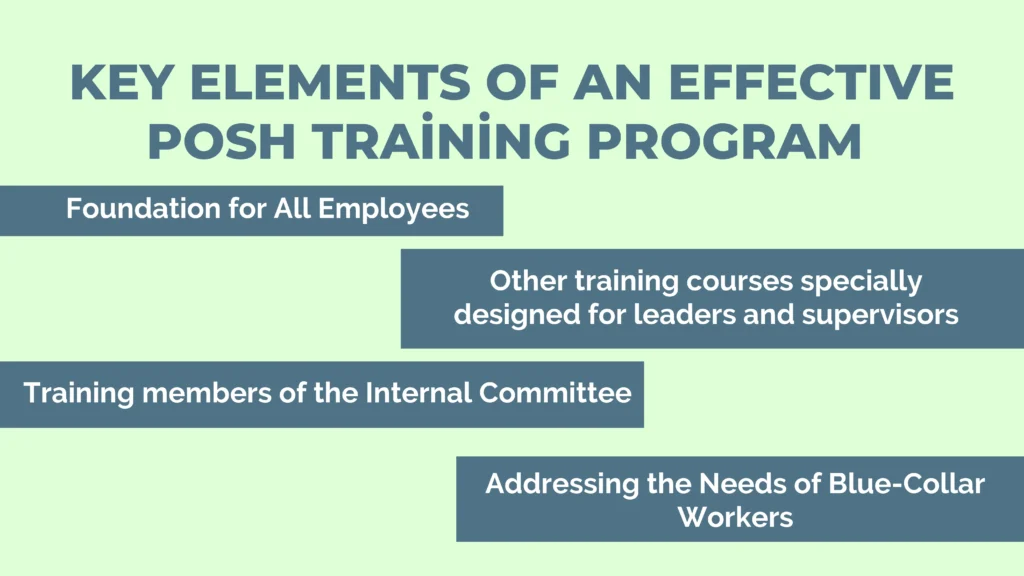
- Foundation for All Employees
As a principle and policy, POSH needs essential awareness of everyone, in rank and sex, in an organization: it shall consider covering key essentials under its program, like,
- What sexual harassment entails: This comprises illustrations of verbal, physical, and visual harassment that workers should be conversant with.
- The rights of the complainant and respondent: Workers ought to understand the rights of complainants and respondents.
- Reporting and complaining: This includes the complaint filing process, with whom to report, and how the organization will process the confidential complaint.
The role of the Internal Committee (IC) should be stated to the employees so that they know how the committee handles grievances and the burden of investigating incident harassment.
Strategies to be used in averting harassment—The training should emphasize strategies for aversion, including how to stop inappropriate behavior at work. Employees should know whether they can participate in stopping other employees from engaging in harassment.
- Penalties in case of a false complaint retaliation: the personnel must be given the respective penalty for making a fictitious report or retaliating against a respondent who reported acts of sexual harassment. Each worker will be empowered with the relevant capacity to identify, avert, and address sexual harassment at work under the core training.
- Other training courses specially designed for leaders and supervisors:
Managers and supervisors play a significant role in creating a safe work environment. They are often the first to know when harassment occurs, so their training needs to be more intense. POSH training for managers should cover the following:
- How to handle sexual harassment complaints: A manager must learn how to document complaints and what is expected of them in cooperation with the IC during investigations.
- Providing the correct answer to complaints: Management must learn to handle victims of harassment, including how to handle sensitive situations with respect and professionalism.
- Provision of what prevents harassment: These include providing tactics for a respectable and nondiscriminatory workplace, ensuring that employees understand all company policies, and taking appropriate measures before things get out of hand.
- Training members of the Internal Committee
POSH Act requires the organization to have an internal committee (IC) with more than 10 employees to entertain harassment complaints. Thus, the IC functions are essential in investigating these complaints and ensuring that the organization adheres to the law by its actions. For this reason, it is essential to provide members of the IC with comprehensive training as follows:
- Role and Responsibilities of the IC Members: The members should clearly understand their tasks, such as conducting investigations, holding hearings, and maintaining confidentiality.
- The complaint and inquiry process: There should be teaching on handling the complaints, procedures when inquiring about them, and legal requirements accompanying them.
- Distinguishing between sexual harassment and gender-based discrimination: The members of the IC must be able to distinguish between sexual harassment and other kinds of discrimination.
- The legal framework: Understanding the legal aspects of sexual harassment, the timeline for completing investigations, and the report submission process are crucial for IC members.
- Addressing the Needs of Blue-Collar Workers
Most organizations overlook the need to educate the blue-collar worker population about awareness training in POSH. The challenges differ for various employees, such as language and poor technological accessibility.
It ensures that POSH training is an integrated process and that all employees learn their rights and duties under the POSH Act.
They provide one of the easiest methods: Offering POSH training in a local language and format acceptable for blue-collar work, such as mobile learning or in-person workshops.
This method would ensure an understanding of workers’ rights and the path they could take before getting harassed.
Uncover details about business growth through POSH Compliance
Mode of POSH Training: Classroom vs. Online Training
When choosing the mode of delivery for POSH awareness training, the organization must balance the advantages of traditional classroom training against online or eLearning. Each has its advantages, but the choice will depend mainly on the organization’s size, the spread of employees across geographies, and resources.
Classroom Training
Classroom training is ideal for smaller to middle-sized organizations with a consolidated workforce as it provides face-to-face interactions. Real-time discussion, role-playing, and Q&A sessions are also possible, which increases engagement. The problems may arise in the case of large or distributed teams and are more expensive in terms of time and resources.
Online Training
Online training is cheaper and more scalable. It can be offered to large or dispersed teams because employees can complete the training at their own pace. E-learning also caters to different learning styles by incorporating multimedia elements such as videos, quizzes, and interactive modules. Online training platforms can track progress and offer certificates, which makes it easier for HR to monitor compliance.
Hybrid Approach
Many organizations choose a hybrid approach, combining both classroom and online training. It allows for more personalized and interactive learning while ensuring remote employees have access to the necessary resources.
Create a Safer Workplace with POSH Training
Making POSH Training Effective
To make the POSH awareness training effective, it should go beyond just filling the legal book. Adequate training should be interesting, relevant, and accessible to all employees. Some tips to ensure POSH training is both meaningful and practical include the following:
Using Real-Life Examples: Real-life scenarios and case studies go a long way in bridging the gap between theory and practice.
The more workplace-specific situations employees may face, the more familiar they will feel. Case studies on different forms of harassment help employees understand what makes harassment, how it can happen, and the most effective way to deal with it. These examples will also equip employees to see warning signs and know when to act on them.
Incorporate Multimedia: Adding videos, animations, and infographics can boost training productivity. Videos can dramatize real-life harassing cases, showing their effect on individuals and organizations. Animations and infographics can break down concepts into easily remembered visuals. Different learning techniques stimulate employees to remember what is critical in this training.
Interactive Modules: Such modules provide opportunities for employees to practice what they have learned, thereby increasing employee engagement and enabling them to use what they’ve learned. They include interactive quizzes, role plays, and discussions, encouraging active participation and allowing employees to test their knowledge.
Continuing Education: POSH education cannot be a one-time event. To keep the message current and top of mind, periodic refreshers and awareness-building programs must occur in an organization. These help the employees stay updated regarding legal and best practice issues surrounding harassment prevention while fostering a continuing culture of dignity and safety.
POSH awareness training is critical in creating a respectful, inclusive workplace.
It ensures compliance with the law and protects employees and the organization’s reputation.
With regular and comprehensive training, organizations can reduce incidences of sexual harassment, boost engagement within the employee base, and create a positive work culture. By prioritizing POSH awareness, companies demonstrate their commitment to upholding the dignity and rights of every individual in the workplace, thus contributing to a healthier, more productive environment. With over 27 years of experience in staffing and 30 years of expertise in labor law compliance, Prompt Personnel is your trusted partner for delivering high-quality PoSH awareness training. Our training programs aim to ensure organizations fully comply with the PoSH Act and create safe, respectful workplaces. Our training includes real-life scenarios and practical case studies to make it relevant and highly effective for all participants.
We provide online PoSH courses and onsite corporate sessions. Our flexible training options are tailored to meet your organization’s needs. Prompt personnel has partnered with leading companies across India, ensuring PoSH compliance in all 28 states and 5 Union Territories. Our courses are informative and engaging, using multimedia, quizzes, and interactive modules to reinforce key concepts and ensure the information is retained. After completion, participants earn a certificate, ensuring a certification to prove and demonstrate their responsibility to maintain harassment – free workplaces. Periodically, we remind them of various workshops and refreshing courses to continuously keep your staff well-informed and empowered; when you want to create and develop a harassing-free workplace at your organization, start by perusing our available PoSH training today. Reach out to us for more information today.
by Prompt Personnel | Jan 9, 2025 | HR outsourcing companies in Mumbai
The demanding health care environment forces organizations to combine intensive patient care delivery with multiple operational duties. Human resources (HR) management stands as a fundamental organizational field that needs thorough examination. Whether it’s recruitment, payroll, compliance, or employee management, healthcare providers must focus on their core mission — delivering exceptional healthcare services. This is where HR outsourcing solutions become a game-changer.
HR outsourcing allows healthcare organizations to delegate functions to specialized third-party service providers. The wide array of services available through these HR outsourcing companies covers recruitment support, onboarding assistance, administration benefits, and compliance management. In this blog, the importance of healthcare HR outsourcing will be analysed, along with evidence of why this approach is beneficial to multiple organizations.
The Growing Need for HR Outsourcing in Healthcare
Healthcare institutions operate under continuous stress from providing advanced health services together with tactical cost optimization. Healthcare naturally includes numerous employees who conduct different work duties. Venturing into human resources management in this sized eclectic workforce can become excessively challenging due to doctors, nurses, technicians, and administrative employees.
This is where HR outsourcing services come into play. By partnering with HR outsourcing companies in Mumbai or other locations, healthcare organizations free up time and resources to dedicate to their main functions while increasing operational efficiencies. Outsourcing human resources operations enables healthcare organizations to simplify their operations, reduce administrative workloads, and boost operational effectiveness.
Key Benefits of HR Outsourcing for Healthcare Organizations
Operating an HR team within an organization means incurring significant financial expenses. Healthcare facilities, especially those with smaller clinics or centres, lack sufficient budgets to support a permanent HR department. Healthcare organizations benefit from HR function outsourcing through reduced costs for staff hiring expenses, training fees, and facility maintenance expenses. Medical institutions in India gain cost-saving, valuable healthcare-oriented services through their partnerships with HR outsourcing firms, which enable budget optimization.
- Access to Expertise and Advanced Technology
Human Resource outsourcing companies maintain deep expertise across their domains. Specialized healthcare knowledge combined with updated industrial expertise defines the proficiency of these human resource businesses. Advanced HR technology enables these companies to manage payroll alongside compliance reports and employee training tasks with greater efficiency than teams within organizations do.
- Compliance with Regulations
Healthcare organizations need to fulfil specific regulatory conditions to operate effectively. They must meet employment regulations, healthcare standards, and tax requirements. Failure to follow these rules leads to serious penalties. HR outsourcing companies have a deep understanding of the legal and regulatory landscape, ensuring that healthcare organizations remain compliant and avoid legal risks.
- Focus on Core Healthcare Activities
Outsourcing non-core functions, such as HR management, allows healthcare providers to focus on their core mission: delivering patient care. HR outsourcing services lift administrative burdens, enabling healthcare professionals to concentrate on what they do best—treating patients and improving healthcare outcomes.
- Scalability and Flexibility
Healthcare organizations often experience fluctuations in staffing needs. For example, during peak seasons, they may require additional temporary staff, or the demand for healthcare workers can spike during an emergency. Outsourcing HR functions provides the flexibility to scale the workforce up or down according to demand without the need to constantly hire or lay off employees.
Also Read about – HR Challenges for SMEs & How Consultancy Solves Them
Key HR Functions That Can Be Outsourced for Healthcare Organizations
Recruiting the right talent is essential in healthcare, where the demand for skilled professionals is high. HR outsourcing companies specialize in sourcing, screening, and hiring healthcare professionals. They help streamline recruitment by identifying the best-fit candidates based on skills, experience, and cultural compatibility.
- Payroll and Benefits Administration
Payroll management in healthcare can be complicated due to various pay scales, overtime regulations, and employee benefits. Outsourcing payroll to trusted HR outsourcing companies in Mumbai or other regions ensures that employees are paid accurately and on time while staying compliant with local laws.
Continuous training is vital in healthcare to ensure that staff members are up-to-date with medical protocols, patient care standards, and compliance regulations. Outsourcing training and development programs to an experienced HR provider allows healthcare organizations to offer specialized training, boosting employee performance and satisfaction.
- Employee Relations and Engagement
Managing employee relations is crucial to maintaining a positive work environment. HR outsourcing companies can handle conflict resolution, grievance management, and employee engagement initiatives, ensuring that healthcare staff remains motivated and productive.
- Compliance and Risk Management
Healthcare organizations must stay updated on the latest healthcare regulations, tax laws, and employee safety standards. Outsourcing compliance management to a trusted provider ensures that healthcare organizations adhere to all applicable laws, reducing the risk of penalties or lawsuits.
Streamline your Healthcare HR with expert outsourcing
Why Healthcare Providers Should Consider HR Outsourcing Companies in India?
Healthcare organizations can find tailored solutions from India’s superior HR outsourcing companies that address their specific organizational requirements. High-class HR talent combined with affordable costs and experienced HR management gives Indian HR outsourcing firms an outstanding proposition for healthcare providers who need operational streamlining and budget scalability.
Moreover, many HR outsourcing companies in India offer services in multiple languages and are well-versed in international standards, making them ideal partners for healthcare organizations with a global presence.
The Future of HR Outsourcing in Healthcare
New technologies and healthcare innovations transform healthcare operations while the industry persists toward evolution. Future healthcare expansion will boost the requirement for external HR service delivery. Hospitals receive efficient HR service by partnering with talented outsourcing firms that help them maintain focus on operational priorities.
Also Read about – Top 15 HR Terms to Know
Conclusion
Healthcare providers benefit substantially from HR outsourcing when they utilize it to achieve lower costs, handle compliance with federal regulations, and enhance their attention to patient care. By selecting reputable HR outsourcing service providers, healthcare providers achieve operation streamlining together with reduced expenses and regulatory compliance. Healthcare organizations seeking outsourcing services for HR operations must select providers who specialize in healthcare sector operations.
Outsourcing HR functions can be a strategic move that allows organizations to improve operational efficiency and concentrate on what truly matters- providing stellar patient healthcare. Healthcare providers who select appropriate HR outsourcing partners can simultaneously optimize administrative diligence while boosting regulatory adherence and enhancing the team’s work quality. If you are searching for trustworthy HR outsourcing solutions, Prompt Personnel is an expert in providing customized HR services for healthcare businesses, keeping them flexible and efficient while guaranteeing excellent patient care. Contact us for more Details.