by Prompt Personnel | Aug 7, 2023 | labour law advisory
Introduction
The retail industry is a complex and constantly changing sector, with retailers facing a myriad of challenges with increasing competition to constantly changing consumer demands. To succeed in this challenging environment, retailers must be laser-focused on retail regulatory compliance with all applicable retail industry regulations.
Retail regulatory compliance is essential for retailers for several reasons. First, it helps to ensure that retailers are operating ethically and responsibly with the help of Labour Law Advisors. Second, retail regulatory compliance helps to protect retailers from costly fines and penalties. Third, compliance advisors can help retailers to build stronger relationships with their customers and suppliers.
If you are a retailer and dealing with compliance issues, you are at the right place. Here, you can thoroughly understand what retail compliance means and its importance.
What is Retail Compliance and Its Importance?
Retail compliance refers to adhering to the specific rules and regulations set forth by different entities, including government regulation, industry standards, and individual retailer guidelines. Retail industry regulations differ according to location and business specifications.
Retail regulatory compliance ensures consumer protection, fair competition, and adherence to labour laws. It includes areas like product safety, data privacy, and environmental sustainability. Similarly, retail compliance with individual retailer requirements such as labelling, packaging, and delivery specifications strengthens business partnerships and avoids costly delays or chargebacks. By prioritizing retail regulatory compliance and retailer-specific guidelines, retailers can confidently operate their business, mitigate risk, and ensure a positive experience for customers and partners.
What are the Major Factors in Retail Compliance?
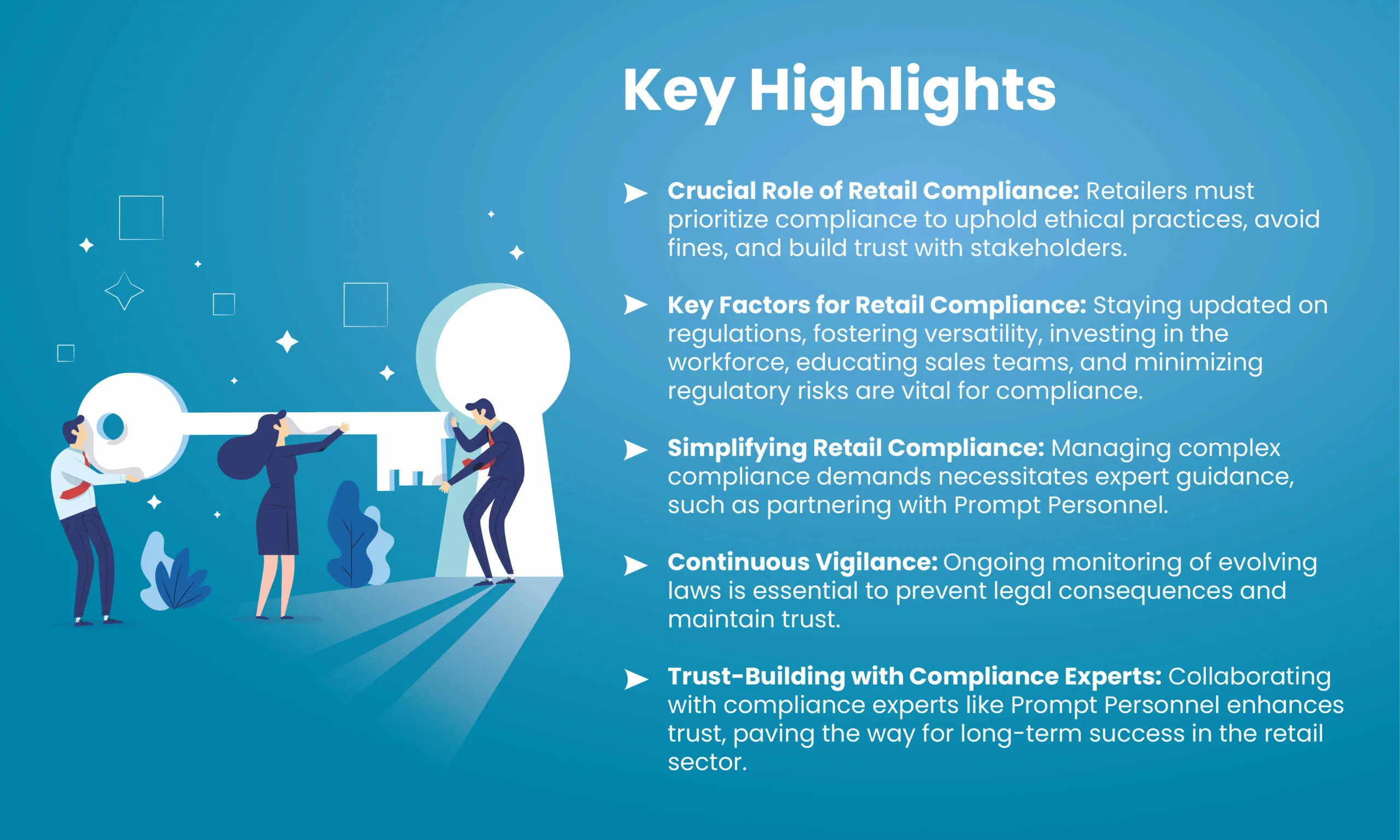
Retail industry regulations change frequently, and therefore, business owners need to stay informed about the latest legislation so that they can effectively address retail operations challenges as they arise. Here are some of the factors every retailer should consider for their business to stay compliant.
1. Stay up to Date
Retailers frequently need to keep a tab on new compliance guidelines. Therefore, it is vital for retailers to proactively monitor and review these guidelines to ensure that any changes do not come as an unexpected and unwelcome surprise for your business. Although, not all changes may directly impact you. However, if you fail this will hamper overall business.
2. Embrace Versatility
You can collaborate with a reliable advisor to take care of the requirements, implement changes, and ensure decisions consider all business aspects, avoiding isolated decisions that could harm your business growth. The professionals regularly address business owners to check for non-compliance issues and chargebacks. The expert team develops processes for consistent retail regulatory compliance support and ensures that you stay compliant.
3. Invest In Your Workforce
While it’s undeniable that retail compliance is equally crucial for all business owners to possess a comprehensive understanding of how these initiatives impact your company and its distribution capabilities. Prompt Personnel as your staffing partner will help you implement retail compliance strategies with valuable insights as per company capabilities to pursue new business opportunities while flourishing and expanding your retail business.
4. Team Development
While retail compliance initiatives centre around operations, the entire organization needs to understand how they impact the business and distribution capabilities. Overlooked at times, educating the sales team can bring substantial rewards. As the operational team successfully implements retail compliance strategies, providing the sales team with insights into the company’s capabilities becomes a valuable asset in pursuing new business. By emphasizing the company’s robust distribution capabilities, the sales team can reach more channels and retailers, ultimately promoting business growth.
5. Minimize Regulatory Risks
By steadfastly abiding by regulations, retail establishments can reduce their exposure to many adverse consequences. These include the jeopardy of losing their licenses, enduring reputational harm, witnessing a decline in customer loyalty, and bearing the burden of substantial financial penalties and losses. Retail businesses must prioritize regulatory compliance to safeguard their operations and uphold a positive image in the marketplace.
How Do You Handle the Complexity of Managing Retail Compliance?
The task of managing retail compliance within the retail industry is a multifaceted challenge. It demands a deep understanding of the often intricate legal frameworks and regulations governing the sector. Additionally, it requires a continuous commitment to keeping up with any modifications or amendments to these regulations.
Moreover, achieving retail regulatory compliance necessitates that every department within a retail organization operates in strict accordance with these standards. To address these complexities effectively, many businesses opt for staffing partners, like Prompt Personnel, to focus on crucial areas such as labour laws, environmental compliance, and safety codes for their employees.

Why Should Retailers Track Their Retail Compliance?
Compliance in the retail industry refers to the ongoing process of adhering to all relevant laws, regulations, and industry standards. It is a critical aspect of retail operations, as failure to comply can lead to serious consequences such as legal actions, fines, and damage to a company’s reputation.
Staying compliant in the retail sector is not a one-time task; it requires continuous vigilance. Retailers must proactively monitor and adapt to changes in retail industry regulations that may impact their business. When new rules or standards are introduced, retailers must ensure that their operations and practices align with these changes by the specified deadlines.
The consequences of non-compliance in the retail industry can be severe, including legal penalties and a loss of trust among customers and stakeholders. Therefore, retailers must prioritize retail compliance efforts as an integral part of their overall business strategy to maintain a positive reputation and avoid legal repercussions.
Detailed Guide About Labour Law Compliance in India for Business Owners
When retailers partner with experts like Prompt Personnel as their Labour Law Compliance Advisors, we ensure you are adhering to all relevant laws and retail industry regulations. This commitment to retail compliance becomes a cornerstone of long-term business success, as shoppers are more likely to frequent stores they trust. In essence, compliance is the foundation upon which strong customer relationships are built.
Understanding these essential aspects of retail compliance, retail business owners can implement best practices to stay compliant with laws and regulations. If you are looking for a law advisor to guide you about retail regulatory compliance, choose Prompt Personnel. Being a pioneer in the HR outsourcing and compliance management field for 25+ years, we have served different clients at the Pan India level. Our range of services includes HR outsourcing, contract staffing, permanent staffing, temporary staffing, labour law advisory and compliance, talent management and many more. Our professionals and labour law advisors closely understand your concerns and provide relevant solutions for your business.
Considering our labour law advisory and compliance services, we provide Regulatory Compliance, Monthly compliances, Compliance audits for Principal employers and contractors, Industrial Relations, Implementation of NAPS (National Apprenticeship Promotion Scheme), POSH training, and many more for businesses and organizations.
Our expertise and experience in this field have led us to receive various awards and recognition. The recent one includes a future-ready organization in the large-scale category and is certified as a great place to work in India in 2023.
Reach out to Prompt Personal today to accomplish your compliance requirements!

by Prompt Personnel | Jul 19, 2023 | labour law advisory
Whether establishing a new business or having a startup of a few years, adhering to labour law compliance in India for business owners is paramount. The Central and State Governments of India enforce these labour laws. One should adhere to the legal requirements and compliance for creating a fair and safe working environment for employees on board while protecting the employers’ interests. However, some of the business owners who are putting their foot in the business or corporate world newly aren’t entirely aware of the labour law compliance that is required to be practiced. Hence, they face difficulties while progressing in the business and towards growth.
Here, one can seek advice from labour law consultants to fulfil the legal requirements for overall business benefit. By understanding these concerns, we have shared a detailed guide about labour law compliance in India for business owners through which they can make informed decisions and adhere to them precisely.
1. Registration and licensing
While commencing a business, owners should complete the necessary procedures to obtain registration and license to comply with labour laws. Some of the related acts are as follows.
- Shops and Commercial Establishments Act (S&E)
For commercial establishments such as offices, shops, etc., it is mandatory to register under this act. This helps regulate the employees’ working hours, holidays, and other work conditions.
One must register under this act when the business involves manufacturing activities or when employing a specific number of workers. The registration ensures that the factory workers are safe, have better health conditions, and look for their welfare.
For a business where contract labourers are hired, it is essential to register under Contract Labour Act. Registration under this act by business owners ensures that the welfare and rights of the contract workers are appropriately maintained.

2. Wages Law
Every business must comply with the wage law implemented by the government to ensure fair compensation for employees and workers. Some of the laws related to wages are stated below.
According to this act, the minimum wage rates are fixed and prescribed by the States through notifications. Business owners should review the act and update their employee’s wages accordingly. The pay or wages should not be less than the minimum wage amount as per the government notification.
- Payment of Wages Act, 1936
This act ensures that the payment of employees working in an establishment is issued on time and no unauthorized deductions are made. According to this act, business owners should pay as per the current currency. Similarly, they can pay through cheque or bank transfer after obtaining written authorization from the employed person.
- Payment of Bonus Act, 1965
Business establishments with over twenty employees are liable to annual bonuses to employees. However, an employee who has worked for less than thirty days is non-eligible for a bonus under this act.
3. Working hours and overtime
Labour law specifies the maximum number of work and rest days a week. The rest days are typically considered Sundays. However, any working hours the employees spend beyond the regular hours shall be considered overtime. Similarly, overtime wages should be paid at the rate distinguished by the law.
As per the act, entities such as shops, theatres, or restaurants should be entirely closed on one day of the week.
4. Leave Policies
Employees have facilities to avail of various types of leave during their employment period. They can avail of sick leave, annual leave, and maternity leave. Hence, business owners need to implement leave policies that benefit employees and those that adhere to the law. Given an example, maternity leave is mandated for a particular duration. Hence, it should not be denied or reduced by business owners.
- Maternity Benefit Act, 1961
As per this act, women working in certain establishments should receive maternity benefits from the employer. This benefit includes wages, maternity leave, bonuses, nursing breaks, etc.
5. Financial Security
Businesses must contribute to the EPF and ESI schemes when reaching a certain number of employees. These services benefit the employees by offering financial and social security.
- Employees Provident Funds and Miscellaneous Provisions Act, 1952
All establishments with 20 or more employees should provide provident funds, pension funds, and deposit-linked insurance funds for employees. This service for employees gives social security and retirement benefits.
- Employees’ State Insurance Act, 1948
This act is implemented to offer employees benefits in case of emergencies such as sickness, maternity, and employment injury. Establishments with more than ten employees are covered under this act.
6. Anti-Sexual Harassment Policies
Business owners should ensure that their employees feel safe while working and hence should implement policies and procedures to prevent and handle incidents related to sexual harassment.
- Sexual Harassment at Workplace (Prohibition, Prevention, and Redressal) Act, 2013
SHW act offers women protection against sexual harassment in the workplace and prevention and redressal. Establishments with ten or more employees should have Internal Complaint Committee for entertaining complaints within the organization.
7. Health and safety measures
A safe and healthy work environment for employees is integral to labour law compliance. Hence, business owners should ensure compliance by adhering to the Occupational Safety and Health Act. It includes measures such as clean drinking water, ventilation, proper sanitation facility, and fire safety in the office. One can approach a labour law advisor to understand the requirements thoroughly.
Stay compliant with labour laws in India with Prompt Personnel
As one of the leading labour law consultants in Mumbai, India, we aim to provide legit information to our clients about labour law rules and familiarize them with roles and responsibilities to comply as business owners. As a labour law consultancy, our experts have in-depth knowledge and understanding of the latest labour laws in India, and they provide you with the right advice for your business.
Labour laws differ from region to region; thus, we understand the laws and requirements of specific areas and liaison with the right government bodies to help you run your business smoothly by being compliant with the laws. Having a compliance capability all over India, we offer business owners with real-time compliance dashboard accessible anytime, anywhere. By partnering with Prompt Personnel, you will rest assured that your business precisely adheres to labour laws and compliance.
Talk with our legal experts today to stay compliant with the latest labour laws in India!

by Prompt Personnel | Mar 29, 2023 | labour law advisory
Sexual harassment in the workplace is a sensitive issue that has been prevalent for a long time. It can have severe consequences on the victim’s mental and physical well-being, leading to anxiety, depression, and other serious illnesses. In the worst cases, it could lead to lifelong impressions on the minds of the victims. Prevention of Sexual Harassment Act addresses workplace harassment. It is an integral part of complete Labour Law Compliance and regulations. Dealing with POSH is very important for an organisation to safeguard its employees and itself from personal and legal consequences.
What is sexual harassment?
The POSH Act defines sexual harassment as any unwelcome sexually determined behaviour (whether directly or by implication) such as physical conduct and advances, a demand or request for sexual favours or making sexually coloured remarks or showing pornography. Any other unwelcome physical, verbal or non-verbal conduct of sexual nature, that has the potential to harm an individual’s dignity or create an intimidating, hostile, or offensive work environment. The harassment in relation to or connected with any act or behaviour of sexual harassment as follows amounts to serious misbehaviour, and the same is required to be viewed seriously. This includes an implied or implicit promise of preferential treatment in one’s employment or threat of detrimental treatment in her employment, or an implied or explicit threat about her present or future employment status or interference with work or creating an intimidating or offensive hostile work environment for her, or humiliating treatment likely to affect her health or safety- Through sexual advances, unwelcome touching, sexually explicit jokes or comments, and displaying sexually explicit material.
Do You Need POSH Implementation in Your Organization?
The Government of India enacted the Prevention of Sexual Harassment Act (POSH) in 2013, which mandates employers to establish a policy to prevent sexual harassment in workplaces. Every employer, having 10 or more than 10 employees in their organisation is obliged to constitute a committee at different administrative units or offices, divisions or subdivisions of his establishments. this committee should consist of the following members nominated by the employer:
- Presiding officers who shall be women employed at a senior level at the workplace
- two members who are committed to the cause of women or have any legal knowledge or have work experience in social issues,
- one member from the non-governmental organisation or association committed to the cause of women or a person familiar with issues related to sexual harassment.
This Act includes the following:
-
Creating a safe working environment:
As an employer, you must ensure that the workplace is free from sexual harassment and that employees feel safe and comfortable while working.
-
Forming an Internal Complaints Committee (IC):
Employers must establish an Internal Complaints Committee IC, which will deal with complaints of sexual harassment.
-
Conducting awareness and sensitization programs:
Employers must conduct regular training programs for employees to create awareness about the POSH Act and sensitize them about sexual harassment.
-
Providing support to victims:
Employers must provide support to victims of sexual harassment and ensure that they do not face any retaliation.
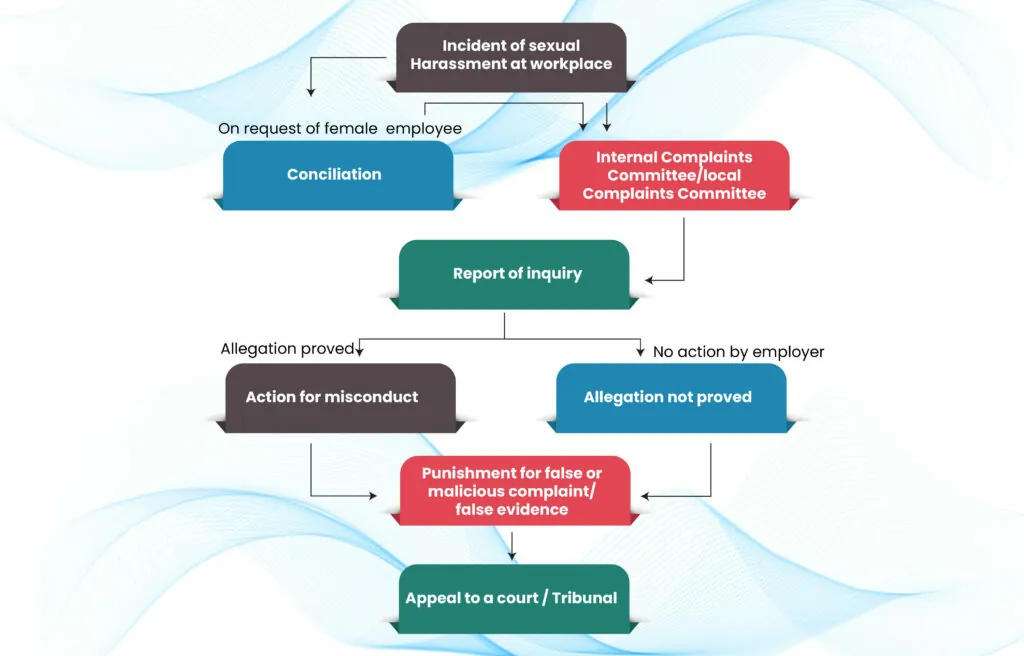
If an employee faces sexual harassment at the workplace, they can file a complaint with the ICC. The ICC will then investigate the complaint and take appropriate action against the accused. The ICC is empowered to impose a range of penalties on the accused, including termination of employment, suspension, demotion, or a warning.
Process Flow Chart for Complaint handling for Sexual Harassment at Workplace
The POSH Act is a significant step towards ensuring the safety and well-being of employees in the workplace. Employers must create a policy to prevent sexual harassment, establish an ICC, conduct regular awareness and sensitization programs, and provide support to victims. Employees who face sexual harassment should not hesitate to file a complaint with the ICC and should take appropriate action to ensure that the accused is punished. By implementing the POSH Act, we can create a safer, more inclusive workplace for all.
In order for an organisation to be completely compliant, it has to look into Labour Law Compliance, regulations and the creation of committees relating to the POSH Act. To completely safeguard your organisation from the consequences of non-compliance, these steps are mandatory. if you are looking for a Labour Law consultancy to look at all your compliance challenges, look no further. Prompt Personnel, with over three decades of labour law and compliance expertise is the right partner for you. We at Prompt deal with not just Labour Law Compliance but also end-to-end solutions relating to the POSH Act. From the formation of an internal committee (IC), conducting an Awareness program for IC as well as employees to Audit of the grievance handling process. With Prompt, you can cover all aspects of your growing business. Permanent Staffing, Temporary Staffing, Payroll Management and implementation of the POSH Act. A complete solution to all your business requirements.

What is a PoSH Certificate?
A PoSH Certificate signifies proficiency in understanding and implementing the PoSH Act in the workplace. It serves as proof of expertise in creating safe working environments, establishing internal complaints committees, conducting awareness programs, and supporting victims. Organizations often seek employees with PoSH certification to ensure legal compliance and promote a respectful, safe culture.
How to Become a PoSH Certified Trainer
Becoming a PoSH certified trainer involves specialized training programs accredited by recognized institutions. These programs cover the legal framework of the PoSH Act, handling sexual harassment complaints, conducting awareness sessions, and facilitating effective PoSH policy implementation. Successful completion of the training and assessment leads to certification, enabling individuals to educate others on preventing and addressing workplace sexual harassment.
Introducing: The Certificate Course on PoSH at the Workplace
This course aims to train individuals and ICC members in the PoSH Act, covering legal aspects, case studies, and practical insights to enhance compliance. The training equips participants with the knowledge and skills to foster a safe and respectful workplace.
Why Choose This Course
Prompt Personnel has championed PoSH compliance in leading organizations across India. Our expertise empowers you to cultivate a culture of dignity and safety in your organization.
Course Details
Our Certificate Course on PoSH at the Workplace offers comprehensive training to individuals and ICC members on the nuances of the Prevention of Sexual Harassment (PoSH) Act. Here’s what you can expect:
- Duration: The course spans 20 hours of intensive training, with each session lasting 4 hours.
- Frequency: Sessions are conducted once a week over five weeks, ensuring comprehensive learning.
- Delivery: Enjoy the convenience of online learning, with interactive sessions held via video conferencing.
- Eligibility: Designed for HR and compliance professionals, in-house counsel, ICC members, students, and anyone interested in PoSH compliance.
- Certificate: Upon successful completion, participants receive a certificate of achievement, recognizing their expertise in PoSH compliance.
Additional Courses Offered:
- Develop Internal PoSH Trainers: Train-the-Trainer PoSH Course: Empower your organization with in-house PoSH trainers. This course equips selected individuals with the skills and knowledge to effectively train others within your organization on PoSH compliance.
- Corporate PoSH Mastery: Flexible Training Options for Your Workplace: Tailored to meet the specific needs of your organization, our Corporate PoSH Mastery program offers flexible training options, including on-site workshops, customized training modules, and ongoing support to ensure comprehensive PoSH compliance.
Register NOW
Take advantage of our HR experts, team of recruiters, and labor law consultants to open avenues of growth and success for your organization. We offer Temporary Staffing, Permanent Staffing, Labour Law Compliance Management & Advisory, and more.
For more information, visit our Certificate PoSH course details.

by Prompt Personnel | Dec 28, 2022 | labour law advisory
What are labour laws?
Labour laws are a set of compliances that strategically and legally set the tone for treating the labour force in the workplace. Labour is the greatest asset for an organisation, and to ensure their rights are protected and safeguard them against exploitation, labour laws are enforced. It regulates trade unions, workers, and companies. Non-compliance with labour laws can lead to penal action against the organization and its employees.
The State imposes Labour Laws along with the Central Government. Labour law compliances are not just prohibited to filing returns, but these records administer as evidence for obedience and proper labour law compliance. The authorities must produce them in case of any discrepancies. Some rules are enforceable only for specific work environments. And some laws are enforceable to all organizations.
Here are 4 signs that you need an expert labour law advisory:
Employment laws are essential because they protect the rights of the employer and the employees. They ensure that employees are not subjected to any sort of harassment and discrimination at work, and they fulfill their agreements along with specific contracts, if applicable, with the company. If employees feel discriminated against or harassed at their workplace, they can consult a labour law advisor who can take legal action.
You want a way to promote business success: Labour laws exist in the jurisdiction to protect employees from unhealthy and unsafe working conditions, improper compensation, and discrimination from their employers. When these labour law compliances are followed correctly, they are highly beneficial to employers as well.
Businesses can suffer tremendous casualties through settlement payments or lawsuits if they don’t comprehend and follow labour laws compliance. In contrast, when companies follow the law with the help of a prominent labour law consultancy, they foster a sense of trust and create a more productive working environment. Labour Laws provide a fair and safe working environment for employees, as well as reasonable compensation for them. As a result, you’ll notice how employees give their best output in their designated jobs.
You need someone to protect the rights of employers and employees: People think labour laws restrict the ability to make critical judgments and decisions and thus impede the company’s development and success. However, labour law compliance is meant to protect the rights of employees and employers. Employers should be unbiased and just when it comes to hiring qualified candidates for their organization. Moreover, they should compensate them fairly and provide a safe environment for the employees to work in.
Similarly, employees are expected to fulfill their duties according to the employment contract terms and be punctual in doing the same. An employer can rightfully fire an employee if the company cannot afford the employee or believes the employee is not making the desired impact on the corporation. It would be best to have a professional and expert labour law consultancy for optimum legal labour law compliance.
Legal compliance issues can cause reputation damage, but above that, breaching the law can cause financial or other kinds of penalties. Generally, a monetary penalty is a primary punishment, but depending on the implication and significance of the case, the court may also order the rightful cancellation of the company’s registration. Hence, one must be cautious and alert to labour law compliance issues. For contemporary small businesses, paying massive financial penalties is a setback.
Experiences and professional labour law advisors can help avoid such nuisances. Labour law details the position you will be employed for, its duties, compensation, and responsibilities. An employment contract is one of the most crucial documents you will ever sign. If you are skeptical about any part of this document, a labour law consultant can answer your questions so that you can strategically evaluate and alter your contract before you sign it or if you believe your employer broke it.
You require some economic stability: It is the purpose of labour law to support both employees and employers equally. Employers have assured the independence to freely operate their businesses so protracted as they treat employees reasonably and do not explore, harass, or discriminate against them for unsafe functional conditions. Labour law compliance supports economic stability and increases the quality of life at a local, state, or country level by ensuring safe employment opportunities. Professional labour law consultancy caters to excellent labour law compliance solutions, keeping a company safe from legal glitches.
You detest discrimination: There are many forms of workplace discrimination. An employee could be demoted based on age or gender. Race, nationality, and sexual orientation are other forms of discrimination. Wrongfully terminating an employee who needs maternity leave or has been ill or injured at work is also a common form of discrimination. By hiring a labour law advisor, employees are protected from discrimination and harassment at the workplace.
Lawyers are professional negotiators who can help you negotiate a good deal, compensation, and terms that will benefit you in the workplace. With the help of labour law compliance, they can help you resolve disputes and issues in the workplace through negotiations. Whenever your employer violates employment law or mistreats its employees, you should consult a labour law advisor. It’s essential to know and understand your rights and responsibilities in your job. This will make you feel confident approaching your employer with problems or concerns.
A lawyer with experience, knowledge, and unbiased judgment is your best source of information for labour law questions. Prompt Personnel’s personnel audit a company’s provisions for labour law compliances and discover possible glitches. Understanding the glitches, opportunities, and drawbacks, we offer you labour law compliance solutions. For better adherence, software or applications are designed to streamline the process.
Prompt Personnel is a leading HR management company in India, offering different kinds of HR recruitment management services. Offering labour law compliance is our forte, and we assure you of accurate and cost-effective services. We provide Temporary Staffing, Permanent Staffing, Labour Law Compliance Management & Advisory, and many more such services.

by Prompt Personnel | Nov 23, 2021 | Human Resources, labour law advisory
Start-ups have disrupted the Indian business world. They have changed the way of doing business and the scenario of employment in India. From tech, manufacturing, finance, pharmaceuticals to media, they are prevalent in every sector and contributing to the economy of our country. Although start-ups and entrepreneurs are special, they still must follow Labour Laws and be fully compliant so that their employees get an equal and safe environment to work, and the start-up ecosystem flourishes. If not compliant, they can face legal action and prosecution from authorities.
The Government of India has given some exemptions to start-ups to help simplify their entrepreneurial journey and to gradually understand the necessity of these rules. In their first 5 years of commencement, they are given the privilege of self-declaration for compliance with 9 labour laws. However, every start-up needs to follow these laws diligently to run a legal business and provide their employees with a good and safe workplace. As written compliant of violations filed startups can be subject to inspection.
Labour law compliance becomes essential for start-ups because of the following aspects:
Minimum Wages
Although a start-up company runs with a small team and limited resources, it still needs to provide respectable pay to its employees. India’s Minimum Wages Act, 1948 makes it mandatory for start-ups to give minimum wages to all their employees. They must follow the state wise minimum wages which are updated from time to time.
Working Hours
Due to their busy working schedules and massive workload, start-ups employees might end up working long hours. Labour legislation guides the start-ups and helps the employees by specifying the maximum working hours every day so that employees do not tire out. All start-ups have to abide by these laws where a definite no. of working hours with breaks are to be adhered to.
Safety & Health Measures
Be it an office space, factory or warehouse, labour regulations make it necessary for entrepreneurs to provide a safe working environment for all their employees and workers. Appropriate safety protocols are mandatory at offices and factories so that employees feel safe and protected.
Legal Framework for Employment
Compliance protects the start-ups as well as employees in the employment cycle. It’s vital to check employee records and provide them with standard documents such as proof of employment and relieving letters to make the business operations smooth. Entrepreneurs are also legally required to provide benefits such as PF, Gratuity, ESIC, etc. so that their workforce is taken care of. Violation of these laws can create legal problems for a start-up; therefore, compliance is necessary.
Preventing Harassment & Discrimination
These rules are drafted to prevent any form of discrimination based on age, race, caste, colour, gender or religion. According to The Sexual Harassment of Women at Workplace Act, 2013, it is also imperative for start-ups to provide a safe working environment for women and there must be a strong policy in place to prevent sexual harassment at the workplace. Additionally, the Industrial Disputes Act, 1947 helps start-ups resolve industrial conflicts through its regulations.
Complying with these regulations ensure that start-ups are following legal ways to run a business and providing a well-cultured and safe environment for the employees.
We understand that Labour Laws can be complicated to understand for entrepreneurs, and they want to focus on the growth of their start-ups. Prompt has an exceptional team of labour law consultants who have expert knowledge of these regulations and are constantly updated with changing developments. We can advise and implement these laws to make your start-up fully compliant.
Looking for a labour law advisor? Contact Prompt and understand how labour law compliance can help your start-up grow and become authentic.