by Prompt Personnel | Apr 23, 2025 | Temporary Staffing
Discover why temporary staffing is booming in 2025 and how AI, remote work, and economic shifts are driving the rise of short-term talent in India.
The year 2025 calls for agility in everything. Businesses today are measuring economic uncertainty, rapid tech adoption, and constantly changing workforce expectations. Amidst all the chaos, one trend is gaining significant traction: temporary staffing.
Startups and even larger enterprises across industries are turning to temporary staffing services. Why? To gain greater flexibility, faster hiring, and access to skilled professionals on demand.
The 2025 Shift: Why Businesses are Betting on Temp Staffing
1. Flexibility is the Future
Businesses love temporary staffing solutions for their flexibility. They hire the right talent without long-term commitments, whether to handle a seasonal spike, manage a short-term project, or cover for someone unexpectedly unavailable. The world is unpredictable, and things can change in the blink of an eye. That’s why adjusting your team quickly is such a significant advantage.
As the economy grows and business needs keep shifting, most companies don’t want to be stuck with fixed hiring plans. Temporary staffing services allow them to expand or cut back based on market conditions. This helps businesses work more smoothly, save money, and get things done without much hindrance. It’s a smart way to stay ahead of the game without having to slow down.
2. AI and Tech Are Making Hiring Smarter
Tech is really changing how temporary staffing services work. With smart tools like AI that sort through resumes and blockchain that helps check backgrounds quickly, companies can hire people way faster now.
Since interviews and onboarding can happen online, it doesn’t matter where someone lives. That means staffing agencies can move quicker, and companies don’t lose time waiting. They get help when they need it.
3. Gen Z Is Changing the Workforce Game
This generation of professionals expects flexibility, purpose, and meaningfulness in their jobs. Gen Z doesn’t hesitate to choose freelance, contract, or gig roles over traditional 9-to-5 jobs.
Temporary staffing agencies are responding with job opportunities that reflect this shift. Things like short-term jobs, project work, and remote gigs aren’t just extras anymore. They’re becoming totally normal. And the businesses using this kind of talent are finding smart, motivated people who really know their stuff.
4. The Gig Economy Is No Longer “Alternative”
The gig economy is mainstream. Millions of professionals are choosing contract work for the freedom it provides. This creates a new pool of skilled, on-demand talent that companies can access through temp staffing companies in India.
The result? Businesses get specialized support without overhead. Overall, it’s a win-win.
5. Reducing Hiring Risk and Overhead
Hiring permanent employees takes a lot of time and is costly, as well. Additionally, it presents a number of challenges. “What if the hire doesn’t work out?” and “What about the benefits, onboarding, and compliance?” are some of the questions that come to mind.
Temporary staffing solutions bypass these obstacles. Companies can try out the required skills before making any commitments. Temporary staffing agencies are well-known for saving time and minimizing legal risks by carrying out background checks, compliance, and payroll management.
6. Rising Demand in Niche Industries
IT, healthcare, and logistics are facing massive talent shortages. Employers are in constant search for skilled professionals, but their supply unfortunately fails to grow.
Temp staffing companies in India offer selected talent pools and quick deployment capabilities. Staffing firms can fill the gap in hours, not weeks, regarding an IT project, a medical need, or seasonal warehouse support.
7. Navigating Economic Uncertainty
Permanent employees might face risks during uncertain economic conditions. Temporary staffing agencies prove to be a smart business move in such cases. Companies can maintain productivity without committing to long-term payroll costs.
This flexibility is crucial in sectors affected by interest rate changes, global disruptions, or regulatory shifts. Temporary staffing allows businesses to stay competitive while managing budgets more.
8. Better Candidate Experience
Temporary staffing agencies really focus on making things better for job seekers. They use smart tech and personal touches to match people with jobs that fit them.
When workers are happy and feel like they’re in the right role, they do a better job, stick around longer, and often come back for more. That’s a win for both the companies and the staffing agencies.
9. Easier Compliance and Payroll
Regulations around labor, taxes, and data protection are getting stricter yearly. From local labor laws to global data privacy rules, companies have a lot to keep track of—and getting it wrong can be costly. That’s why many businesses are turning to trusted temporary staffing services that offer full compliance support.
These agencies take care of everything—drafting correct contracts and handling ESI/PF contributions to make sure labor laws and GDPR regulations are complied with. This ensures that businesses are on the right side of the law and saves them time and anxiety. It also helps businesses operating in various states or countries where regulations are different. With professionals taking care of the paperwork and regulations, businesses can get on with their core job without worrying about legal glitches.
10. The Rise of Project-Based Work
With businesses focusing more and more on innovation, short-term projects are quickly becoming the norm. Whether launching a new app, rolling out a marketing campaign, testing a product, or building a prototype, companies often need skilled people—and they need them fast. Waiting weeks or months to hire full-time employees doesn’t work in these situations.
That’s where the temporary staffing agencies leave their footprint. By their offerings, companies are able to recruit the right individuals with precise skills and expertise without resorting to the lengthy hiring process of full-time professionals. It’s all about assembling a team just for that one particular project. And once the job’s finished, the team disperses. There are no additional expenses, no long-term arrangements, moreover it provides flexibility for whatever lies ahead.
To Sum it Up
Temp staffing isn’t just a trend—it has a lot to offer. If businesses want to stay ahead, it’s definitely something worth trying out. As we move through 2025, the way people work changes, technology is evolving fast, and the market can be unpredictable. It makes temporary staffing a practical and flexible solution for companies that want to stay prepared and future ready.
Whether you need one person for a month or a team for a quarter, temp staffing offers speed, flexibility, and results.
Why Prompt Personnel is the Partner You Need
If you’re exploring temporary staffing solutions, look no further than Prompt Personnel. Our team is one of the most reliable temp staffing companies in India since 1997.
Get access to customized staffing solutions besides recruitment, onboarding, payroll, compliance, and even employee training. Be it a sudden surge in demand or a specific project, receive temporary staffing services matching your needs.
Allow us to be your trusted partner so you can put all your efforts into scaling the business. Rest assured, we will take care of your workforce.
Ready to embrace the flexibility of temporary staffing? In 2025, partner with our team at Prompt Personnel, your trusted staffing ally.
by Prompt Personnel | Apr 14, 2025 | BFSI
From missing tech talent to compliance chaos, discover how recruitment firms are the secret weapon helping the BFSI sector stay ahead in a fast-changing world.
India is witnessing immense growth in its Banking, Financial Services, and Insurance (BFSI) sector. But with this growth comes a big problem—a shortage of skilled people. As everything shifts to digital and customer needs keep changing, BFSI companies find hiring the right talent tough. That’s where recruitment firms step in and help bridge the gap.
Let’s examine the significant skills missing in the BFSI space and how banking & financial staffing solutions are helping to fix the issue.
Filling BFSI’s Talent Gaps: How Recruiters Help
1. Tech-Savvy Talent Is Hard to Find
Almost everything in BFSI is now digital, from online banking and mobile apps to AI-powered chatbots. So, companies need tech professionals who can handle this change.
There’s a strong need for people who know about AI, data science, fintech tools, and cybersecurity. But these skills are in short supply. Traditional hiring methods can’t keep up with the speed at which technology is changing.
This is where staffing firms make a big difference. BFSI staffing companies help find people who are comfortable with new tech. Recruiters screen candidates who understand banking and know how to work with modern systems. This saves BFSI firms time and gives them a substantial edge in the digital world.
2. Compliance and Regulations Keep Changing
The BFSI sector is heavily regulated, with constant updates in rules such as KYC, AML, data privacy, and global norms. Most employees are unaware of these continuous changes, which have the potential to expose them to huge risks or penalties and even compliance failures.
Recruitment for BFSI helps by sourcing professionals who are already trained in current regulations—both Indian and international. They also support contract hiring for short-term compliance projects, providing companies with flexibility without long-term costs. This enables BFSI companies to remain compliant, avoid fines, and quickly adapt to new regulations without overwhelming their internal resources.
3. Customer Handling Skills Are Lacking
Customer service is all about BFSI. Everyone must speak clearly and establish trust with customers, whether they are insurance agents, bank officers, or loan advisors. Unfortunately, most job applicants lack these soft skills.
Recruiters now don’t just check resumes. They also check how well a person speaks, listens, and handles real situations. Interviews are designed to test people’s skills. Banking & financial staffing solutions help BFSI firms bring in staff who can better connect with customers and give them a great experience.
4. Risk Management Experts Are Few
Risk management is a massive deal in the BFSI industry. Firms require experts who know credit risk, market risk, and how to manage surprise events. However, recruiting people with the proper experience in these areas might be challenging.
That is where specialized BFSI staffing services enter the picture. They have access to risk management experts with hands-on experience in multiple fields. Recruitment agencies can find the perfect fit in a matter of time if a business requires a senior executive or a junior analyst. This ensures the company has the right individuals to manage risks effectively and efficiently.
5. Product Knowledge Isn’t Easy to Find
There are hundreds of financial products, such as mutual funds, home loans, insurance plans, etc. Selling or marketing them isn’t easy unless the person has product-specific knowledge and the proper certifications.
BFSI staffing services help find people who already know these products inside out. These professionals often come with practical market experience and relevant licenses. These hires need less training and start delivering results faster, which is a big win for growing financial businesses looking to scale quickly and efficiently.
6. Cybersecurity Talent Is in Demand
With everything going online, BFSI companies are becoming prime targets for cyber threats. One data breach can cause massive damage. That’s why there’s a considerable need for cybersecurity professionals who understand both IT and financial systems.
Recruiters now tap into their network to bring in cybersecurity experts who have worked in banks or financial institutions. BFSI staffing companies know how to keep systems safe and comply with all the rules.
7. Hiring Needs to Be Quick and Flexible
BFSI firms often need to hire quickly to launch a new branch, handle seasonal workloads, or build a tech team. But internal HR teams can’t always move that quickly.
Recruitment firms offer flexible hiring models, such as contract-to-hire, temp staffing, or remote workers. BFSI companies can build teams based on their current needs without long delays. Recruiters also handle background checks, documents, and onboarding, taking the load off the company’s HR team.
8. Fresh Talent Needs Grooming
While many fresh graduates are entering the BFSI job market, many lack practical skills. Recruiters work closely with colleges and training institutes to identify suitable candidates and prepare them for real-world BFSI roles.
Some BFSI staffing companies even provide pre-hiring testing and job readiness training. These assist firms in attracting more qualified candidates and enhancing their opportunities for long-term success.
Learn more about the How Prompt Personnel can benefit BFSI with HR solutions
Why Prompt Personnel Makes a Big Difference
Prompt Personnel stands out when it comes to fixing the BFSI hiring challenge. We’re not just another agency; we genuinely understand how BFSI hiring works.
We have years of experience helping banks, NBFCs, insurance companies, and fintech firms hire the right people. Whether finding a skilled compliance officer or building an entire tech team, we offer banking & financial staffing solutions that fit your needs and timelines.
We focus on quality over quantity. Our recruitment for BFSI goes in-depth to know what talent your company requires and then locate candidates who match not only on paper but also fit your company culture.
Our team also assists in skill testing, compensation benchmarking, and onboarding, ensuring a hassle-free recruitment process.
If you are a BFSI organization that wants to develop strong teams, minimize recruitment blues, and expand confidently, we are the partner of choice.
The BFSI sector is changing fast, and so are the skills needed to succeed. There’s a shortage of tech-savvy workers, risk experts, compliance professionals, and customer service pros. But that doesn’t mean companies have to settle.
Recruitment for BFSI is helping bridge this gap by offering more innovative, faster, and more focused hiring. They find people who bring both knowledge and the right attitude.
Prompt Personnel knows exactly what BFSI firms need and delivers every time. Contact us today for more information on banking & financial staffing solutions.
by Prompt Personnel | Apr 10, 2025 | POSH Compliance
Establishing a safe, respectful, and inclusive workplace is not something to be ticked off a list. It’s everyone’s responsibility. One of the most effective ways to establish this is by organizing a POSH awareness program. These workshops educate employees about their rights and obligations and how to actively avoid sexual harassment in the workplace.
Let’s break down what every employee should learn from these programs. Also, understand why POSH training for employees should be a regular part of every company’s culture.
Essential POSH Training Lessons for Every Employee
1. Understanding What Counts as Harassment
A big reason why harassment goes unnoticed or unreported is confusion. Many people don’t fully understand what sexual harassment looks like. It’s not always loud or obvious. Sometimes, it’s subtle. And that’s why a POSH awareness program matters.
These programs clearly explain what qualifies as verbal, non-verbal, or physical misconduct. Once employees know this, they’re more likely to recognize and avoid such behavior. It helps prevent both intentional and unintentional violations.
2. Why Reporting Is So Important
Many employees hesitate to report incidents. Some are unsure about the process, and others worry about retaliation. But POSH training online addresses this directly.
These sessions explain how to file a complaint using real-life examples and simple steps. They also explain how your company is expected to support you, which builds confidence and reminds everyone that their voice matters.
3. Who’s on the Internal Committee?
You’ve probably heard of the Internal Committee (IC). But do you know what they do? Or how to reach them?
A good online POSH certification makes this super clear. It walks employees through how the committee is formed and explains their roles, responsibilities, and complaints handling. It also helps them know who to approach and how which is a significant part of staying safe at work.
4. Respectful Communication
How we communicate with each other is very crucial. Employees’ POSH training involves not only anti-harassment. It also encourages learning to respect in communication. Employees are taught how to address sensitive issues without being rude or judgmental. The outcome? Less misunderstanding, more cohesive teamwork, and a less tense, more open workplace.
5. Inclusion Is for Everyone
There’s a common myth that POSH compliance is only about protecting women. But that’s not true.
POSH certification online helps clarify this. It explains that the law applies to everyone, regardless of gender. The goal is a workplace where all employees feel respected, safe, and valued.
6. Being a Responsible Bystander
Sometimes, you’re not the target but a witness. And in those moments, knowing what to do is key.
POSH awareness programs include bystander training. This enables employees to support coworkers who may be harassment victims and encourages people to speak up, step in, or report incidents. This shared responsibility builds a more caring and accountable workplace.
7. What Leaders Need to Know
Team leads and managers aren’t there to delegate work. They’re examples. And they should be as aware of POSH compliance as anyone.
That’s why it’s worth it for leaders to take a POSH course online. They learn to handle complaints properly, communicate better, and build safer team cultures. If leaders take it seriously, then everyone else will follow.
8. Preventing Future Problems
Daily POSH training online isn’t all about ticking legal boxes. It’s about minimizing risk. Each session drives home the message that harassment will not be tolerated.
These initiatives are proactive. They identify early warning signs and build a culture of respect before issues arise.
9. Online Training = Flexible Learning
Today’s workforce is a mix of remote and in-office employees. And that’s where online POSH certification shines.
Workers can do training modules at their own pace. Information remains consistent regardless of their work-from-office or in-office arrangement. This shows convenience for everyone without sacrificing quality.
10. Documentation That Protects Everyone
Once employees finish their POSH certification online, there’s a record. This is more than just a checkbox. It’s an essential documentation.
It proves that the company has taken steps to educate its people. If there’s ever an audit or complaint, this paperwork shows that the employer took the issue seriously. It protects both the employee and the organization.
11. Confidentiality Is a Must
Rumors and speculations can worsen challenging situations. Thus, POSH awareness programs emphasize confidentiality. Staff are instructed not to talk about current cases or divulge sensitive information. This keeps everyone safe and preserves trust in the system.
12. Becoming More Self-Aware
Beyond laws and procedures, POSH employee training offers a chance for reflection. It encourages employees to think about their behavior. To understand how their words or actions may impact others.
This kind of self-awareness leads to more thoughtful interactions. And fewer workplace issues.
13. Positive Culture = Better Morale
Workplaces that offer regular POSH training online have better morale. It is because people feel safe, heard, and respected.
Employees who feel valued are more motivated and productive and tend to stick around. A respectful culture does make a difference.
14. Spotting the Red Flags
A solid POSH course online helps employees identify early warning signs. Whether it’s a shift in someone’s behavior or an uncomfortable joke, being aware helps people take action before things escalate.
That kind of early intervention can prevent serious issues later.
15. It’s the Law—But It’s Also the Right Thing to Do
Yes, POSH compliance is a legal requirement under the Sexual Harassment of Women at Workplace (Prevention, Prohibition and Redressal) Act, 2013. But beyond laws and audits, it’s about values.
Creating a safe space for employees is more than just a rule. It’s a commitment to doing the right thing for everyone.
Learn more about the POSH Act and all you need to know about it.
Final Thoughts
All staff members have a role in creating a respectful, safe working environment. POSH training for staff members clearly outlines expectations. It makes individuals aware of their responsibilities and rights and creates a culture where everyone feels supported.
Whether through regular sessions, leadership training, or flexible formats like POSH training online, these programs make a real difference.
Need Help Getting Started?
Prompt Personnel offers full support for all your POSH compliance needs. Our team handles everything from setting up an Internal Committee (IC) to hands-on training and easy-to-access POSH certification online.
Our sessions are customized for every level of employee, from staff to senior management. Whether you need in-person sessions or prefer online modules, we’ve covered you.
Want to create a safer and more compliant workplace? Contact Prompt Personnel today for expert-led POSH awareness programs and hassle-free POSH training for employees.
by Prompt Personnel | Apr 8, 2025 | Human Resources, Learning & Development
Imagine your business as a garden, and your employees as unique plants. As a gardener will nurture each plant’s growth, you too, as an HR executive, need to make sure that you give the right space for the growth of all the talent in your organization. It is here that you need to establish effective talent retention methods.
After the routine review of an employee’s work performance, also known as post-appraisal, usually done at the year or quarterly close, it helps in determining compensation, promotion, and training needs. Post-appraisals contribute much to career development since they help employees understand their place in the company and how to improve it.
We know that although post-appraisals have numerous benefits, they also pose some challenges to HR executives or managers. It may result in employee dissatisfaction or a perception of unfair assessment. Good retention strategies after appraisal can overcome these challenges by ensuring open communication and ongoing feedback.
We are here to show you how to develop talent retention strategies after the appraisal season is over. Read on!
Why Talent Retention is Crucial Post-Appraisal
Did you know? According to a survey, 61% of workers said they would think about quitting if they didn’t receive regular feedback. Post-appraisal is a period when employees reassess their performance, role, and future growth within the organization, and what happens if they don’t see any scope for improvement or growth? They are more likely to seek new opportunities somewhere else, maybe they’ll go to your competitors as well (you don’t want to lose your ace players to them).
As an HR executive, it is important to tackle the employee dissatisfaction that follows after appraisals. When there is a mismatch of expectations for promotions or pay hikes, frustration, low morale, and higher attrition follow. Effective handling of post-appraisal discontent is important in keeping employees engaged and retained.
Your talent retention initiatives must ensure that you are avoiding employee turnover, employee disengagement through regular feedback, transparent career progression, competitive remuneration, and a constructive, growth-positive work culture. Your high-performance employees have greatly contributed to the productivity and achievement of the organization. Now, losing them is a big deal. The costs are too high. According to various studies, the cost of replacing your ace employee can range from 90% to 200% of their annual salary.
Employee Expectations Post-Appraisal
Being an HR executive, you should understand how employee expectations change after appraisal season. During pre-appraisal, workers expect that they will receive various material benefits such as promotions, salary hikes, or extra responsibility based on performance. Post-appraisal employees may realign their expectations upon receiving the feedback.
Why does your employee leave post-appraisal?
- They are disappointed in the reviews
Employees tend to feel undervalued and underappreciated if the appraisal does not align with their perceived performance. It is at this point that they will begin to search for companies where they are better appreciated.
- They feel a lack of recognition
If the employee senses that their efforts are not being recognized or valued, they will surely lose the drive to work and opt to go elsewhere.
- Their expectations were not met
This normally occurs when the appraisal results are contrary to the expectations of the employees. This can be the failure to receive anticipated salary increases or promotions, which can result in higher turnover.
- They found better offers in the market
Unsatisfactory appraisals can encourage your employees to accept the offer that they were going back and forth with if they present a better option compared to your organization.
Effective Talent Retention Strategies Post-Appraisal
All this time, we have been talking about having good, effective talent retention strategies in place for HR executives. Now, let us show you how you can develop it. Here’s the breakdown:
- Provide constructive feedback
You must ensure that the appraisal result you give to your employee is clear and transparent. Explain to them the parameters of the performance evaluation process, how these parameters impact future opportunities within the organization. Your feedback has to be very specific, actionable, and, more importantly, it should focus on growth. Make sure your employee understands everything. In case there are queries, schedule meetings to resolve those issues or questions.
Takeaway: The transparency in the feedback will not only enhance the employee’s comprehension but also promote trust and a sense of direction for them, which is one of the key elements in performance review retention strategies.
- Offer a career development plan, but customize it
Your career development plan, which you present to your employees, must be customized, i.e., it must align with the aspirations of the individuals as well as organizational aspirations. Provide them with opportunities for upskilling and reskilling, and assist them in their career advancement. You can even assign your employees mentors who can guide and counsel them to achieve their objectives.
Takeaway: A customized development plan will help in preventing employee turnover by encouraging them for long-term goals, not only their immediate position.
- Reward your deserving employees
Have a reward and recognition program that acknowledges and celebrates your employees’ achievements throughout the year. It can be public recognition, awards, or even special privileges. As an HR executive, you must offer rewards beyond monetary incentives, like additional vacation days, flexible work arrangements, or maybe opportunities to work on high-profile projects.
Takeaway: Motivation comes from recognition. If your employees feel that they are noticed and heard, their performance and loyalty will automatically increase.
- Have an enhanced employee engagement in place
After appraisal, you may also want to have frequent check-ins to keep things going. Organize employee engagement events that enhance employee morale and team cohesion. Utilize different mechanisms to measure employee satisfaction, frequent check-ins, so that employees feel listened to and appreciated.
Takeaway: Regular check-ins post-appraisals keep the employees engaged and in sync with the company objectives.
- Provide competitive compensation
You, being an HR executive, must review compensation packages regularly to make sure that they are competitive and in line with industry standards. You can modify your compensation based on the performance of the employee and market conditions. Offer benefits that are more than mere compensation, such as health insurance, retirement schemes, or flexible work arrangements.
Takeaway: Equitable and competitive pay reinforces your organization’s value recognition commitment, making it more difficult for top performers to seek employment elsewhere.
Common Mistakes HR Executives Must Avoid
The gardener has to guard against the weeds as they will choke the lovely blooms and reduce the shine of his garden. In the same manner, as an HR executive, you have to keep away from common errors that can cause dissatisfaction among employees, turnover, and employee engagement post-review. Continue reading to know about the top mistakes that you can avoid, ensuring your garden of talent flourishes.
- Ignoring your employee’s feedback post-appraisal
Mistake: It is always best to follow up on the feedback that your employee receives after their appraisal. In case it is not followed up, this will tend to result in dissatisfaction and disengagement among the workers.
Solution: Make sure that their comments are heard and responded to. This can assist in keeping trust intact and demonstrating to your employees that their opinions are important.
- No clear growth plans
Mistake: You didn’t provide your employees with clear direction about their career development opportunities? This again would lead to confusion and dissatisfaction among the employees.
Solution: Ensure that you are communicating with your employees about the future of their careers within your organization.
- Ignoring signs of employee dissatisfaction or burnout
Mistake: Overlooking your employees’ dissatisfaction or their burnout will for sure result in increased turnover or revenge quitting.
Solution: Always do regular check-ins and monitor their satisfaction levels and address their concerns promptly.
- Appraiser Bias
Mistake: As an HR executive, avoid biases such as the halo effect, similarity error, or recency error, as these biases can skew performance evaluation.
Solution: Have a fair and just evaluation of every employee based on their performance and contributions.
- Not having proper feedback systems
Mistake: You need to make sure that you are also considering your employees’ feedback. There should be a clear and transparent way to communicate their feelings and inputs without any hindrance.
Solution: You might want to have weekly or monthly feedback sessions for your employees where they can communicate their expectations, and you, as an HR executive, can also give them constructive feedback to help maintain their motivation.
Performance Review Pitfalls and Practical Solutions
| Common Mistake |
Description |
Solution |
| Ignoring employee feedback post-appraisal |
Failing to follow up on feedback after appraisals can lead to dissatisfaction and disengagement. |
Ensure employees’ comments are heard and addressed to maintain trust and show that their input is valued. |
| No clear growth plans |
Lack of direction regarding career development can cause confusion and dissatisfaction. |
Regularly communicate career growth opportunities and pathways within the organization. |
| Ignoring signs of dissatisfaction or burnout |
Overlooking these signs may lead to increased turnover or “revenge quitting.” |
Conduct regular check-ins to monitor satisfaction levels and address concerns promptly. |
| Appraiser bias |
Biases such as the halo effect, similarity bias, or recency error can skew performance evaluations. |
Ensure fair, objective evaluations based solely on performance and contributions. |
| Lack of proper feedback systems |
Not having transparent channels for employee feedback hinders communication and demotivates staff. |
Implement regular (weekly/monthly) feedback sessions to gather employee input and provide constructive guidance. |
Real-Life Case Studies & Examples
- Signpost: Use of Assessments for Reduced Turnover
Software startup Signpost streamlined its hiring process by using assessments such as the Employee Personality Profile (EPP) and General Aptitude Mobile Evaluation (GAME). As a result, the turnover rate for inbound phone support workers was reduced by 70%, while new hire productivity increased.
Key Takeaway: By helping businesses place more qualified applicants into positions, assessments can improve performance and retention.
- Cisco: Employee Recognition and Rewards
Cisco successfully launched “Connected Recognition,” a program for employee rewards and recognition. By fostering a healthy work atmosphere, this increased retention and allowed employees to recognize their coworkers.
Key Takeaway: Employee engagement and retention can be greatly impacted by praising and recognizing them for their efforts.
- Briggs Industrial Solutions: Engagement Surveys
Briggs Industrial Solutions addressed technician retention difficulties through focus groups and engagement surveys. They increased employee happiness and retention by tackling issues with compensation, recognition, and job fit.
Key Takeaway: Retention and engagement can be significantly increased by providing regular feedback and taking appropriate action on employee issues.
- Mutual of Omaha: Pulse Surveys
Mutual of Omaha used pulse surveys to learn more about the preferences and attitudes of its employees. They achieved an 86% retention rate as a result of their deliberate use of pulse surveys.
Key Takeaway: Regular pulse surveys can yield important insights into the factors influencing employee engagement and retention
- Bespoke HR: Leadership Development
After nine months, the turnover rate dropped to 0% thanks to the implementation of team development and leadership training by Bespoke HR. Ongoing team-building exercises also raised employee morale.
Key Takeaway: Investing in team motivation and leadership development can yield significant returns in terms of morale and retention.
Role of HR Technology in Retention
These days, AI integration in HR processes has become quite common. A lot of companies are using technology to process payroll, manage attendance, and perform other HR operations. We have provided an overview of the role of HR technology in supporting talent retention strategies. We have also included the tools and techniques that can refine and streamline the retention efforts.
- HRMS (HR Management Systems)
These systems are developed to centralize employee data, automate the onboarding and performance management processes, and also provide insights into employee engagement and retention trends.
- Feedback tools
There are platforms available in the market that can facilitate real-time feedback that can help address the employee concerns without any delay. These tools can help HR executives like you improve the job satisfaction level in your organization.
- AI-driven engagement platforms
The AI-powered tools are a game-changer in analyzing employee sentiment, predicting turnover, and even helping in suggesting personalized talent management strategies.
- Internal talent marketplaces
These are the platforms promoting career development by advertising internal job opportunities, mentorship programs, and skill-building projects, significantly reducing turnover and improving the amount of growth opportunities.
- Predictive analytics
These apps can utilize data analysis to be able to predict employee turnover and help you implement proactive employee retention strategies based on the information on turnover trends, job satisfaction, and productivity.
HR technology supports automating tasks and releasing HR executives to focus on employee engagement and retention strategy. Technology gives you actionable insights into employee engagement and retention patterns, and their performance metrics that allow you to make informed decisions. Also note that Learning management systems (LMS) support continuous learning and skill development that aligns with your employees’ aspirations and organizational goals.
Practical insights:
Recognizing Retention Risks: Prompt intervention is made possible by predictive analytics, which identify early warning indicators of discontent or turnover risk.
Improving Employee Experience: Focusing on experiences that will influence engagement and retention, technology assists in shaping and enhancing employee journeys.
Promoting Work-Life Balance: Remote working technologies and flexible working arrangements enable staff to strike a balance between work and private life, which is critical for staff motivation and retention.
Conclusion
We covered a lot throughout this HR executive retention guide. From proactive talent retention strategies post-appraisal to hacks for maintaining a motivated workforce. Post-appraisal season is more than just a formality, it is the moment when employees re-evaluate their jobs and their future with the company.
As an HR executive, this is your opportunity to address dissatisfaction, enhance employee engagement, and retain top performers’ loyalty to the company. Effective HR retention practices should be followed for post-appraisal management. Employee disengagement and dissatisfaction can be handled through employee motivation strategies that help maintain your employees’ satisfaction with the organization. Because at the end of the day, retention isn’t about just keeping people, it’s about helping them thrive.
Key takeaways from the blog:
● Foster transparent communication
● Have personalized development plans
● Reward your employees for their hard work
● Improve job satisfaction through employee engagement
● Provide competitive compensation and benefits
Are you looking to develop customized talent retention strategies for your organization? Explore how Prompt Personnel can help you with their comprehensive HR solutions. Reach out to us today!
by Prompt Personnel | Apr 4, 2025 | Human Resources, Learning & Development
Are you trying to match your employees with future business objectives as a CHRO (Chief Human Resource Officer? Strategic workforce planning (SWP) for organizations may then be of interest to you. You will play a crucial part in this process as we move closer to FY 2025–2026 by making sure that companies have the proper people in place to achieve their strategic goals.
In this blog, you will explore key elements of strategic workforce planning and CHRO priorities of 2025, practical advice on improving their strategic workforce management strategy. You’ll also explore the importance of utilizing data analytics to make sound decisions, allowing you to make decisions that maximize resource allocation, retention initiatives, and much more.
What is Strategic Workforce Planning?
To ensure that you have the right people with the right capabilities in the right roles at the right time, this step focuses on planning and forecasting your workforce supply and demand. The overarching goal of this process is to fit workforce capacity within corporate strategic intent.
Why Strategic Workforce Planning is Essential for CHROs in 2025-26
First, let’s look at the workforce scenario. We are aware that managing and organizing your personnel presents many difficulties. Among the difficulties you might face are:
Gaps in Skills – The technology has advanced so fast that it would be no surprise that more than half of the workforce lacks the skills to stay ahead of the curve. This has given rise to upskilling and reskilling as a critical part of workforce management.
Retention Issues – Yeah, correct. Employee expectations have changed over the years. In 2025, they value workplace culture, flexibility, and growth opportunities more than anything. And this has made retaining ace employees even more difficult.
Hybrid Workforces – It is no wonder that the ongoing popularity of remote and hybrid work arrangements necessitates you to balance flexibility and productivity with employee engagement.
Below are the reasons why SWP is crucial for CHROs.
- Disruptions in the Workforce
Studies say that by 2025, approximately 44% of workers’ skills will be disrupted due to technological changes and a shift in job demands. You would have to proactively cater to these changes and disruptions, maybe through upskilling or reskilling initiatives. This is a good solution to keep the workforce abreast of the latest advancements.
- Aligning the Workforce with Business Strategy
With the support of strategic workforce planning, now you can translate your business goals into realizable talent plans so that even in the coming times, your company will possess the right abilities that fulfill its needs.
- Successful Cooperation among C-Suite
Cooperation amongst you, CFOs, and CIOs is required in order to align the SWP and implement it. Such cross-functional planning guarantees a smooth execution of workforce priorities.
- Improving the Employee Experience
It’s 2025, and employees are placing more value on the company’s work environment, career advancement opportunities, physical and mental well-being, than on compensation. To attract the best talent and retain them, you must make efforts to optimize your employee engagement and collaboration.
As a CHRO, you can transform alignment by converting workforce plans into business goals. You must ensure that the workforce plans are connected to wider strategic and financial goals through collaboration with other C-suite executives, such as CFOs and CIOs. Predictive AI platforms and data insights enable you to make effective allocations of resources. In strategic HR planning you should keep the proper talent available to capture future demands at the expense of no resources. Aligning the workforce may assist the business in holding onto a competitive advantage by acting before time with changes in the marketplace and with innovativeness.
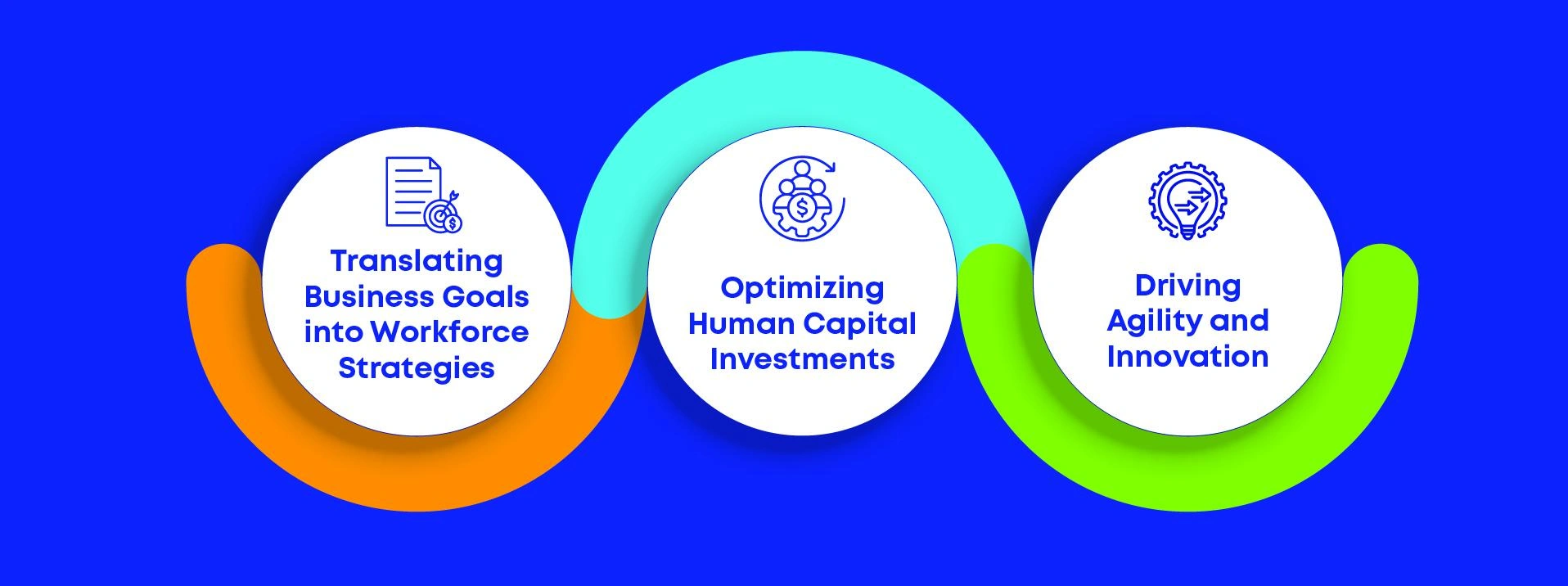
In the coming years, strategic workforce planning will become critical for you to meet short-term challenges and position your organization for long-term success in this fast-changing business environment.
Key Workforce Planning Trends Every CHRO Should Understand
As a CHRO, you can’t miss these key trends that would shape the future of workforce management. Let’s explore workforce planning trends in 2025:
AI in workforce planning
It is not surprising that AI is replacing the majority of manual work in the HR profession. It is also transforming strategic workforce planning. AI-driven predictive analytics can spot talent deficiencies, predict turnover, and even alert you to your future labor requirements. To make effective decisions, you must focus on achieving peak utilization of these tools and incorporating them into your strategic workforce planning cycle.
Skills-based workforce planning
Over the past few years, you may have seen a significant trend away from traditional recruitment towards skill-based hiring. Because technology is developing so quickly, the skills needed for the majority of jobs are changing quickly as well. Performing periodic skills gap analyses, providing upskilling or reskilling training, and developing personalized career development plans for your staff are the main priorities.
Remote and hybrid workforce management
The trend persists. Remote and hybrid work arrangements are still changing the workplace. You need to create ways of balancing flexibility and productivity, ensuring employee engagement within different teams, and setting remote work policies that can retain and attract the best talent.
Multi-generational workforce management
With approximately up to 5 different generations working side by side, you need to create inclusive strategies that can cater to these diverse generations’ needs and expectations.
Increased reliance on gig and flexible workforce
The gig economy is growing at a rapid rate. With more people seeking flexible labor options and cost-effectiveness, the gig workforce, including temporary workers, freelancers, and contractors, is on the rise. Besides managing regulatory, onboarding, and benefits issues, as a CHRO, you might be pondering how to rapidly integrate gig workers into your organization. You can utilize a flexible staffing agency for that.
Emphasis on employee development
Do you want to know the magic of retaining employees and getting them ready for tomorrow? It’s investing in your employees. You, as a CHRO, should have a customized career development plan for your employees. Perhaps you can even utilize software to organize the career development for every single employee and set goals, track progress, and help them upskill.
Sustainability and diversity-focused hiring practices
Employees of today, particularly Gen Zers, prefer to work for organizations that share their values. They choose the organization they wish to collaborate with based on these commonalities. Organizations have begun integrating ethical and sustainable practices into their onboarding procedures to draw in these value-driven workers. Corporate Social Responsibility is now a part of the organization’s long-term success.
Integrating AI & Analytics in Strategic Workforce Planning
Use of analytics and AI in strategic workforce planning is changing the way that companies are managing people and bridging human capital with business aims. Here is a comprehensive view of how AI is changing the game in terms of strategic workforce planning and analytics.
- Scenario Modeling: AI models can forecast future recruitment needs. Machine learning models different future scenarios, enabling businesses to forecast future challenges and opportunities. Scenario modeling is very time-consuming and costly, though.
- Real-time Decision Making: The AI model produces real-time information to enable CHROs like you to make well-informed hiring, training, and resource-allocation decisions. For instance, Walmart uses AI to scan in-store data to automate employee schedules, improving customer satisfaction while lowering labor costs.
- Skills Mapping: AI platforms such as IBM’s system generate tailored learning routes for employees based on their present skills and future career goals. AI-driven systems perform skills forecasting and can align employees with internal roles according to their skills, making mobility and retention as well as filling labor gaps possible.
- Automation of Routine Tasks: The time you could have used on manual processes is now saved. You can now concentrate on other strategic projects. IBM employs AI to automate competency evaluations for its entire global workforce.
Step-by-Step Guide to Effective Strategic Workforce Planning
Want to know how to do strategic workforce planning? And what makes it so essential for you? Here is the guide for you that we have broken down into simpler steps that you can follow along.
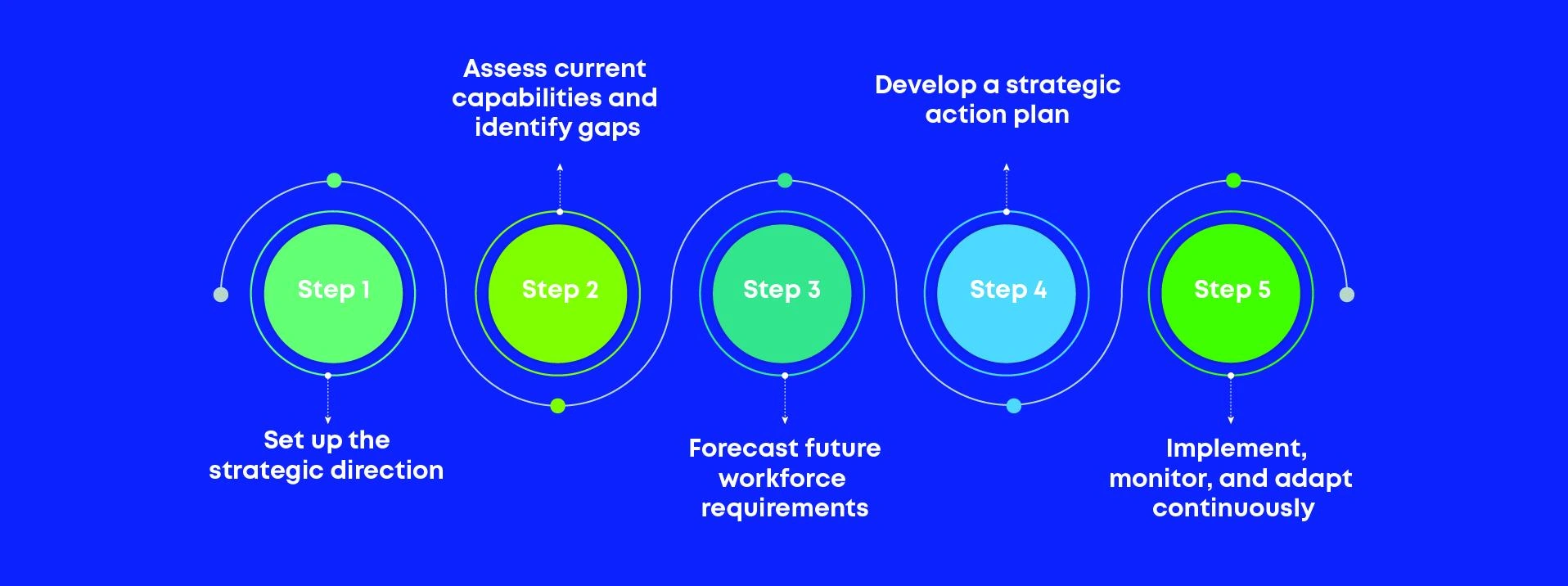
Step 1: Align the organizational and workforce plan
First, ensure that the business goals are aligned with your strategic workforce plan. Set clear objectives and KPIs (Key Performance Indicators) to measure the success of the plan. It’s not necessary to rush through this stage. You can take your time, but make sure you’re clear of the goals you desire to accomplish.
Step 2: Identify the gaps you need to address
To begin workforce planning for your organization, you must analyze the current workforce strengths and determine any existing turnover or skill gaps that need to be resolved. All these can be accomplished effortlessly using analytics that will enable you to determine all of the strengths and weaknesses of your workforce with the click of a few buttons!
Step 3: Use technology to forecast workforce demands
Make use of the technology to stay ahead of the challenges. Predict your future hiring requirements based on the growth of your business. Incorporate demand planning in your strategic workforce planning framework to determine the number and types of roles needed to achieve strategic goals.
Step 4: Develop a strategic action plan
What is a strategic action plan? The one that includes strategies related to recruitment, training, retention, and succession planning. These are usually focused on filling gaps that you found in the previous stages. You need to ensure that this action plan is time-bound, has enough budget to execute, and defines responsibilities for each person involved.
Step 5: Now execute and monitor it
All the things you added to the action plan, now you need to put them into ACTION, literally. Arrange some recruitment campaigns and training programs occasionally. You need to track the results of these campaigns using the KPIs you defined at the start. Evaluate these outcomes on a regular basis, as it will help you identify areas for improvement.
How CHROs Can Address Talent Retention Challenges in FY 2025-26
The talent shortage has become a high-priority concern for you. In the face of increasing competition for top talent and changing employee expectations, you will have to implement successful talent attraction strategies for 2025 to drive employee engagement and loyalty.
Invest in your employees’ career development
As per LinkedIn, 94% of employees mentioned that they would remain with their organizations for longer if their career growth were to be addressed. You must make sure that formal programs like mentorship, coaching, and online course access that support upskilling are included in your strategic workforce planning map.
Build the experience
Studies show that effective onboarding can increase retention up to 82%. Organized onboarding allows new hires to rapidly adjust and reduces turnover in the initial months. You must create end-to-end onboarding programs that establish clear expectations and integrate new hires into corporate culture.
Leverage people analytics
With people analytics, CHROs can determine trends in employee turnover, forecast attraction risk, and gain a greater understanding of what employees require, so imagine you would be using people analytics to make informed decisions. Feedback surveys may be employed to measure levels of worker satisfaction and areas.
Recognize and reward their contributions
Acknowledging employees’ contributions regularly can enhance their morale of employees and make them loyal to the company. You should ensure that the remunerations and benefits your employees are being provided with are competitive in the industry, considering the worth of employees’ efforts and skills is being valued.
Improve your managerial effectiveness
Train your managers with the appropriate skills to lead and manage their teams positively. Great leadership is a key driver of employee retention, hence, managers should be trained in conflict management, performance management abilities, and emotional intelligence.
Strategic Workforce Planning Examples
Vision without execution is just a hallucination. Just talking about the benefits of strategic workforce planning won’t cut it. Some organizations have effectively put this into action. Here are real-world examples of how leading companies have implemented SWP effectively.
- Pepsi-Co
Pepsi-Co ensured that terminology, scheduling, and execution were all aligned by putting strategic personnel planning into its business planning system. One of the principal enhancements was the capacity for quantifying the talents of the organization, which can result in successful financial performance. Thus, PepsiCo had aligned personnel planning with its financial plans and sales objectives when it launched the new product. They sought to remove ambiguity in their decision-making process through the use of data streams and linking the needs of the local workforce with global solutions. To develop a comprehensive workforce plan that would serve to advance their organizational goals, their HR team collaborated to recruit leaders.
- IBM
IBM’s employee strategy is strongly focused on inclusion and diversity. To bridge skills gaps globally, they looked to AI. To identify any such gaps, its forecast model provided analytics that regularly assessed staff skills with the aid of AI. It provided tailored learning programs that helped individuals achieve their ambitions in upskilling. They have a digital badge that employs open recognition methods to highlight skills that are in high demand. Establishing a platform that would accommodate diversified talent streams was one of the prime undertakings of IBM; their predictive analytics were used successfully to pre-emptively identify talent gaps.
- Bristol-Myers Squibb (BMS)
BMS developed a comprehensive system for strategic labor planning to manage market limitations and industry competitiveness. They adopted the approach of identifying the organization’s core functions and strategic competencies. They had developed an algorithmic tool for Excel that gathered information on the supply and demand for labor. “Build, Buy, or Borrow” was an approach that only managed skill gaps. Risk assessments of the demand and supply gaps were conducted with this tool. It can be used to develop an action plan that will supplement corporate strategy.
- PwC
PwC helped a client who was struggling with disconnected personnel data between teams. Through integrating data sources into one system and applying an SWP decision-making model for talent development and hiring, they made SWP concepts a reality. The integration of strategic workforce planning principles into their teams to manage disconnected data. They created an evidence-based methodology that assisted with hiring decisions. To fill in any gaps in advance, this also generated workforce forecasts for the next five years.
These examples help us understand how strategic workforce planning is used in leading organizations to address any shortcomings related to talent management.
5. Google
For both short-term and long-term employment planning, Google utilizes strategic workforce planning. It is mostly characterized by its advanced use of analytics and forecasting technologies. To cover any shortage of staff, data analytics is applied to determine any gaps in skills within the existing workforce. Google encourages ownership and teamwork that allow workers to be involved in the organization’s objectives by aligning its human capital programs with its organizational objectives.
6. Amazon
Seasonal fluctuations in demand for products are typical for Amazon. Therefore, it focuses on operational effectiveness in its strategic staffing planning to satisfy all of its customers. It utilizes a highly advanced forecasting model to predict when demand will peak seasonally, especially during holidays or festivals. Their staff is optimized by their technology, which helps in the efficient allocation of human resources across the globe. Amazon’s SWP allows the company to maintain operational effectiveness while adapting quickly to market or customer change.
Common Pitfalls CHROs Must Avoid
You are the driving force behind operational workforce planning and execution, but sometimes, some mishaps can happen. And we want to help you avoid it.
Ignoring talent development
Problem: Neglecting to offer development chances to staff could result in disillusionment, demotivation, and high employee turnover.
Solution: You should make upskilling and reskilling programs, mentorship, and career progression plans their top priorities to build a committed and future-fit workforce.
Misalignment Between HR Strategy and Business Goals
Problem: When HR programs are not aligned with organizational goals, they do not yield significant outcomes.
Solution: You need to work with other executives to ensure HR strategies align with overall business objectives and financial objectives.
Poor Communication with the Workforce
Problem: Inconsistent and unclear communication can create disconnections between leadership and employees, causing mistrust and dissatisfaction.
Solution: You have to keep lines of communication open, communicate frequently with employees, and address their concerns appropriately in order to establish trust and accountability.
Unequal Recognition of Success Stories
Problem: Acknowledging only the success stories of leadership and excluding contributions from other employees can generate resentment and demoralize the workforce.
Solution: Celebrate successes throughout all levels of an organization so that every employee will feel valued for what they can contribute.
Failing to Leverage Data Analytics
Problem: Using anecdotal or outdated workforce planning techniques leads to inefficiencies and lost opportunities.
Solution: Use advanced people analytics to inform talent acquisition, retention, and workforce optimization.
Conclusion
As a CHRO, you will experience many changes throughout this financial year. Since strategic workforce planning will become more important than ever, you should start implementing these strategies by using our guide. Utilize predictive analytics! As you can see, many top companies are doing so to match their workforce plans with their corporate objectives to maintain their competitive edge in the ever-changing market. Strategic workforce planning will help you make sure that, despite competition, your company not only survives but also flourishes.
Strategic workforce planning is all about building the future of your organization while taking advantage of technology for even more efficient workforce management. Discover how Prompt Personnel can assist you in creating your tailored workforce strategy.