by Prompt Personnel | Apr 4, 2025 | Human Resources, Learning & Development
Are you trying to match your employees with future business objectives as a CHRO (Chief Human Resource Officer? Strategic workforce planning (SWP) for organizations may then be of interest to you. You will play a crucial part in this process as we move closer to FY 2025–2026 by making sure that companies have the proper people in place to achieve their strategic goals.
In this blog, you will explore key elements of strategic workforce planning and CHRO priorities of 2025, practical advice on improving their strategic workforce management strategy. You’ll also explore the importance of utilizing data analytics to make sound decisions, allowing you to make decisions that maximize resource allocation, retention initiatives, and much more.
What is Strategic Workforce Planning?
To ensure that you have the right people with the right capabilities in the right roles at the right time, this step focuses on planning and forecasting your workforce supply and demand. The overarching goal of this process is to fit workforce capacity within corporate strategic intent.
Why Strategic Workforce Planning is Essential for CHROs in 2025-26
First, let’s look at the workforce scenario. We are aware that managing and organizing your personnel presents many difficulties. Among the difficulties you might face are:
Gaps in Skills – The technology has advanced so fast that it would be no surprise that more than half of the workforce lacks the skills to stay ahead of the curve. This has given rise to upskilling and reskilling as a critical part of workforce management.
Retention Issues – Yeah, correct. Employee expectations have changed over the years. In 2025, they value workplace culture, flexibility, and growth opportunities more than anything. And this has made retaining ace employees even more difficult.
Hybrid Workforces – It is no wonder that the ongoing popularity of remote and hybrid work arrangements necessitates you to balance flexibility and productivity with employee engagement.
Below are the reasons why SWP is crucial for CHROs.
- Disruptions in the Workforce
Studies say that by 2025, approximately 44% of workers’ skills will be disrupted due to technological changes and a shift in job demands. You would have to proactively cater to these changes and disruptions, maybe through upskilling or reskilling initiatives. This is a good solution to keep the workforce abreast of the latest advancements.
- Aligning the Workforce with Business Strategy
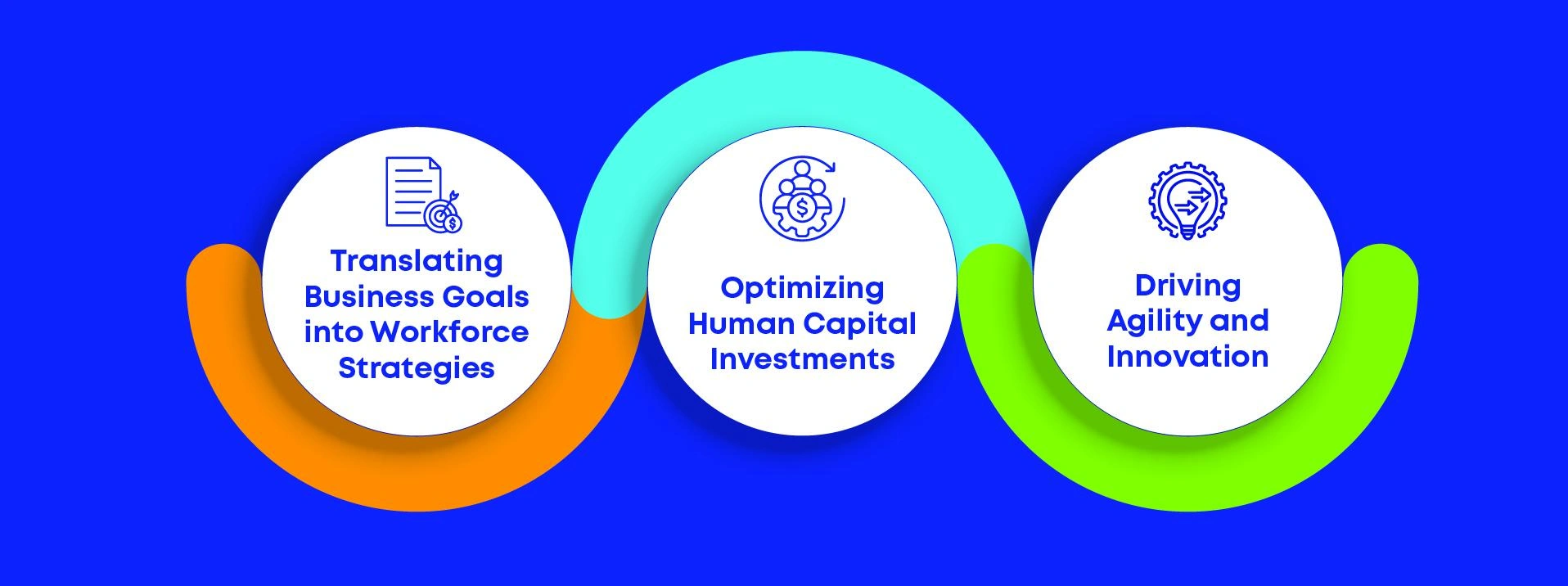
With the support of strategic workforce planning, now you can translate your business goals into realizable talent plans so that even in the coming times, your company will possess the right abilities that fulfill its needs.
- Successful Cooperation among C-Suite
Cooperation amongst you, CFOs, and CIOs is required in order to align the SWP and implement it. Such cross-functional planning guarantees a smooth execution of workforce priorities.
- Improving the Employee Experience
It’s 2025, and employees are placing more value on the company’s work environment, career advancement opportunities, physical and mental well-being, than on compensation. To attract the best talent and retain them, you must make efforts to optimize your employee engagement and collaboration.
As a CHRO, you can transform alignment by converting workforce plans into business goals. You must ensure that the workforce plans are connected to wider strategic and financial goals through collaboration with other C-suite executives, such as CFOs and CIOs. Predictive AI platforms and data insights enable you to make effective allocations of resources. In strategic HR planning you should keep the proper talent available to capture future demands at the expense of no resources. Aligning the workforce may assist the business in holding onto a competitive advantage by acting before time with changes in the marketplace and with innovativeness.
In the coming years, strategic workforce planning will become critical for you to meet short-term challenges and position your organization for long-term success in this fast-changing business environment.
Key Workforce Planning Trends Every CHRO Should Understand
As a CHRO, you can’t miss these key trends that would shape the future of workforce management. Let’s explore workforce planning trends in 2025:
AI in workforce planning
It is not surprising that AI is replacing the majority of manual work in the HR profession. It is also transforming strategic workforce planning. AI-driven predictive analytics can spot talent deficiencies, predict turnover, and even alert you to your future labor requirements. To make effective decisions, you must focus on achieving peak utilization of these tools and incorporating them into your strategic workforce planning cycle.
Skills-based workforce planning
Over the past few years, you may have seen a significant trend away from traditional recruitment towards skill-based hiring. Because technology is developing so quickly, the skills needed for the majority of jobs are changing quickly as well. Performing periodic skills gap analyses, providing upskilling or reskilling training, and developing personalized career development plans for your staff are the main priorities.
Remote and hybrid workforce management
The trend persists. Remote and hybrid work arrangements are still changing the workplace. You need to create ways of balancing flexibility and productivity, ensuring employee engagement within different teams, and setting remote work policies that can retain and attract the best talent.
Multi-generational workforce management
With approximately up to 5 different generations working side by side, you need to create inclusive strategies that can cater to these diverse generations’ needs and expectations.
Increased reliance on gig and flexible workforce
The gig economy is growing at a rapid rate. With more people seeking flexible labor options and cost-effectiveness, the gig workforce, including temporary workers, freelancers, and contractors, is on the rise. Besides managing regulatory, onboarding, and benefits issues, as a CHRO, you might be pondering how to rapidly integrate gig workers into your organization. You can utilize a flexible staffing agency for that.
Emphasis on employee development
Do you want to know the magic of retaining employees and getting them ready for tomorrow? It’s investing in your employees. You, as a CHRO, should have a customized career development plan for your employees. Perhaps you can even utilize software to organize the career development for every single employee and set goals, track progress, and help them upskill.
Sustainability and diversity-focused hiring practices
Employees of today, particularly Gen Zers, prefer to work for organizations that share their values. They choose the organization they wish to collaborate with based on these commonalities. Organizations have begun integrating ethical and sustainable practices into their onboarding procedures to draw in these value-driven workers. Corporate Social Responsibility is now a part of the organization’s long-term success.
Integrating AI & Analytics in Strategic Workforce Planning
Use of analytics and AI in strategic workforce planning is changing the way that companies are managing people and bridging human capital with business aims. Here is a comprehensive view of how AI is changing the game in terms of strategic workforce planning and analytics.
- Scenario Modeling: AI models can forecast future recruitment needs. Machine learning models different future scenarios, enabling businesses to forecast future challenges and opportunities. Scenario modeling is very time-consuming and costly, though.
- Real-time Decision Making: The AI model produces real-time information to enable CHROs like you to make well-informed hiring, training, and resource-allocation decisions. For instance, Walmart uses AI to scan in-store data to automate employee schedules, improving customer satisfaction while lowering labor costs.
- Skills Mapping: AI platforms such as IBM’s system generate tailored learning routes for employees based on their present skills and future career goals. AI-driven systems perform skills forecasting and can align employees with internal roles according to their skills, making mobility and retention as well as filling labor gaps possible.
- Automation of Routine Tasks: The time you could have used on manual processes is now saved. You can now concentrate on other strategic projects. IBM employs AI to automate competency evaluations for its entire global workforce.
Step-by-Step Guide to Effective Strategic Workforce Planning
Want to know how to do strategic workforce planning? And what makes it so essential for you? Here is the guide for you that we have broken down into simpler steps that you can follow along.
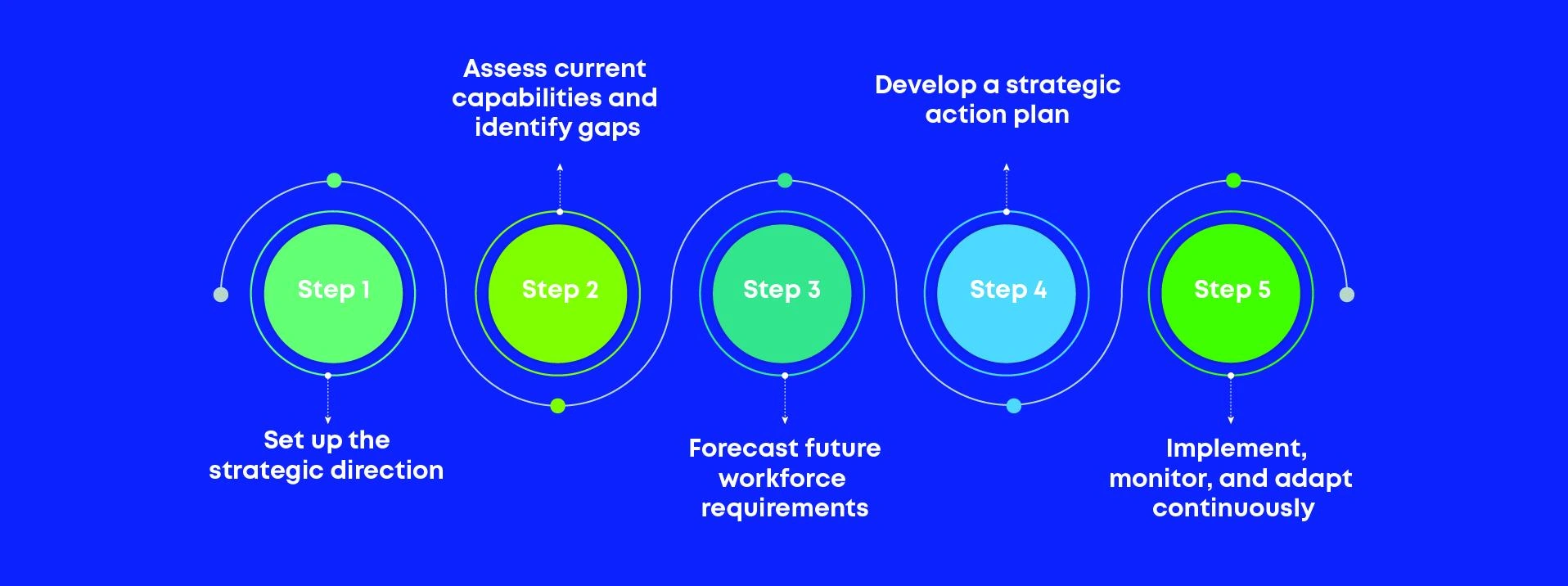
Step 1: Align the organizational and workforce plan
First, ensure that the business goals are aligned with your strategic workforce plan. Set clear objectives and KPIs (Key Performance Indicators) to measure the success of the plan. It’s not necessary to rush through this stage. You can take your time, but make sure you’re clear of the goals you desire to accomplish.
Step 2: Identify the gaps you need to address
To begin workforce planning for your organization, you must analyze the current workforce strengths and determine any existing turnover or skill gaps that need to be resolved. All these can be accomplished effortlessly using analytics that will enable you to determine all of the strengths and weaknesses of your workforce with the click of a few buttons!
Step 3: Use technology to forecast workforce demands
Make use of the technology to stay ahead of the challenges. Predict your future hiring requirements based on the growth of your business. Incorporate demand planning in your strategic workforce planning framework to determine the number and types of roles needed to achieve strategic goals.
Step 4: Develop a strategic action plan
What is a strategic action plan? The one that includes strategies related to recruitment, training, retention, and succession planning. These are usually focused on filling gaps that you found in the previous stages. You need to ensure that this action plan is time-bound, has enough budget to execute, and defines responsibilities for each person involved.
Step 5: Now execute and monitor it
All the things you added to the action plan, now you need to put them into ACTION, literally. Arrange some recruitment campaigns and training programs occasionally. You need to track the results of these campaigns using the KPIs you defined at the start. Evaluate these outcomes on a regular basis, as it will help you identify areas for improvement.
How CHROs Can Address Talent Retention Challenges in FY 2025-26
The talent shortage has become a high-priority concern for you. In the face of increasing competition for top talent and changing employee expectations, you will have to implement successful talent attraction strategies for 2025 to drive employee engagement and loyalty.
Invest in your employees’ career development
As per LinkedIn, 94% of employees mentioned that they would remain with their organizations for longer if their career growth were to be addressed. You must make sure that formal programs like mentorship, coaching, and online course access that support upskilling are included in your strategic workforce planning map.
Build the experience
Studies show that effective onboarding can increase retention up to 82%. Organized onboarding allows new hires to rapidly adjust and reduces turnover in the initial months. You must create end-to-end onboarding programs that establish clear expectations and integrate new hires into corporate culture.
Leverage people analytics
With people analytics, CHROs can determine trends in employee turnover, forecast attraction risk, and gain a greater understanding of what employees require, so imagine you would be using people analytics to make informed decisions. Feedback surveys may be employed to measure levels of worker satisfaction and areas.
Recognize and reward their contributions
Acknowledging employees’ contributions regularly can enhance their morale of employees and make them loyal to the company. You should ensure that the remunerations and benefits your employees are being provided with are competitive in the industry, considering the worth of employees’ efforts and skills is being valued.
Improve your managerial effectiveness
Train your managers with the appropriate skills to lead and manage their teams positively. Great leadership is a key driver of employee retention, hence, managers should be trained in conflict management, performance management abilities, and emotional intelligence.
Strategic Workforce Planning Examples
Vision without execution is just a hallucination. Just talking about the benefits of strategic workforce planning won’t cut it. Some organizations have effectively put this into action. Here are real-world examples of how leading companies have implemented SWP effectively.
- Pepsi-Co
Pepsi-Co ensured that terminology, scheduling, and execution were all aligned by putting strategic personnel planning into its business planning system. One of the principal enhancements was the capacity for quantifying the talents of the organization, which can result in successful financial performance. Thus, PepsiCo had aligned personnel planning with its financial plans and sales objectives when it launched the new product. They sought to remove ambiguity in their decision-making process through the use of data streams and linking the needs of the local workforce with global solutions. To develop a comprehensive workforce plan that would serve to advance their organizational goals, their HR team collaborated to recruit leaders.
- IBM
IBM’s employee strategy is strongly focused on inclusion and diversity. To bridge skills gaps globally, they looked to AI. To identify any such gaps, its forecast model provided analytics that regularly assessed staff skills with the aid of AI. It provided tailored learning programs that helped individuals achieve their ambitions in upskilling. They have a digital badge that employs open recognition methods to highlight skills that are in high demand. Establishing a platform that would accommodate diversified talent streams was one of the prime undertakings of IBM; their predictive analytics were used successfully to pre-emptively identify talent gaps.
- Bristol-Myers Squibb (BMS)
BMS developed a comprehensive system for strategic labor planning to manage market limitations and industry competitiveness. They adopted the approach of identifying the organization’s core functions and strategic competencies. They had developed an algorithmic tool for Excel that gathered information on the supply and demand for labor. “Build, Buy, or Borrow” was an approach that only managed skill gaps. Risk assessments of the demand and supply gaps were conducted with this tool. It can be used to develop an action plan that will supplement corporate strategy.
- PwC
PwC helped a client who was struggling with disconnected personnel data between teams. Through integrating data sources into one system and applying an SWP decision-making model for talent development and hiring, they made SWP concepts a reality. The integration of strategic workforce planning principles into their teams to manage disconnected data. They created an evidence-based methodology that assisted with hiring decisions. To fill in any gaps in advance, this also generated workforce forecasts for the next five years.
These examples help us understand how strategic workforce planning is used in leading organizations to address any shortcomings related to talent management.
5. Google
For both short-term and long-term employment planning, Google utilizes strategic workforce planning. It is mostly characterized by its advanced use of analytics and forecasting technologies. To cover any shortage of staff, data analytics is applied to determine any gaps in skills within the existing workforce. Google encourages ownership and teamwork that allow workers to be involved in the organization’s objectives by aligning its human capital programs with its organizational objectives.
6. Amazon
Seasonal fluctuations in demand for products are typical for Amazon. Therefore, it focuses on operational effectiveness in its strategic staffing planning to satisfy all of its customers. It utilizes a highly advanced forecasting model to predict when demand will peak seasonally, especially during holidays or festivals. Their staff is optimized by their technology, which helps in the efficient allocation of human resources across the globe. Amazon’s SWP allows the company to maintain operational effectiveness while adapting quickly to market or customer change.
Common Pitfalls CHROs Must Avoid
You are the driving force behind operational workforce planning and execution, but sometimes, some mishaps can happen. And we want to help you avoid it.
Ignoring talent development
Problem: Neglecting to offer development chances to staff could result in disillusionment, demotivation, and high employee turnover.
Solution: You should make upskilling and reskilling programs, mentorship, and career progression plans their top priorities to build a committed and future-fit workforce.
Misalignment Between HR Strategy and Business Goals
Problem: When HR programs are not aligned with organizational goals, they do not yield significant outcomes.
Solution: You need to work with other executives to ensure HR strategies align with overall business objectives and financial objectives.
Poor Communication with the Workforce
Problem: Inconsistent and unclear communication can create disconnections between leadership and employees, causing mistrust and dissatisfaction.
Solution: You have to keep lines of communication open, communicate frequently with employees, and address their concerns appropriately in order to establish trust and accountability.
Unequal Recognition of Success Stories
Problem: Acknowledging only the success stories of leadership and excluding contributions from other employees can generate resentment and demoralize the workforce.
Solution: Celebrate successes throughout all levels of an organization so that every employee will feel valued for what they can contribute.
Failing to Leverage Data Analytics
Problem: Using anecdotal or outdated workforce planning techniques leads to inefficiencies and lost opportunities.
Solution: Use advanced people analytics to inform talent acquisition, retention, and workforce optimization.
Conclusion
As a CHRO, you will experience many changes throughout this financial year. Since strategic workforce planning will become more important than ever, you should start implementing these strategies by using our guide. Utilize predictive analytics! As you can see, many top companies are doing so to match their workforce plans with their corporate objectives to maintain their competitive edge in the ever-changing market. Strategic workforce planning will help you make sure that, despite competition, your company not only survives but also flourishes.
Strategic workforce planning is all about building the future of your organization while taking advantage of technology for even more efficient workforce management. Discover how Prompt Personnel can assist you in creating your tailored workforce strategy.
by Prompt Personnel | Mar 28, 2025 | Learning & Development
Corporate learning is undergoing a major transformation due to technological advancements and the growing need for customized employee development. The corporate training courses and practices which were successful in the past do not correspond with present-day organizational requirements. The integration of AI-powered learning systems has transformed how companies train and upskill their employees. AI-powered solutions increase engagement, effectiveness, and retention, opening the door to a more responsive and customized learning experience. As companies focus on developing their workforce, AI in business learning is not only a trend—it is the future.
The Shift from Traditional to AI-Powered Corporate Learning
The traditional method of training, e.g., instructor-led classes and off-the-shelf e-learning modules, seldom caters to unique learning preferences and paces. AI is transforming corporate training courses by providing data-driven intelligence, real-time performance monitoring, and personalized learning paths. Such innovations enable employees to learn more efficiently while synchronizing with business objectives.
AI-based learning solutions utilize machine learning and big data to examine employee performance and recommend customized courses. This helps learners get the appropriate content at the appropriate time, making training more effective and less time-consuming.
Benefits of AI in Corporate Learning & Development
- Personalized Learning Paths
AI-driven systems analyse the strengths, weaknesses, and learning style of an individual. In the process, they create training programs tailored to address particular needs, optimizing engagement and understanding. Unlike conventional practices, AI-driven training is adaptive and dynamically changes as the learner advances.
- Real-Time Performance Tracking
AI enables real-time monitoring of employee progress through assessments and feedback loops. By analysing data, AI systems identify areas where learners need improvement and suggest targeted resources. This approach helps people keep learning and improving their skills.
- Improved Engagement through Gamification
Many corporate training companies are incorporating AI-driven gamification techniques to make learning more interactive and enjoyable. AI helps create scenario-based learning experiences, virtual simulations, and interactive assessments, keeping employees motivated throughout their learning journey.
- Affordable and Scalable Solutions
AI-based training reduces reliance on traditional classrooms and human instructors, significantly cutting costs related to travel, materials, and instruction. AI-based platforms are very scalable and, therefore, suitable for organizations of any size, from small businesses to multinational corporations. They can support an increasing number of employees across various locations with guaranteed quality of training. AI optimizes resources, allowing companies to focus on strategic initiatives while supporting employee growth.
- Enhanced Knowledge Retention
AI enhances knowledge retention through the analysis of learning patterns and presentation of content at the best possible intervals. AI personalizes review cycles to impact important concepts without overloading employees. Microlearning methods segment complicated subjects into bite-sized lessons, which improve long-term comprehension. AI identifies weaknesses and offers quick refresher courses, helping employees remember key information and apply what they’ve learned in real-life situations.
How AI is Transforming Corporate Training Courses
AI is transforming corporate training courses by changing how employees learn skills and knowledge. Here are some ways AI is making a difference:
- Automated Content Creation: AI creates customized training materials based on employee roles, industry trends, and performance data.
- Chatbots & Virtual Coaches: AI-powered chatbots assist employees with instant answers to queries, guiding them through training modules.
- Predictive Analytics: AI predicts future learning needs based on job roles and market demands, ensuring employees remain industry ready.
- Voice & Facial Recognition: Advanced AI systems assess engagement levels through facial expressions and voice tone, refining training methods accordingly.
- Adaptive Learning Platforms: AI platforms change content instantly based on how learners interact, creating a dynamic learning experience.
The Role of AI in Learning and Development for Corporate Growth
AI is transforming corporate training and helping businesses succeed. Organizations that use AI-based training solutions experience:
- Higher Employee Productivity: Personalized learning ensures employees acquire relevant skills faster, improving efficiency.
- Reduced Employee Turnover: Providing customized career development paths keeps employees engaged and motivated.
- Better Compliance & Risk Management: AI-based training programs ensure employees stay updated on industry regulations and compliance requirements.
- Faster Onboarding Processes: AI enables new employees to access relevant training materials instantly, speeding up adaptation periods.
- Increased Learning Accessibility: AI platforms offer training for employees in different locations, promoting inclusivity.
Challenges and the Road Ahead
AI-driven corporate learning has a lot of advantages, but its use comes with certain challenges:
- Data Privacy & Security: Companies must ensure that AI-driven platforms comply with data protection regulations.
- Initial Implementation Costs: Integrating AI-based training solutions may require significant investment, but the long-term benefits outweigh the costs.
- Workforce Readiness: Employees and trainers must adapt to AI-driven learning models to maximize their potential.
- Continuous AI Evolution: AI technology is constantly evolving, requiring businesses to stay updated on the latest advancements to remain competitive.
Getting Ready for the Future of AI-Powered Corporate Learning
Organizations have to implement a strategic path towards integrating AI into their business learning systems. The following steps will ensure an easy transition:
- Assessing Training Needs: Identifying skill gaps and aligning AI-driven training programs with organizational goals.
- Choosing the Right AI-Powered Platform: Selecting a scalable and user-friendly AI learning management system.
- Providing Training for AI Integration: Equipping employees with the necessary knowledge to navigate AI-based learning tools effectively.
- Tracking AI-Driven Learning Outcomes: Monitoring employee progress to measure the effectiveness of AI-enhanced training programs.
Final Thoughts
AI-based corporate training programs are transforming the process of talent nurturing in organizations. As learning and development corporate programs become more flexible, AI ensures that training becomes personalized, interactive, and goal oriented. It is no longer a matter of choice but important for businesses to adopt AI-based corporate learning in order to remain competitive in the current changing environment. Investing in AI-enhanced training solutions will empower employees and drive long-term business success.
Organizations seeking customized corporate training companies can find advanced corporate services through Prompt Personnel who address modern workplace needs. The workforce development focus of Prompt Personnel brings customized training initiatives for companies of any scale through their specialized learning programs. The combination of trained experts with AI solutions and corporate learning customization enables Prompt Personnel to deliver efficient employee upskilling programs to their clients. The advanced AI-based training programs at Prompt Personnel will guide organizations toward establishing learning frameworks for enduring accomplishments.

by Prompt Personnel | Mar 26, 2025 | POSH Compliance
Workplace safety is essential for creating a respectful and inclusive environment. The POSH Act in India plays a crucial role in safeguarding employees. Many myths still exist about this important act. This results in misconceptions, non-compliance, and legal liabilities for organizations.
Here are some of the common myths. Knowing these will help organizations stay compliant and create safer workplaces.
Myth 1: Many believe POSH compliance is only for large firms
Reality: The POSH Act applies to all organizations, regardless of size.
POSH compliance is mostly for large firms. However, the statute prescribes that any organization employing over ten employees — whether startup company, small business enterprise, or multinationals — must have steps in place to prevent sexual harassment at the workplace.
Establishing an Internal Committee is crucial. Regular POSH training and strong anti-harassment policies are equally essential. Not doing these things can lead to legal issues and a loss of trust.
Myth 2: POSH Training is a One-Time Activity
Reality: POSH training is an ongoing process.
Some employers think that running one training session alone would be enough to meet their requirements. The POSH Act, though, stresses the need to be continuously aware and trained. Ongoing POSH awareness training makes employees aware of what their rights and responsibilities are and helps to create a safe work environment.
Advancements in technology enable companies to offer online POSH training, ensuring accessibility for employees. Such practices allow smoother employee training without sacrificing procedure and policy clarity.
Myth 3: Filing a Complaint is Complicated and Risky
Reality: The POSH Act ensures a safe and confidential complaint process.
Employees often refrain from reporting harassment due to fear of retaliation or lack of trust in management. But the POSH Act has a clear, outlined procedure. It keeps the complainant anonymous and deals with cases in an unbiased manner.
Employers should educate their teams through POSH training, ensuring employees understand the complaint process, the role of the Internal Committee, and their rights.
Myth 4: POSH Compliance is Only for Women
Reality: Although the POSH Act is meant to protect women chiefly, respect in the workplace is good for all.
While the POSH Act primarily addresses sexual harassment against women, POSH awareness fosters a culture of respect for all. It also helps everyone in the workforce see it as a good thing. Encouraging professional boundaries reduces conflict, enhances productivity, and supports a positive work environment.
Myth 5: Hiring a POSH Service is Expensive and Unnecessary
Reality: Investing in professional POSH services is cost-effective in the long run.
Some organizations believe they can achieve POSH compliance internally without expert assistance. While internal effort is integral, seeking professional assistance guarantees effectiveness and correctness of legal compliance.
Professional POSH assistance provides customized training programs, assists in establishing Internal Committees, and assist organizations through the process of compliance, finally protecting the organization from legal implications.
Myth 6: POSH Compliance is Only About Avoiding Penalties
Reality: POSH compliance is about creating a respectful work environment.
Many people think that compliance is just about avoiding fines and legal issues. But the actual intent goes much deeper. It’s important to enforce the act effectively. It builds trust, promotes gender equality, and boosts employee morale.
Moreover, continuous POSH training for employees showcases significant advantages. It minimizes risks, resists employee misconduct and makes a more productive environment.
Myth 7: Remote Workplaces Don’t Need POSH Compliance
Reality: POSH compliance applies to virtual workspaces too.
With the growth of remote work, most people believe that virtual environments do not need POSH measures. Yet, inconsiderate behavior can take place through emails, chats, video conferencing, or social media communication.
Online POSH training for employees guarantees that remote employees know what acceptable online behavior is and how to report virtual harassment. Virtual workplaces are just as accountable for maintaining employee safety and building respectful environments.
Why Busting These Myths Matters
These myths can put your business at legal, financial, and cultural risk. Non-compliance may result in fines, reputational damage, and loss of employee trust. Ongoing POSH awareness training and professional POSH services create a safer, more inclusive workplace.
POSH compliance goes beyond legal obligations—it builds a respectful, anti-harassment culture that boosts morale, trust, and productivity. Proper execution of the POSH Act strengthens your company’s reputation and growth.
At Prompt Personnel, our tailored POSH training for employees ensures compliance and fosters workplace safety. Whether you need help with Internal Committees, legal guidance, or online POSH training for employees, our experts provide seamless support.
From face-to-face sessions to online POSH employee training, we equip your staff while keeping your business compliant. Don’t let myths compromise workplace safety. Take action today to build a respectful, harassment-free environment.
Protect your business. Empower your team. Stay POSH compliant with Prompt Personnel.
by Prompt Personnel | Mar 20, 2025 | Learning & Development
Technology today is advancing faster than ever. While technical skills are essential for using digital tools, human-centric skills remain the key differentiator for success. Automation has reshaped industries but being able to adapt to change and work in collaboration is still crucial. These soft skills exist for developing strong relationships and creating innovations.
As digitalization increases, workplaces emphasize soft skills alongside technology to enhance motivation and productivity. Organizations implement employee training programs to stay competitive and develop these crucial skills. Let’s look further at why soft skills are important. Besides, how employee training and development can enable the contemporary workforce.
Why Are Soft Skills Important in the Digital Age?
Soft skills bridge the gap between technology and people. Human-centric skills set individuals apart in the era of AI. How? Through enhancements in collaboration, creativity and resilience. Technology handles the “what,” while employees manage the “how” through soft skills. This empowers smooth interactions, problem-solving and team dynamics. Here are some reasons why soft skills matter more than ever:
Effective Communication: In digitalization, communication is more about how you say than what you say. Clear communication is essential for virtual teams and online collaboration tools. Conveying ideas through video calls and messaging apps can prevent misunderstandings. Effective communication keeps projects aligned with organizational goals, fostering better collaboration.
Adaptability: Technology evolves quickly and staying relevant means embracing change. Employees start learning new tools and handle unexpected challenges through adaptability. It allows teams to remain agile and the organization to follow appropriate industry trends.
Digital projects: Limited in-person interactions make it challenging for colleagues to build harmony and rapport. These often need collaboration across departments and time zones. Strong teamwork skills build productivity and trust among teammates. Even during remote work, collaboration becomes easy through good team bonding.
Emotional Intelligence: Understanding emotions in digital interactions improves workplace harmony. Virtual meetings prevent conflicts and build stronger relationships. Why? Because reading between the lines becomes easy in fewer face-to-face conversations. Besides, an inclusive work culture exists through emotional intelligence, simplifying complex interpersonal dynamics.
Problem-Solving: Critical thinking is essential for navigating complex digital challenges. Employees tackling issues with creativity and logic help organizations stay agile and competitive. Problem-solving skills help us overcome challenges. Using new strategies can lead to effective solutions for problems.
Strategies for Soft Skills Development
Acquiring soft skills needs deliberate effort. Organizations can use employee training and development programs to foster these skills. Some effective strategies are:
Integrate Soft Skills in Corporate Training
- Combine technical training with corporate employee training programs.
- Integrate modules on communication, leadership, and emotional intelligence.
- Use real-life scenarios to enable employees to tool these skills in real-life scenarios.
Use Digital Learning Platforms
- Provide soft skills online courses and webinars.
- Use virtual simulations and gamification to enhance the learning process.
- Offer access to an online library for ongoing learning.
Encourage Peer Learning
- Create virtual team-building activities and group projects.
- Develop mentorship programs wherein senior employees offer advice and feedback.
Give Regular Feedback
- Carry out regular reviews on soft skills development.
- Use 360-degree feedback to provide constructive feedback from supervisors.
- Reward and acknowledge enhancements to encourage employees.
Develop a Culture of Continuous Learning
- Motivate attendance at workshops, seminars, and online forums.
- Encourage lifelong learning by sponsoring extra courses.
- Establish a safe environment where workers can learn from errors and new methods.
Advantages of Corporate Soft Skills Training
Corporate soft skills training is a helpful investment for both employees and organizations. Let’s take a closer look.
- Improved Communication: Decreases errors and increases productivity. Effective communication results in fewer errors and better project management.
- Increased Team Collaboration: Develops a harmonious working environment where ideas are free. Team members collaborate with one another to complete common objectives.
- Improved Employee Satisfaction: Workers feel confident and appreciated with the right tools. This increases their morale and ultimate retention.
- Improved Leadership: Equips future leaders with necessary management skills. Effective leaders who motivate and inspire their teams can propel organizational growth.
- Increased Adaptability: Enables teams to manage digital disruptions. Having resilient staff helps the organization adapt more easily to changes in the industry.
Implementing Soft Skills Employee Training and Development
When initiating employee training initiatives on soft skills, keep these steps in mind:
- Assess Skill Gaps: Pinpoint areas of improvement by conducting surveys, interviews, and performance reviews.
- Set Clear Objectives: Determine what the training can do. For instance, developing conflict resolution skills or improving virtual communication.
- Personalize Learning Paths: Make programs that fit individual needs. Understand that every employee is different with varying strengths and areas for growth.
- Track Progress: Track development through digital means. Regular checks and tracking guarantee employees remain on the correct path.
- Gather Feedback: Adjust programs based on feedback from participants. Ask employees to input their experiences and make recommendations.
In the age of technology, soft skills are not “nice to have.” They are “must-haves” for professional success. Organizations that invest in corporate soft skills training can develop a strong workforce. They can overcome contemporary challenges, and change in adaptability, communication and collaboration. Companies can help employees succeed in a digital-first world with these measures.
At Prompt Personnel, we know the role of soft skills in molding leaders. Our tailored training programs help employees develop skills and succeed in the market. We’re dedicated to enabling your staff with the skills needed to succeed. Experience the art of communication, leadership development, and adaptability with us. Contact us for more details today.
by Prompt Personnel | Mar 17, 2025 | Recruitement Company
Talent acquisition is an ongoing challenge for all firms. Finding the right talent is becoming increasingly challenging as the job market evolves daily. The answer may lie in changing your hiring strategy and moving away from antiquated techniques and toward more contemporary, tech-driven strategies. While the debate over traditional vs modern recruitment methods continues, recruiters increasingly adopt mobile-friendly platforms and social media to enhance hiring.
Traditional Recruitment: What Is It?
The term “traditional recruitment approach” describes the time-honoured procedures and methods that have been used for decades to find and hire workers throughout our nation. There are several age-old recruitment methods that date back hundreds of years. What are the conventional approaches to hiring, then? Keep reading to find out.
Traditional Recruitment Methods
- Print advertising: To reach a large number of possible applicants, job vacancies might be posted in newspapers or on job boards.
- Internal Hiring: Filling vacancies by recommendations from current employees.
- Local Employment Offices: To reach a larger audience, post job openings in local employment offices.
- Temp Agencies: Shortlisting and identifying qualified applicants through temporary staffing agencies.
- Headhunting: The process of finding applicants via personal networks and relationships is often contrasted in a recruitment process comparison with more formal sourcing techniques.
- Organizing In-Person Interviews: Asking applicants to come to the company’s offices or a neutral setting to speak with a hiring manager or a panel of interviewers face-to-face.
- Examining Cover Letters and Resumes: Review cover letters and resumes to assess if a candidate is suitable for the role and has the right qualifications.
- Conducting Tests or Assessments: Conducting aptitude tests or other evaluations to gauge the competencies of applicants.
- Verifying References: To learn more about a candidate’s work history and performance, get in touch with their references, such as previous managers or coworkers.
- Referral programs: Encourage current workers to recommend friends or coworkers for available opportunities because these referrals are frequently more successful and dependable recruits.
There are benefits to using traditional recruitment techniques, including:
- Familiarity: They are friendly and known by both job seekers and employers, reflecting key aspects of traditional vs modern recruitment methods in established hiring systems.
- Personal Connection: Employers can learn more about a candidate’s personality and organizational fit through in-person interviews and other evaluation techniques. This is often highlighted in a recruitment process comparison with digital hiring methods.
- Set Procedures: Standard hiring practices usually follow specific steps and rules. These can help make sure the hiring process is fair and consistent.
Modern Recruitment: What Is It?
The term “modern recruitment” refers to the current methods used to find and hire the best candidates for a job, whether for temporary roles or permanent staffing. These strategies use technology and creative ideas to boost efficiency, enhance the candidate experience, and speed up the hiring process. Whether businesses are seeking permanent staffing or temporary workforce solutions, modern recruitment methods provide a streamlined approach to acquiring top talent compared to traditional vs modern recruitment methods. Here are a few essential modern hiring techniques:
Modern Recruitment Methods
- Artificial Intelligence (AI) Technology: By automating processes like candidate matching, screening, and filtering, AI simplifies the hiring process. It helps identify the most qualified candidates based on their experience and skills.
- Social Media Platforms: Companies create their employer brands, post job openings, and connect with candidates on social media platforms like Facebook, Twitter, and LinkedIn. This method can reach specific groups of people and has a wide audience.
- Applicant tracking systems (ATS): ATS software facilitates the management and screening of job applications, hence facilitating the identification of the most qualified applicants. By automating administrative procedures, it also conserves time and resources.
- Google Meet and Zoom Communication: Candidates can communicate with the company remotely through virtual interviews conducted via Google Meet and Zoom. This shift is often highlighted in a recruitment process comparison with traditional face-to-face hiring.
- Mobile Recruiting: Job postings are posted, prospects are contacted, and interviews are conducted using mobile devices. Reaching younger generations, who are more inclined to utilize mobile devices for job searches, is especially successful with this approach.
- Talent Pool: This approach entails keeping track of prior applicants who had promise but were not hired. These applicants can be quickly contacted and given consideration for the role when a new opening occurs.
- Boomerang Employee: This tactic entails hiring back former workers who parted ways on a good note. Since these workers are already familiar with the corporate culture and are likely to blend in with ease, this approach may work.
- Internal Recruitment: This strategy promotes employees from within the company. It costs less and can increase employee engagement and motivation by showing a commitment to their professional growth.
- Collaborative Hiring: In this approach, executives and line managers participate in the hiring procedure. It guarantees that the chosen applicant satisfies the demands and anticipations of all parties involved.
- Video Interviews: By conducting interviews remotely via video, time and resources can be saved. They also give the candidate a more intimate experience.
- Employer branding: To attract top talent, companies should create a strong employer brand. This means showing potential employees the company’s culture, values, and benefits.
Modern hiring practices focus on improving how effective and efficient the hiring process is, as well as enhancing the experience for candidates.
Which Is Better, a Traditional or Modern Approach to Hiring?
The specific needs of the company, the job market, and the types of positions available influence whether traditional or modern recruitment methods are better. To better understand the pros and cons of each approach, consider the following comparison:
Strengths of Traditional Recruitment Techniques
- Personal Touch: Direct communication and in-person interviews can help establish a solid rapport with applicants, often discussed in traditional vs modern recruitment methods.
- Familiarity: Well-established procedures are simple to apply and comprehend.
- Employee Referrals: Recommendations from dependable staff members can result in excellent recruits.
Weaknesses of Traditional Recruitment Techniques
- Limited Reach: Internal hiring and print advertising might not reach a wide range of people.
- Time-consuming: Manual procedures such as reviewing applicants and holding face-to-face interviews require a substantial amount of time.
- Potential Bias: Subjective opinions and personal relationships may cause biasness.
Strengths of Modern Recruitment Techniques
- Expanded Reach: Social media and online job boards have the ability to draw applicants from a larger, more varied population, which is a key shift in traditional vs modern recruitment methods.
- Efficiency: AI and applicant tracking systems (ATS) save time and money by streamlining the employment process.
- Improved Candidate Experience: Candidates find the process more convenient thanks to mobile recruiting and video interviews.
- Data-Driven: Data and analytics support better hiring practices and well-informed decision-making.
Limitations of Modern Recruitment Techniques
- Impersonal: Using technology can make the process feel less personal.
- Initial Cost: You may need to pay a one-time fee for staff training and to set up new technology.
- Over-reliance on technology: the chance of passing on excellent applicants who might not have the strongest online presence increases.
When Is It Better to Use Modern or Traditional Recruitment Techniques?
When to Apply Traditional Techniques
- Local, small businesses: Traditional approaches may be adequate for companies who hire locally.
- Roles Needing Personal Interaction: In-person interviews can be helpful for jobs that require strong people skills or customer service.
When to Apply Modern Techniques
- High-Volume Employment: Modern techniques provide efficiency and scalability for businesses who need to fill a large number of roles rapidly.
- Tech-Aware Prospects: Positions in cutting-edge and IT industries where applicants are more likely to interact with digital platforms.
- Diverse Talent Pools: The wider reach of social media and online platforms will be advantageous to companies looking to recruit a diverse workforce.
The Best Method: A Hybrid Framework
The best results are frequently obtained by combining ancient and modern methods. For instance:
- Employee Referrals: To be more efficient, manage employee referrals using an online platform along with traditional methods.
- Face-to-face interaction: Use video interviews for initial screenings, then meet in person with the top candidates.
- Job Ads: To get more people to see your job ads, post them on online job boards and in local newspapers.
Final Thoughts
The job market is constantly evolving, making it essential to compare traditional and modern recruitment methods. Each has pros and cons, but a hybrid approach is the most effective, combining the best of both to attract and retain top talent. Companies must assess their culture, values, and hiring needs to choose the right strategy.
Prompt Personnel offers effective staffing solutions by blending traditional and modern hiring methods. They understand industry trends and help businesses attract, evaluate, and retain top talent. Whether you need permanent employees, temporary staff, or executive search services, their tailored approach ensures the right candidates for growth and success. Partner with Prompt Personnel to optimize recruitment, ensuring your business attracts and retains top talent in an evolving job market.