



The Role of Labour Law Advisors in Financial and IT Sectors
Labour laws constitute the pillars of employee rights and employer obligations with the aim of promoting fairness and justice in workplaces. With today’s fast-moving business world, particularly in finance and information and technology (IT) sectors, abiding by the labour laws is more difficult. Labour law consultants and experienced labour law advisor teams play an important role in navigating businesses through this network, providing excellent advice and ensuring conformity with the constantly changing laws. This blog will discuss the indispensable role of labour law advisors in these two key industries and why their service is vital for businesses, especially those looking for reliable guidance similar to a labour law advisor fund or specialist consultancy.
Understanding Labour Laws and Their Importance
Labour laws are created to regulate the relationship between employees and employers, providing fair compensation, safe working conditions, and protection against exploitation. Labour laws address a wide range of issues, such as minimum wage, overtime compensation, workplace safety, anti-discrimination practices, and employee benefits.
In the financial and IT industries, these rules have a tremendous influence on business operations on a day-to-day basis. The slightest mistake could lead to huge financial penalties, damage to reputation, and, in the worst-case scenarios, litigation. This is where the expertise of labour law consultancy services becomes indispensable. A labour law advisor or labor law advisor helps businesses stay on the right side of the law, providing solutions to potential compliance issues and advising best practices.
The Growing Complexity of Labour Law in the Financial Sector
The financial sector is one of the most regulated industries globally. Banks, insurance providers, and investment houses have to adhere to a plethora of national and international regulations. These range from anti-money laundering legislation, tax laws, and employee welfare codes. The introduction of newer financial technologies (FinTech) has also introduced new regulatory issues.
With the industry becoming more dynamic, labour law compliance in India becomes all the more essential. Labour law consultants who specialize in the finance sector assist companies in overcoming the issues that they encounter, including:
- Employment Contracts and Benefits: Financial institutions often employ workers under complex contracts. A labour law consultant ensures these contracts are in line with the law, providing clarity on salaries, bonuses, retirement benefits, and other benefits.
- Classification of employees: Financial institutions have to correctly classify the employees, separating full-time, part-time, and contractual workers. Misclassification may have legal consequences.
- Labour Disputes: The financial sector often faces disputes related to compensation, promotions, or termination. Labour law consultants help mediate such disputes, offering legal advice and suggesting resolutions.
- Compliance with International Regulations: Given the global nature of the financial industry, firms must comply with international standards like the EU’s GDPR and other global financial regulations. Labour law advisors in this sector ensure that all employee data handling practices are in compliance.
- Workplace Safety: While most people associate workplace safety with physical environments, financial institutions must also address mental well-being. Labour law advisors help develop policies that provide a safe and welcoming workplace for every employee.
Labour Law Consultants in the IT Industry: Navigating a Shifting Landscape
The IT sector is rising as one of the most dynamic fields today, fuelled by unending advancements in technology. While this offers many opportunities, it also poses unique challenges when it comes to labour law compliance. As businesses in this sector scale up, the need for robust labour law consultancy becomes crucial.
IT companies often face rapid growth and workforce shifts, including remote work arrangements, freelance contracts, and short-term hires. Labour law consultants for the IT sector assist businesses in ensuring that:
1. Work-from-Home and Remote Work Policies: With the rise of remote work in the IT industry, establishing clear, legal, and fair policies has become essential. A labour law advisor helps develop policies that cover working hours, data security, communication, and compensation.
2. Freelance and Contractual Workers: Most IT firms depend on freelancers and contractors for certain projects. Labour law consultants advise companies on how to legally classify these workers, how to pay them, provide benefits, and treat them in terms of tax. Additionally, with the rising trend of moonlighting—where employees take up secondary jobs—companies must understand the legal implications. For a deeper understanding of moonlighting regulations, read Compliance and Legal Issues in Moonlighting – Insights from Labour Law Advisor.
3. Intellectual Property (IP) Rights: Protecting intellectual property is critical in the IT industry. A labour law consultant assists in framing agreements that specify who will have rights over any software, code, or technology created by employees.
4. Termination and Severance: In IT, the demand for skills can change rapidly. Labour law advisors ensure that any terminations or layoffs comply with the law, helping companies avoid wrongful termination lawsuits.
5. Employee Welfare: IT professionals tend to work long hours, and burnout and stress are serious issues. Labour law consultants assist firms in creating welfare programs to ensure employees remain content and legally safeguarded.
Labour Law Compliance in India: A Challenge for Both Sectors
Though each of the financial and IT industries has its own set of problems, one thing is for sure-these are subject to a complex series of labour legislation. In India, the law is especially complicated in that a range of acts and regulations applies to the various aspects of employment.
Some of the key legislation governing labour law compliance in India includes:
- The Industrial Disputes Act, 1947: This Act deals with the resolution of disputes between employers and employees, including strikes, layoffs, and retrenchments.
- The Employees’ Provident Funds and Miscellaneous Provisions Act, 1952: This Act mandates the creation of a provident fund to which both employers and employees contribute.
- The Minimum Wages Act, 1948: This Act sets the minimum wages that an employer must pay to workers.
- The Payment of Gratuity Act, 1972: This Act ensures that employees are entitled to gratuity payments for long-term service with a company.
Adhering to these laws can be challenging, especially for companies operating across multiple states or managing diverse workforces. Labour law consultants, including those in major business hubs like Mumbai, help companies interpret and comply with these laws, reducing the risk of non-compliance.
How Labour Law Advisors Assist Financial and IT Businesses
The role of a labour law advisor goes far beyond basic compliance. Their support includes:
- Risk Mitigation: Consultants identify and mitigate risks in employment practices, preventing fines and reputation damage.
- Contract Drafting and Review: They help draft transparent, legally compliant employment contracts.
- Training and Awareness: Regular training sessions conducted by labour law advisors improve workplace awareness, rights, and responsibilities.
- Conflict Resolution: Consultants resolve disputes through negotiation and mediation before they escalate.
- Audit and Compliance Checks: Continuous audits by labour law advisors ensure alignment with updated regulations.
Conclusion
In today’s highly regulated financial and IT landscapes, staying compliant with evolving labour laws is no longer optional—it is essential for sustainable growth. Businesses rely on the expertise of a Prompt Personnel to navigate complex regulations, reducing legal risks, and maintaining a fair, transparent work environment. Whether managing workforce structures, addressing disputes, or ensuring adherence to national and global standards, these advisors play a critical role in strengthening organizational stability. For IT companies, dedicated labour law consultants for the IT sector ensure smoother operations, while organisations seeking structured compliance can benefit from guidance similar to a well-managed labour law advisor fund. Ultimately, partnering with trusted labor law advisors empowers companies to stay compliant, enhance employee trust, and foster long-term success.

How Labour Law Consultants Help Companies Avoid Legal Disputes
Adherence to labor laws in the current highly regulated business environment is not merely a matter of regulatory compliance but also a necessity for running businesses effectively. Noncompliance with labor laws invites stringent legal penalties, economic expenses, and reputational damage. This is where labour law consultants come into play, helping companies navigate complex labour laws and maintain compliance.
For businesses operating in a country like India, where labour laws are dynamic and frequently updated, engaging a professional labour law consultancy can be the key to avoiding unnecessary legal disputes. In this blog, we will explore the critical role of labour law consultants in Mumbai and across India, how they support businesses, and why compliance is essential in today’s market.
Understanding the Role of Labour Law Consultants
Who Are Labour Law Consultants?
Labour law consultants specialize in employment laws, compliance regulations, and human resource-related legal matters. Their primary role is to help businesses understand, interpret, and implement labour law compliance in India to ensure they operate within the legal framework.
Key Responsibilities of Labour Law Advisors
A labour law advisor ensures businesses comply with employment laws, protecting both employers and employees. Here’s how they help:
1. Compliance with the Factories Act, 1948: Ensures safe and healthy working conditions, regulates working hours, safety measures, and welfare provisions to prevent workplace hazards.
2. Adherence to the Minimum Wages Act, 1948: Guides businesses in setting fair wages, ensuring timely payments, and preventing underpayment disputes.
3. Implementation of The Employees’ Provident Funds and Miscellaneous Provisions Act, 1952: Helps register employees for EPF, manage contributions, withdrawals, and ensure compliance to avoid penalties.
4. Understanding The Payment of Bonus Act, 1965: Ensures employees receive rightful bonuses based on wages and company profitability, while helping businesses stay compliant.
5. Ensuring Compliance with The Maternity Benefit Act, 1961: Advises on granting 26 weeks of paid maternity leave, workplace support for mothers, and protection from discrimination.
6. Managing Labour Contracts under The Industrial Disputes Act, 1947: Drafts and reviews contract, resolves disputes over layoffs, terminations, and strikes while ensuring legal compliance.
7. Handling Employee Grievances and Legal Disputes: Investigates workplace issues, mediates disputes, and ensures fair disciplinary actions while avoiding legal complications.
8. Ensuring Adherence to The Contract Labour (Regulation & Abolition) Act, 1970: Regulates contract workers’ rights, ensures fair wages, and prevents illegal terminations or exploitation.
9. Providing Insights on The Equal Remuneration Act, 1976: Promotes equal pay for men and women, prevents wage discrimination, and ensures fair employment policies.
How Labour Law Consultancy Helps Businesses Stay Compliant
- Navigating Complex Labour Laws
India has a complex and extensive network of labor laws. These laws are cumbersome to implement, particularly for small and medium enterprises. Labor law consultants in Mumbai and other parts of the nation assist companies in understanding the laws thoroughly and maintaining a grip on central and state laws.
- Reducing Legal Risks and Disputes
One key function of a labour law advisor is to prevent legal disputes between employers and employees. By ensuring employment contracts, company policies, and grievance redressal mechanisms comply with labour law in India, firms can avoid costly litigation.
- Payroll and Employee Benefits Compliance Assistance
Payroll management, contribution to provident fund, gratuity, and other employee benefits are essential to ensure compliance with labour laws. Labour law consultants help companies in structuring payrolls that meet all the legal requirements with lesser chances of fines.
- Resolution of Employee Grievances and Legal Matters
Disputes at the workplace, wrongful dismissal, compensation disputes, and compliance problems can lead to legal problems. Mumbai’s labour law consultants provide expert mediation and advocacy to resolve differences successfully.
- HR Teams Training in Labour Law Compliance
It is the responsibility of an HR department of an enterprise to implement employment laws. Labour law consultancy services refer to imparting training to HR professionals in best practices of recruitment, induction of employees, grievance redressal, and labour law compliance.
- Ensuring Proper Documentation and Record-Keeping
Businesses must maintain proper documentation, such as payroll records, employee contracts, and statutory compliance reports. Labour law consultants help companies maintain accurate records and meet legal requirements during audits or inspections. To simplify this process, businesses can refer to our Labour Law Compliance Checklist to avoid legal missteps and stay on top of compliance requirements.
- Compliance with Workplace Safety Regulations
Ensuring a safe work environment is mandatory under laws like The Occupational Safety, Health, and Working Conditions Code, 2020. Labour law consultants help businesses implement safety protocols and meet workplace safety compliance standards.
Why Labour Law Compliance in India is Essential
Avoiding Legal Penalties
Non-conformity with Indian labour law can result in hefty fines, lawsuits, and even the closure of a business. Companies must periodically update their policies to stay aligned with the recent amendments and legal provisions.
Building a Positive Work Environment
Adhering to labour laws ensures that employees receive fair wages, proper working conditions, and job security, leading to higher job satisfaction and productivity.
Enhancing Business Reputation
Companies known for compliance and fair employee treatment attract top talent, customers, and investors. Working with labour law consultants ensures businesses maintain a positive brand image and ethical workplace standards.
Ensuring Smooth Business Operations
Labour-related legal disputes can disrupt business operations, lead to financial losses, and impact overall growth. Engaging a labour law advisor minimizes such risks by proactively addressing compliance requirements.
Staying Current with Evolving Labour Legislation
Indian labor laws tend to get updated occasionally, and companies must stay in sync with new rules. Labor law consultants make companies adhere to changing policies and law updates. Companies can avoid last-minute compliance problems by following government notifications and amendments. Read more about the Influence of Digitalization on Labour Laws to stay informed on how technology is shaping employment regulations.
M&A and Business Expansion Facilitation
Expanding businesses and those undertaking mergers and acquisitions must follow labor laws to ensure a smooth process. Labor law consulting services assist companies with handling workforce restructuring, severance policy, and regulatory compliance.
Ensure Legal Security for Your Business with Labour Law Consultants!
×
Contact Us
Choosing the Right Labour Law Consultants in Mumbai
Since Mumbai is the commercial capital of India, corporate houses based here require expert legal counsel to keep pace with evolving labour legislation. Here are key factors to consider when selecting a labour law consultancy:
- Industry Experience: Look for labour law consultants in Mumbai with experience handling legal matters in your specific industry.
- Expertise in Indian Labour Laws: Ensure the consultancy is well-versed in labour law compliance in India and stays updated on the latest legal changes.
- Proven Track Record: A reputable labour law advisor should have a successful compliance management and dispute resolution history.
- Client Reviews and Testimonials: Assessing client feedback can help businesses gauge the reliability and professionalism of a labour law consultancy.
- All-inclusive Range of Services: The best labor law consultants provide end-to-end services from compliance audits, documentation, dispute resolution, and HR training.
- Multi-State Compliance Management Skill: Businesses in several states need consultants with experience with state-specific employment law and compliance regulations.
Companies must be ahead of the curve to comply with the constantly evolving legal environment of employment laws. Labour law consultants are the key drivers in ensuring that companies steer clear of legal traps, simplify operations, and offer a fair and legally compliant work environment.
For businesses seeking expert guidance in employment regulations, labour law consultants in Mumbai, such as Prompt Personnel, offer reliable solutions to navigate the complexities of labour law compliance in India. Engaging a trusted labour law consultancy ensures long-term business stability, risk mitigation, and a positive work environment for employees. To learn more about how Prompt Personnel can help your business stay compliant, Contact Us today!
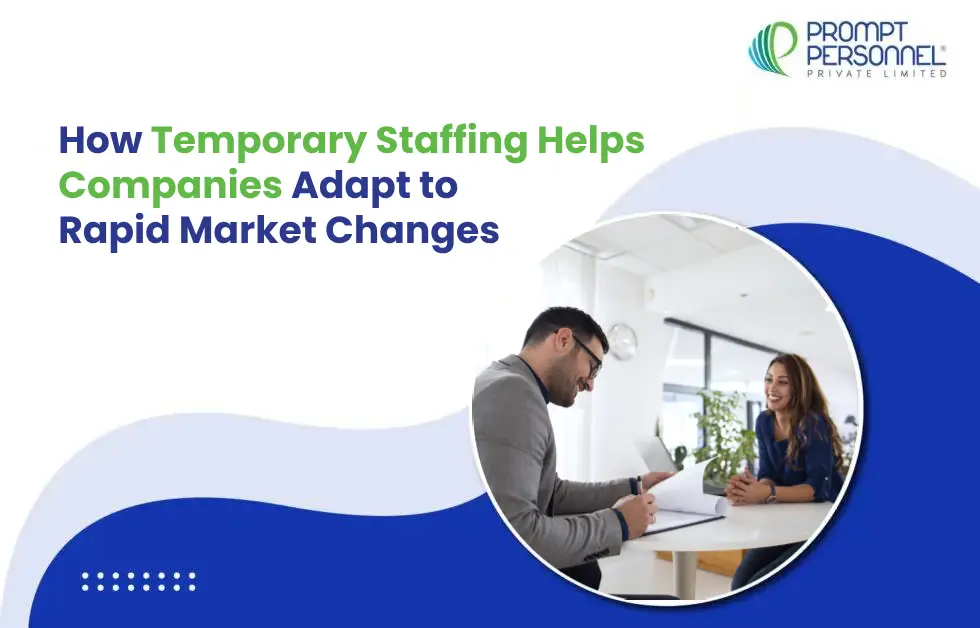
How Temporary Staffing Helps Companies Adapt to Rapid Market Changes
Firms need to be adaptable to remain competitive in the dynamic business environment of the times. Market forces change, industries change, and firms need to change quickly. Temporary staff services are where firms turn to fill the gap. Seasonal needs, unexpected expansion, or short-term projects are where temporary staffing solutions offer flexibility and affordability without the long-term obligation of hiring. Many temporary-services firms supply trained workers to other companies, making it easier for businesses to handle fluctuating workforce demands.
Companies worldwide, including those in India, leverage temporary staffing services to ensure operational stability while optimizing costs. In this blog, we’ll explore how temporary staffing agencies help businesses navigate dynamic market conditions and why temp staffing companies in India are an essential resource for workforce management, especially with emerging temporary staffing trends shaping the workforce ecosystem.
The Growing Need for Temporary Staffing Services
With an ever-changing business environment, companies must manage fluctuation in their workforce actively. Temporary staffing services allow companies to expand or contract as per need, so that they meet their production goals and customer demands effectively. Several factors drive the increasing reliance on temporary staffing agencies:
- Business Expansion and Market Uncertainty
Companies experiencing growth or entering new markets often face workforce challenges. Temporary staffing solutions enable businesses to hire talent on short notice without long-term financial commitments.
- Seasonal and Project-Based Demands
Industries such as retail, manufacturing, and hospitality see seasonal spikes in demand. Temp staffing companies in India provide businesses with on-demand staff to handle peak workloads and prevent productivity dips.
- Cost-Efficiency and Reduced Hiring Risks
Permanent employment entails massive recruitment campaigns, benefits, and training expenses. Temporary staffing agencies simplify the recruitment process by offering pre-screened, experienced professionals without the expense of permanent staff.
- Access to a Diverse Talent Pool
Temporary staffing services provide businesses with access to skilled professionals in different industries. Whether the company requires IT professionals, logistics personnel, or administrative personnel, temporary staffing ensures timely and effective placement.
- Reduced Burden on HR Teams
Employee hiring and management require a lot of HR work. Temporary staffing agencies bear this burden, managing payroll, benefits, and compliance, leaving the in-house HR team to concentrate on strategic objectives.
- Faster Response to Market Changes
With unpredictable economic fluctuations, businesses need to remain flexible. Temporary staffing solutions help companies adjust their workforce quickly to meet sudden market changes, minimizing disruptions.
Industries Benefiting from Temporary Staffing
1.Information Technology and Startups: Tech firms require developers, analysts, and cybersecurity experts for short-term projects. Temporary staffing agencies help IT companies secure top-tier talent without the hassle of full-time hiring, especially with the rise of rapid contract staffing in the tech ecosystem.
2.Manufacturing and Supply Chain: From assembly line workers to warehouse managers, temp staffing companies in India provide the workforce necessary to handle surges in production demand.
3.Healthcare and Pharmaceuticals: Hospitals and pharmaceutical firms depend on temporary staffing to fill critical roles, ensuring uninterrupted patient care and medical research progress.
4.Retail and E-commerce: Seasonal sales require additional customer service, logistics, and inventory control staff. Seasonal staffing arrangements allow retailers to be lean but not overhired.
5.Finance and Accounting: Tax season and year-end audits necessitate extra personnel. Temporary staffing agencies provide accounting firms with skilled professionals who can efficiently complete short-term tasks.
6.Real Estate and Construction: Building and property ventures typically entail professional labor for a short time. Temporary staff services enable firms to hire project workers without the inconvenience of long-term commitments.
7.Hospitality and Event Management: Hotels, restaurants, and event organizers often need temporary staff for peak seasons or large-scale events. Temporary staffing solutions allow these businesses to maintain quality service without long-term commitments.
How Temporary Staffing Enhances Business Agility
- Rapid Workforce Scaling
One of the biggest advantages of temporary staffing is the ability to scale up or down quickly. Businesses can employ seasoned professionals for short periods and operate seamlessly without delay.
- Reduced Hiring Time
It is time-consuming to find suitable talent. Temp agencies in India speed up the recruitment process by providing pre-screened professionals so that firms can hire the right person without experiencing long recruitment cycles.
- Compliance and Administrative Ease
Labor regulations, payroll, and compliance are a hassle. Temporary agencies take care of these, allowing companies to focus on core business.
- Uncertainty Management in Markets
Economic recessions, industry disruption, and unforeseen challenges can affect staffing needs. Temporary staffing arrangements provide a flexible model of workforce, minimizing risk during uncertain times.
Discover more about how temporary staffing can help your business navigate economic uncertainty and ensure business continuity in unpredictable times.
- Facilitating Business Continuity
Unexpected employee absences can impede workflow. Temporary staffing agencies offer a steady supply of quality labor, keeping businesses running without interruption.
Temporary staffing solutions also enhance workforce diversity and support professionals re-entering the job market.
- Supporting Business Innovation
Organizations experimenting with new products or entering new markets can use temporary staffing solutions to test workforce requirements before committing to permanent hiring.
Temporary staffing also supports diversity and inclusion. Many professionals, including women returning from career breaks, benefit from flexible employment opportunities that temporary roles offer.
Why Companies Should Partner with Temporary Staffing Agencies
- Market Intelligence and Industry Experience
Leading staffing firms understand hiring patterns and temporary staffing trends, helping companies connect with the right professionals.
- Workforce Management Support
Besides recruitment, temporary staffing agencies provide workforce management solutions to optimize performance and productivity.
- Access to Niche Talent
Certain industries require specialized expertise. Temp agencies in India offer niche experts without requiring permanent employment.
- Affordable Recruitment Strategy
Since temporary workers do not require long-term benefits, temporary staffing services provide an economical workforce model.
- Improving Productivity and Efficiency
Temporary staffing helps maintain productivity levels and operational efficiency during peak workloads or employee shortages.
- Adapting to Evolving Workforce Trends
With remote and hybrid work becoming standard, temporary staffing agencies help businesses adopt flexible hiring solutions.
Temporary Staffing: The Future of Workforce Flexibility
By partnering with temp staffing firms in India like Prompt Personnel, companies can remain efficient, reduce costs, and respond swiftly to market shifts. These temporary staffing firms offer the expertise and support required to build a flexible workforce strategy that adapts to modern market challenges.
For companies seeking stability, agility, and competitiveness, temporary staffing solutions are no longer optional—they’re essential.

Best Practices for Implementing Posh Policies in Your Organization
Developing a respectful and safe work environment for all workers is vital in creating a space where individuals feel safe, valued, and protected. Having strong POSH (Prevention of Sexual Harassment) policies is important in ensuring this is achieved. A well-structured POSH policy is a legal necessity and a powerful tool for promoting dignity, respect, and equality within an organization. This blog will discuss the best practices for implementing POSH policies, including the importance of POSH training for employees, compliance, and creating an environment where harassment is not tolerated.
Understanding POSH: The Basics
To effectively implement POSH policies, it’s essential to understand what POSH is all about and why it is needed. The POSH Act (Prevention of Sexual Harassment at the Workplace) was enacted to prevent and address cases of sexual harassment in the workplace. It requires employers to provide a safe and harassment-free environment, effective grievance redressal, and proper training for all employees.
Even as the POSH Act has formal requirements, the actual worth it provides is establishing a culture of respect and responsibility. A positive and detailed POSH policy establishes that all parties in the working environment are made aware of the behavior that can and cannot take place. The policy gives permission to employees to raise their voice against harassment and provides them assurance of a comfortable work environment with no fear of discrimination or misconduct.
Best Practices for Implementing POSH Policies
Implementing a POSH policy is not simply about creating a document and filing it away. To truly create a safe and respectful workplace, organizations must integrate these practices into the fabric of their culture. Here are some of the best practices to ensure the effective implementation of POSH policies:
1. Create Clear and Detailed POSH Policies
The initial action in adopting a POSH policy is to prepare an explicit and detailed policy document that defines sexual harassment, the procedures for reporting an incident, and the measures the organization will adopt to deal with grievances. The policy should be easy to understand and provide examples of what constitutes harassment. By defining clear guidelines, you eliminate ambiguity and help employees understand what behaviour is considered unacceptable.
The policy should also include the mechanisms available for reporting harassment, whether it’s through a POSH committee, human resources, or an external body. It should clearly outline how complaints will be investigated and resolved, ensuring confidentiality and impartiality throughout the process. A well-written POSH policy fosters trust and assures employees that management will take their concerns seriously.
2. Seek Support from Top Management
It is only possible to make a POSH policy successful if the senior management lends full support to it. Top leaders in the company need to lead by example and follow the POSH policy themselves. It conveys a strong message among the employees if the management not only supports the POSH policy but also proves committed to the prevention of sexual harassment. Involvement of the leadership can also ensure that there are the requisite resources, e.g., training and specialized personnel, to preserve the integrity of the policy. Senior management buy-in is effective in establishing a top-down response to the introduction of POSH policies. This guarantees that POSH is not perceived as an HR ritual but as part of the company culture and values.
3. Designate a POSH Committee or Officer
Appointing a POSH committee or officer is among the most successful means of making POSH policies work. Such a committee oversees the policy, addresses complaints, and makes sure that the company is compliant with the law. The POSH committee should be made up of representatives from different departments in the organization to ensure diversity and objectivity.
The committee should also be properly trained in dealing with sensitive complaints, providing a confidential and supportive environment for complainants. The officers or committee members should be capable of carrying out proper investigations and taking timely action when required.
4. Conduct Regular POSH Awareness Training
Regular POSH awareness training for employees is crucial for ensuring that everyone in the organization is aware of what sexual harassment is, how to recognize it, and how to report it. Training should cover the different forms of harassment, such as verbal, physical, and psychological harassment, and educate employees about the impact of such behaviour on both the victim and the workplace as a whole.
Training must also address reporting incidents of harassment, assuring employees that the process is confidential and that they will not be retaliated against for reporting. It is necessary to provide an environment in which employees feel at ease raising issues and assured that their concerns will be dealt with professionally and impartially.
5. Incorporate Online POSH Training for Employees
In today’s digital world, offering online POSH training for employees is becoming increasingly popular and essential. Online training programs provide flexibility and accessibility, making it easier for employees to complete their training at their own pace. This method is particularly beneficial for companies with multiple branches or a geographically dispersed workforce. It also allows employees to revisit the training materials as needed, reinforcing the lessons learned.
In addition, online training can be customized to fit your organization’s needs, giving it a more personal touch. For example, organizations can add case studies, quizzes, and interactive content to maximize employee participation and retention.
To explore a step-by-step guide on ensuring effective POSH awareness training and compliance, read our detailed blog on POSH Awareness Training: Steps to Ensure Compliance and Safety.
The Role of POSH Training in Building a Safe Work Environment
Successful POSH training is among the most critical weapons for developing a culture of respect and stopping sexual harassment in the workplace. This is why POSH training for employees is essential for the creation of a healthy and safe work environment:
1. Promotes Awareness and Understanding
POSH awareness training helps employees understand what constitutes sexual harassment and the different ways it can manifest. Many individuals may not realize that certain behaviours are considered harassment, especially when it comes to subtle forms like inappropriate comments or jokes. Training provides clarity on the issue, ensuring that everyone knows what is acceptable and what isn’t.
Through this knowledge, POSH training can avoid harassments from occurring in the first place. If an employee understands what is unacceptable behaviour, they are less likely to do it and more likely to call out someone who does.
2. Encourages Reporting and Transparency
One of the most important goals of POSH training is to get employees to report any cases of harassment without fear of retribution. If employees are trained in how to report harassment and are promised that their complaints will be dealt with confidentially, they are more likely to report. This transparency is vital for organizations to identify problems early and take corrective action before they escalate.
3. Fosters a Culture of Respect and Dignity
Regular training and awareness programs contribute to fostering a culture of respect where employees feel safe, supported, and valued. A respectful work environment leads to increased productivity, better employee morale, and greater job satisfaction. Employees are more likely to remain with an organization that prioritizes their safety and well-being.
Protect Your Workforce with Robust POSH Policies & Training!
×
Contact Us
Ensuring POSH Compliance in Your Organization
Compliance with the POSH Act is not a choice but an obligation for every organization. Compliance, however, is not merely following the law; it’s about having a safe and healthy environment where harassment is not accepted.
To ensure POSH compliance, organizations should focus on the following:
1. Create an Effective Reporting and Investigation Process
It’s important to have a well-defined procedure for dealing with harassment complaints. Employees must be aware of how to report an incident, whom to go to, and what will happen after a complaint is made.
The process must be fair, transparent, and confidential, ensuring that all complaints are treated seriously.
2. Conduct Regular Audits and Reviews
Organizations should regularly review their POSH policies and practices to ensure ongoing compliance. This includes conducting audits to check if the policies are being followed, whether the POSH committee is functioning effectively and whether employees are receiving the necessary training. Regular reviews can help identify gaps in the policy or its implementation, ensuring that any issues are addressed promptly.
3. Provide Ongoing Training and Refreshers
The training on POSH must not be done once. Workers must go through periodic training to keep them aware of any law or policy change within the company. Reminder courses also act as a refresher on how critical it is to have a workplace free of harassment and keep the workers focused and aware of their rights and responsibilities.
Enhance Workplace Safety with POSH Compliance
Having a wide-ranging POSH policy in place is an essential first step to designing a workplace that is secure, respectful, and inclusive. Organisations can ensure that everyone at work is safeguarded and treated with dignity by establishing specific policies, ensuring continuous training, and enforcing regulations. POSH training is pivotal to building understanding, avoiding harassment, and motivating workers to make a stand if they need to.
Expert POSH services may ease the process for organizations who are in need, ensuring compliance with POSH and developing quality training programs. Proper guidance and support can make your organization design a harassment free environment that everyone benefits from.
Prompt Personnel is a leading HR solutions provider, offering expert assistance in POSH compliance, training, and workplace policies to help organizations create a safe and inclusive work environment.
To learn more about our services, visit Prompt Personnel or contact us today!


