by Prompt Personnel | Jun 2, 2022 | Human Resources
HR departments face an uphill battle because they must cut HR costs while also boosting productivity and employee engagement. With super competitive markets and capricious economies, businesses are under incessant pressure to lower costs and maximize profitability. Human resources costs are among the unexpected costs that businesses may need to contemplate.
Here’s the good news! You can both reduce HR costs and boost employee engagement at the same time. Here’s how –
1) Making the right hires
When cost-cutting is taken into consideration, recruiting is one of the first things that is cut down. This is one of the first initiatives taken by businesses to reduce costs. Honestly, this may not be the ideal thing to do. This is the best time to figure out your recruitment process and to make sure that every person you hire adds value to your organization.
Recruiting becomes a costly affair when it is done incorrectly. It is an integral part of business growth, and poor hiring can directly affect employee motivation and engagement. If your company has a revolving door of undesirable recruits, it can directly impact staff morale and your employer brand.
Recruitment is an end-to-end process and where HRs should speculate as to what didn’t work and find solutions the same. Ask the right questions – Is it the appropriate skill set? Was it the person’s charisma? Cultural fit? Was there a gap in your hiring process that overlooked an important aspect of the role? Invest your time to sternly evaluate the overlooked gaps and how they can be avoided in future hires.
The hiring perspectives may vary from business to business as different industries demand different criteria that need to be fulfilled. The act of engaging others is closely associated with team building, collaboration, and fostering connections with colleagues and teammates. Hire passionate, committed employees who are culturally a good match for your company during the hiring process thereby stabilizing unnecessary HR costs.
2) HR Automation can change the game
Human resources automation (HR automation) employs software to automate and optimize repetitive and time-consuming operations to assist an HR department in personnel management. By deploying new-age HR Tech, HR services can boost productivity and bring value to the company by focusing on more complicated duties like strategizing initiatives that deliver a bigger business impact. The time spent on employee onboarding can be reduced considerably with HR software. In addition to providing HR leaders with candidate tracking, employee onboarding and offboarding tools, people analytics to aid decision-making, and an employee database, most good HR software also offers performance management tools.
Automation of HR processes will increase employee engagement by also allowing them to self-serve and manage their requests for annual leave, training, and expenses. As a result, employees have access to their HR files, meaning they can easily find the information they need, and they are in control of their personal HR experiences.
On successful implementation of the right HR Tech, expect huge cost savings and improved employee experience which will have a long-lasting impact on the organization.
3) Incorporate the Right Training Programs
Most cost-cutting strategies make learning and development the first casualties. On the other side, upskilling through learning and development can save HR costs while also increasing employee engagement in the long run. While reduced employee turnover is unquestionably a benefit of investing in training, it can also help you boost your productivity. This is true not only while the employee is at work, but also when an employee is absent or leaves; if a colleague has gotten the same training, it is easier for them to take over their responsibilities.
Could you transfer some staff training online if it is inevitable that L&D spending must be cut? Employees can get virtual training for a fraction of the expense of in-person classes using tools like LinkedIn Learning. Alternatively, enlist the help of some of your employees to create online tutorials, films, or instructions that can be shared with the rest of the company.
Evaluate the cost for everything. Identify the gaps in what demands manual attention and what can you automate. This will eventually help you reduce your HR costs to a great extent without impacting productivity and employee engagement.

by Prompt Personnel | May 21, 2021 | Human Resources
With the rising digitization, every business needs to focus on their business activities and drive innovations that can lead to their growth and profitability. It is all about who knows about your business in the digital era rather than who you do. Many companies have already adopted the innovations and are staying ahead in competitive marketing by utilizing outsourcing services.
Outsourcing means hiring a third-party organization to carry out services that were previously performed in-house. Organizations can lead their tasks in the hands of specialist providers to sub-contract some or all non-core HR activities, thus creating an opportunity for the businesses to focus on their profits and other core areas of the businesses’ growth.
-
What is the role of outsourcing?
Outsourcing provides businesses with an opportunity to tap into pools of employees according to their needed position in a talented company. It might turn out to be helpful for that position where your internal resources might be limited. While a third party handles the whole recruitment process, it can benefit your business from time and cost-effectiveness.
-
Why should businesses consider HR outsourcing?
Organizations are now modifying by being relevant in the industry. They must keep improving the total value their customers generate from their services or products and carry on with innovation or some tactics that will keep their customers highly satisfied with their business offerings.
Outsourcing HR services augments the growth of your organization and a healthy, qualified workforce. HR outsourcing is a contractual agreement between an employer and an external third-party provider. In contrast, the employer (your business) gives the management and responsibility for some HR functions to the external provider.
Depending on your business capabilities and requirements, you can profitably utilize outsourcing services.
HR Outsourcing companies drive many benefits for businesses. Significant benefits are INNOVATION and ORGANIZATIONAL GROWTH.
Innovation and organizational growth can go hand in hand, and now it is possible due to outsourcing.
HR outsourcing agencies have superior knowledge and information of the market and are experts in hiring employees by marketing the required positions your business needs. It is crucial to keep you updated with the trends and proceed with them in a constantly evolving world. The experts provide and utilize the latest insights to implement a successful strategy for hiring employees without extra resources.
Outsourcing service providers have data and benchmarks on what an employee is compatible with. This means your business spends less time on marketing strategies for job openings that are less likely to generate results. Instead, of focusing on the previous approaches, it is better to use innovations in your business with tested procedures designed that create new business opportunities to fulfil it. Outsourcing would carry the whole hiring process, so you should not have worries about it. You can accomplish activities that would grow your organization in measuring and achieving the results you set for.
Prompt Personnel is a leading HR outsourcing company in PAN India, with HRIS (human resources information systems) assists to improve human resource management in your organization.
Prompt Personnel has a team of experts in the fields of recruitment and provides standardized and hr solutions.

by Prompt Personnel | May 20, 2021 | Human Resources
Labour laws play a crucial role in shaping a fair, safe, and balanced workplace. They ensure that employees receive proper wages, fair treatment, and safe working conditions — all while supporting the smooth functioning of businesses. The importance of labour law lies in its ability to protect both employers and employees by maintaining harmony, productivity, and compliance within the organization.
Why Are Labour Laws Important?
The Indian Government enforces labour law compliance to promote economic and social justice for workers across industries. These laws provide clear guidelines on fair wages, working hours, safety measures, and welfare facilities.
For employers, the importance of labor laws is equally vital — they help prevent disputes, build trust, and ensure smooth business operations. For employees, they guarantee respect, equality, and dignity in the workplace.
- Fair Wages and Equal Pay
One of the primary aspects of labour law is ensuring fair compensation. Employers are legally bound to pay at least the minimum wages set by the government. Fair pay motivates employees, reduces turnover, and boosts morale — leading to a more productive work environment.
- Health and Safety Measures
The importance of labor also lies in providing a safe and healthy work environment. Labour laws include detailed provisions to prevent workplace hazards and protect employees’ well-being. Employers must ensure proper safety equipment, hygienic conditions, and quick access to healthcare facilities for their workforce.
- Regulated Working Hours
With the rise of digital and remote work, maintaining a healthy work-life balance has become essential. Labour laws define reasonable working hours and rest periods to prevent overexertion. These rules help employees stay motivated and maintain productivity, ensuring that employers get the best performance without burnout.
- Strengthening Employer-Employee Relations
Understanding the importance of labour laws helps build a harmonious relationship between employers and employees. When companies treat their workforce fairly, employees become more loyal and aligned with business goals. This mutual trust and respect drive better collaboration and long-term success.
- Enhancing Employee Retention
Labour laws guide organizations in maintaining a positive work environment where employees feel valued and secure. By following these laws, companies can reduce conflicts, improve communication, and retain skilled talent. High retention not only lowers hiring costs but also enhances a company’s reputation in the market.
- Preventing Workplace Discrimination
Another key importance of labor law is promoting equality. These laws prohibit discrimination based on age, gender, race, religion, caste, or ethnicity. Every employee deserves equal opportunities and respect, ensuring that the workplace remains inclusive and performance driven.
- Promoting Business Success
Labour laws are not only beneficial for employees but also for employers. A compliant, fair, and transparent work culture attracts top talent, enhances productivity, and fosters business growth. By adhering to labour law compliance, organizations can avoid legal disputes and strengthen their credibility.
Guidance from Labour Law Experts
Understanding and implementing labour laws can be challenging due to their complexity and frequent updates. This is where expert consultants play an important role.
At Prompt Personnel, we specialize in providing end-to-end labour law consultancy, including compliance audits, payroll regulatory services, legal updates, and advisory support. With our pan-India presence and deep expertise, we help organizations stay compliant while maintaining a motivated and secure workforce.
Conclusion
The importance of labour laws cannot be overstated — they form the foundation of a responsible, fair, and productive work culture. Businesses that follow these laws not only protect their employees but also pave the way for sustainable success.
Partner with Prompt Personnel to ensure your organization remains fully compliant while fostering a healthy, motivated, and future-ready workforce.
by Prompt Personnel | Dec 23, 2020 | Human Resources
1. It has been a difficult year not just for working women but also for men, There has been a shift in the workplace and patterns, blurring lines between work hours and home. How have you managed the work-life balance during the pandemic?
Yes, it has been a difficult time for everyone as no one might have thought they would face these days, it was difficult in the beginning as all was new for us and it took time to sink in but gradually we accepted the new norm and sulk into it. Again, there was a challenge as there were no domestic help around where one has to do all the chores related to housework and also at the same time not let your work suffer. But I guess after a weeks’ time things started to settle in and we manage to come out of it with a brave heart and a new routine was set.
2. What role have you played in supporting teams during this time, both men and women?
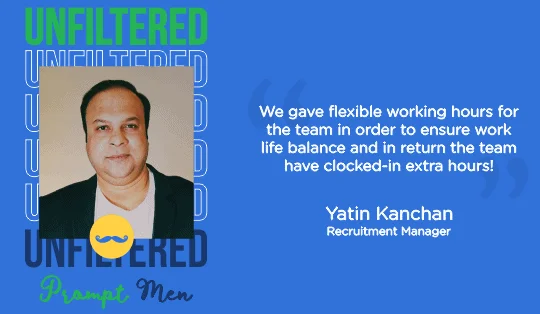
Yes, as it was difficult to accept and understand how one would survive in this challenging time where there were so much negativity spread across and heart filled with fear, these are the times when being the leader of the team you need to step-up and set an example in front of the team and hold your emotions and come with the solutions for the problems faced by the team and lead the team keeping the sentiments in mind. For eg (in the initial days of complete lockdown it was difficulty for lot of people to manage their daily groceries and essential stuff where some time they need to get down in working hours we understood the situation and allowed them those brakes so that we can maintain work life balance and in return they have clocked extra hours to balance work).
3. What do you think about gender disparity at the workplace today? What steps would you personally take to make a difference here?
I believe in equality, an fortunately my organization thinks on the same line and it has been followed over years, although in recruitments, you will find more females compare to men so we need to maintain that balance across and have an open approach keeping the integrity of the team in intact. Also lot of our clients are looking for gender diversity and often consult us on the same.(Research has found that you can attract more diverse candidates through more carefully worded job postings, offering work schedule flexibility, using assessments, and tapping into novel candidate pipelines also AI-powered software technology is enabling recruiters and talent acquisition professionals to increase diversity through automated screening)

by Prompt Personnel | Dec 16, 2020 | Human Resources
- It has been a difficult year not just for working women but also for men, There has been a shift in the workplace and patterns, blurring lines between work hours and home. How have you managed the work-life balance during the pandemic?
Many people across the country are struggling to maintain their work-life balance because of the pandemic. Workplaces are going fully or partially remote, kids are home from school, businesses are closed, and normal events and gatherings are restricted or canceled. Initially, it was very challenging for me because I had never experienced work from home condition. It was very difficult to manage my daily routine work at home.
Despite the challenges, it’s possible to stay healthy and positive. Here I have learnt few ways to improve my work-life balance while managing the new remote pandemic environment.
- Created working environment at home, which helps me to focus on my day to day activity.
- Created daily schedules which help me to build equal balance between work and personal life.
- Focus on my Mental Health, because it help me to calm during the pandemic by doing meditation and yoga.
2. What role have you played in supporting teams during this time, both men and women?
I have Increased the frequency of virtual meetings, calls with my team in both ways, professionally and personally. It helps me to build good relationships with my team professionally and personally. We usually did Chai pe samvaad with the Team so that they feel relax and energetic.
3. What do you think about gender disparity at the workplace today? What steps would you personally take to make a difference here?
Steps needs to be taken to promote gender equality at workplace.
- Positive company culture. A gender-equal work environment where all employees feel respected and valued creates an overall more positive workplace for all of your employees. When you have a gender-diverse environment, your employees will likely notice that their coworkers have talents and strengths they don’t possess themselves. The appreciation for these differences will help promote an environment of respect among the team.
- More innovation and creativity. People of different genders bring unique talents, strengths and skills into the workplace, which can improve collaboration and result in a stimulating and creative environment. In fact, companies often find that a gender diversity can lead to greater innovation within the workplace.
- Build a great reputation. By being intentional about promoting gender equality in the workplace, you’ll foster a great company reputation with the outside world. People who have similar values will want to work for you, and with happy employees you’ll have a positive and productive workforce.
- Improved conflict resolution. Strong communication skills among employees is essential for company-wide success. People of different genders naturally communicate differently, with some preferring to communicate problems directly and others work as peacemakers. When you combine these different communication styles in one work environment, you can more easily achieve conflict resolution.