
by Prompt Personnel | Dec 3, 2019 | Human Resources
Labour laws are the body of rulings pertaining to working people and their organizations, including trade unions and employee unions, enforced by government agencies. Individual labour laws involves concerns for employees’ rights in the workplace.
Labour laws have a uniform purpose; they protect employees’ rights and set forth employers’ obligations and responsibilities. They also have multiple functions; the primary functions of labour laws are to provide equal opportunity and pay, ensure employees’ physical and mental well-being and safety, and workplace diversity.
Necessity and Importance of Labour Law:
- Improves industrial relation i.e. employee-employer relations and minimizes industrial disputes.
- Protects workers from exploitation by the employers or management
- Helps workers in getting fair wages
- Minimizes labour unrest
- Reduces conflicts and strikes etc.
- Ensures job security for workers
- Promotes favourable environment conditions in the industrial system
- Fixes rest pauses and work hours etc.
- Provides compensation to workers, who are victims of accidents.
With labour laws, a company can create a productive work environment that elevates business growth.
Labour laws play a significant and vital role in the corporate sector. The laws exist so that employees are treated appropriately in work environments and so their rights as an employee are protected. They ensure that employers are valued for their expertise and are compensated accordingly.
Although employees are expected to adhere to their agreement in a work contract, they still cannot be subjected to ill-treatment. One cannot, in any case, harass an employee physically, mentally or emotionally at work. Gender bias, sexism and racism isn’t be allowed to practice. Equality is given utmost priority, and credibility, skill sets, and hard-work of an employee should be the only criteria for promotions and rising pay-scales.
Company policies should not discriminate or devalue employees, but rather elevate the employee experience.
Through benefits and skills development plans, companies can ensure that they are in line with these laws. Employees should be able to enjoy the leaves, breaks and other company benefits. Skills development is now a priority for companies. In this way, when employees enrich their skills, the company promotes from within.
Labour laws being in place is a win-win situation for both parties, as there is equal protection given to both. It also familiarizes the employee and especially the employer with what is right and wrong and what can get them in legal trouble. It is important to be aware of all the labour related laws if you own a business. It not only protects you from getting into any legal trouble related to labour but also contributes to better employee retention and performance, and hence, growth and success of the organisation. Ultimately, labour laws work for both – employees and the employer, ensuring a successful working relationship.
Know more about Labour Law Advisor & Compliance Consultants
Importance of Labour Law Compliance
Labour law in India is a complex and dynamic area of law that regulates the rights and obligations of employees, employers, and trade unions in the workplace. In recent years, the importance of labour law has come to the forefront as issues such as worker exploitation and wage inequality have gained greater attention. As a result, there has been increased scrutiny and debate over the role of labour law in protecting workers’ rights and promoting fair and equitable working conditions.
A successful company or organization is not solely dependent on a good business idea or a skilled leader. Instead, it requires internal motivation and strength. The employees, or foundation, of the company, play a crucial role in its success, just like the cement that holds a building together. The purpose of labour law is to create a fair working environment for all parties involved and to promote the welfare of workers and the stability and prosperity of society as a whole.
It is crucial for businesses to ensure that their employees feel safe, valued, and supported. One way to do this is by following labour laws, which are a set of guidelines established by the government to protect the rights and well-being of workers.
Why Do We Need Labour Laws?
Labour law is designed to safeguard the rights and interests of workers, both as individuals and as a collective, by regulating the employment relationship between workers and employers. It strives to level the playing field between these two parties, ensuring that workers are not unfairly dismissed or treated unfairly in negotiations about their working conditions.
The ultimate purpose of Labour Law is to promote worker empowerment and seeks to establish workers as equal partners in the employment relationship.
Significance of Labour Law Compliance
Labour laws are important in the business world because they ensure that employees are treated fairly and their rights are upheld in the workplace. Staying compliant with labour law can also help you in today’s dynamic business environment. These laws also help to ensure that employers are properly compensated for their skills and contributions.
Here is the importance of Labour Laws:
- Prevent exploitation of workers
- Ensure fair wages
- Reduce conflicts and strikes
- Provide job security
- Create favourable working conditions
- Establish rest and work periods
- Provide compensation for workers who are injured on the job.
Labour laws are complex and comprehensive, and businesses need to comply to avoid potential risks. To ensure compliance, many companies choose to work with labour law consultants to manage their obligations. Non-compliance can have serious consequences, so businesses need to take this aspect of their operations seriously. These labour law consultants can also help you save time & money as well as help you manage your workforce and employees more efficiently
The purpose of Labour Laws is to help companies create a productive work environment that supports business growth.
There are many service providers available, but only a few can provide strong and reliable solutions like those offered by Prompt Personnel. We are a team of labour law experts that have an experience of 30 years in the industry. Here are some suggestions for how companies can have a sound understanding of the importance of Labour Legislation and comply with them:
Stay Informed and Updated About The labour laws That Apply to Your Firm
Labour laws vary depending on the location and type of business. For example, the laws that apply to manufacturing firms may be different from those that apply to IT companies.
Companies need to understand which laws are relevant to their business and to stay up to date on any changes or updates to these laws.
Workplace Safety
Workplace safety encompasses both physical and mental well-being. Employers are expected to maintain professional and respectful decorum when addressing any mistakes made by their employees. It is the responsibility of the company to take necessary precautions to ensure the physical safety of its employees. In addition, superiors need to know how to handle their employees healthily and respectfully.
A safe and positive work environment can increase productivity and motivation among employees, which is essential for the success and growth of the company.
Women ‘s Safety
Several laws and regulations are in place to protect women and prevent sexual harassment in the workplace. These measures may include the establishment of an Internal Complaints Committee and voluntary actions taken by companies such as providing women-only transportation.
Employment Contract
An employment contract or agreement helps to define and clarify the terms of employment and makes it clear to employees what their rights are. It also serves as evidence that the company has provided employees with information about their employment and that the employee has agreed to these terms. This can help to reduce confusion and potential legal issues for both the employee and employer.
An Employee Handbook can also be useful in providing employees with clear and concise information.
Checklist Of Labour Law Compliance
A company needs to ensure that it fully comprehends the importance of Labour Legislation. To help with this, it can be useful to have an updated compliance checklist or calendar to keep track of events and deadlines and to ensure that nothing is missed. This can help the company avoid delays and ensure that it is meeting all of its obligations under labour laws.
Audits to Study Internal Labour Law Compliance
Internal audits for labour law compliance involve examining the company’s practices for signs of job discrimination based on factors such as race, religion, gender, and so on. Companies need to conduct regular self-audits to ensure that they are not engaging in discriminatory practices, as this is both morally wrong and can be costly for the company.
Provident Fund, Gratuity and Other Benefits:
There are certain benefits that companies are legally required to provide to their employees. These benefits are specified by the government and may vary based on factors such as the size of the company, the employee’s salary, age, and length of service. It is crucial for companies to be aware of these requirements and to ensure that they comply.
When the government establishes rules and regulations, it is setting the minimum standards for the safety and well-being of employees that must be met by all companies.
In addition to meeting legal requirements, companies can take additional steps to ensure their employees’ safety, well-being, and happiness these actions can provide motivation and a sense of value to employees and help set a company apart from its competitors.
These steps do not have to be costly or complicated; they can be as simple as respecting an employee’s vacation time and not contacting them unless it is an absolute emergency, or recognizing that productivity is more important than the number of hours spent in the office. Companies can create a positive and satisfying work environment by adopting a “smart work” approach and valuing their employees.
Find The Right Labour Law Compliance Management & Advisory Service
Professional labour law consulting firms provide excellent compliance solutions to keep a company safe from legal issues related to labour laws. Utilize the expertise of our HR professionals, recruiters, and Labour Law Consultants to help your organization achieve success and growth. We offer a variety of services, including Temporary Staffing, Permanent Recruitment, Labour Law Compliance and Advisory, Talent Management and others.
Why do I need to outsource my organization’s Labour Law Compliance & Advisory service? How will it help me?
With the ever-changing employment laws, it becomes a challenge for companies to keep themselves compliant. These organizations need reliable Labour Law compliance services from an experienced provider. Outsourcing from an experienced firm such as Prompt Personnel Pvt. Ltd can ensure compliance without incurring hiring costs and maintaining a separate department for it There are heavy penalties and persecution from legal authorities if an organisation is non-compliant. To avoid such losses expert advice can help businesses immensely. Our clients find that our statutory compliance & labour law consultancy services are an ideal solution to be compliant in all aspects of type answer statutes and labour laws. As the leading labour law advisor & consultant in India, we offer compliance services that perfectly meet your organization’s requirements.
What is the difference between Legal compliance and Labour Law Compliance?
Labour Laws are a set of compliances which lay down the treatment of the labour workforce at the workplace. Labour law compliance is acting in accordance with or complying with a requirement, rule, or command. It is the mandatory rules and regulations which the companies have to follow with respect to the labour workforce. These are a set of rules and conditions set for employment. Legal compliance can be broken down into two parts: legal and compliance. Labour law compliance is acting in accordance with or complying with a requirement, rule, or command. Legal compliance takes a broad interpretation and includes national, provincial, and local legislation, codes, standards, and company policy. Labour Law Compliance is the Two mandatory rules and regulations which companies have to follow with respect to the labour workforce. These are a set of rules and conditions set for employment.
Where can I get answers to queries related to PF/ ESIC/ LWF?
- If you are an employee: [email protected]
- If you are an employer: [email protected]
- You may also make a call on at our toll-free number: 1800118005
- For any further details, you can contact us at [email protected] or call 869 290 0881. We can help your
- establishment to get registered under PF, and handle end-to-end PF process.
- For ESIC – https://www.esic.nic.in/Publications/FAQ_ESIC_181210.pdf
- We can help your establishment to get registered under ESIC, and handle end to end ESIC process. LWF- It is a kind of financial aid for labourers to improve their working conditions, social security, and standard of living. The Labour welfare fund act includes various services, benefits, and facilities for the employee by the employer. Both the employer and the employee contribute towards this fund. But the rate and frequency of contribution and the due date differ from state to state.
- Licenses under Shop & Establishment Act, Factory Act, Trade Act
Can Prompt Personnel help organizations in Obtaining / amend / Renewing various Licences under Shop & Establishment Act, Factory Act, and Trade Act?
Yes, our expertise, liaising with Local Authorities and Pan India Presence will facilitate you to get this License / RC hassle-free. For any further details, kindly contact us at [email protected] or call 869 290 0881

by Prompt Personnel | Nov 9, 2019 | Human Resources
The Indian E-commerce industry has been booming with every passing year and is expected to surpass the e-commerce market of the US, becoming the second-largest e-commerce market in the world by 2034. India’s growth in this sector was recorded as US$ 38.5 billion in 2017 and
is estimated to reach US$ 200 billion by the year 2026. The factors that have played a major role here are the surge in internet penetration, rise in income and smartphone sales. Now, after substantial changes in India’s taxes and policies, like the GST and demonetization, the e-commerce industry has become a formal sector, with popularity and a rise in flexi-staffing jobs, too. The formal flexi-workforce also formed a whopping 91 % of the total workforce in the e-commerce sector by 2018, which is the highest among other sectors.
Flexi staffing makes for a large portion of the e-commerce employee base. Especially, due to higher demand during the sale period of festivals and celebrations, in the latter half of the year, these statistics only keep rising. A minimum of 40% more flexi hiring is predicted to happen during the festive period ahead, to meet the high demands and tight schedules with ease and professionalism. Safe to say, seasonality of business is facilitating the growth of e-commerce and hence, of flexi-working. A flexi staffing model also comes with the advantage of combating the issue of immediate workforce supply and increasing attrition rate that arises during the packed festive season in the e-commerce business. Moreover, salaries for e-commerce workforce are rising due to urgent and high demand and limited talent supply. Flexi-staffing is believed to resolve this dilemma too.
To say the least, the e-commerce industry in India is flourishing day by day, year by fear, aiming to be the largest globally; and flexi staffing is ready to see that positive and record-breaking growth, willing to back it up for years to come.

by Prompt Personnel | Oct 9, 2019 | Human Resources
Objective
The Objective of the Act is to provide protection against sexual harassment of women at workplace and also to prevent and reduce the number of complaints against sexual harassment and other connected and incidental issues.
Origin of POSH Law
The Sexual Harassment of Women at Workplace (Prevention, Prohibition and Redressal) Act, 2013 is a legislative act in India that seeks to protect women from sexual harassment at their place of work. It was passed by the Lok Sabha on 3 September 2012.
Applicability
The Prevention of Sexual Harassment (POSH) at workplace Act is applicable to every workplace, establishment, company or organization employing 10 or more employees (full time, part-time, interns or consultants included) irrespective of the location or nature of the industry. It is applicable across India to all establishments, governments and private. Even domestic women workers are also given protection under the purview of this Act.
Defining Sexual Harassment under POSH
The Act defines sexual harassment quite widely, and also includes ‘quid pro quo’ harassment, such as promises of advancement in return for sex.
Sexual harassment does not have to involve physical contact but could, for example, include sexual remarks, sexually explicit pictures or screensavers and inappropriate advances made directly or via social networking sites.
Prevention of SEXUAL HARASSMENT (POSH)
Sexual Harassment is defined as an unwelcome sexually determined behaviour (whether directly or by implication) such as:
• Physical conduct and advances
• A demand or request for sexual favours or making sexually coloured remarks or
• Showing pornography or
• Any other unwelcome physical, verbal or non-verbal conduct of sexual nature
• The harassment in relation to or connected with any act or behaviour of sexual harassment as follows amount to serious misbehaviour and the same is required to be viewed seriously
• Implied or implicit promise of preferential treatment in her employment or
• Implied or explicit threat about her present or future employment status
Prevention of Sexual Harassment (POSH) at WORKPLACE Act
The Act utilises the concept of the ‘extended workplace.’ In addition to the office of the employer or employee, any place visited by the employee arising out of or during the course of employment, including transportation provided by the employer for the purpose of commuting to and from the place of employment, will also constitute a workplace.
Further, social settings endorsed or financed by the employer are also considered a workplace under POSH law.
Establishing a mechanism to address POSH-related complaints
If an organisation wants to be POSH compliant, it must have a mechanism for employers to address complaints relating to sexual harassment.
This channel is known as the Internal Complaints Committee (ICC) or Internal Committee (IC).
Reporting requirements under POSH Law
The IC must also prepare an annual report for submission to the employer and the local labour district office. This mandatory report must include:
• Number of cases received and resolved
• Number of cases pending for more than 90 days
• Actions taken by the employer
• Number of workshops or awareness programmes undertaken.
There is also an obligation under the Act for the employer to include this POSH law-related annual report in the company’s annual report.

Non-Compliance
Non-compliance to POSH act will result in heavy monetary penalty, additional damages and company license cancellation.
The Ministry of Corporate Affairs has made it mandatory for all private companies to make disclosure of compliance under “POSH Act” through their Annual Board Report.
“Feminism is not about making women stronger. Women are already Strong , it’s about changing the way the world perceives that STRENGTH”
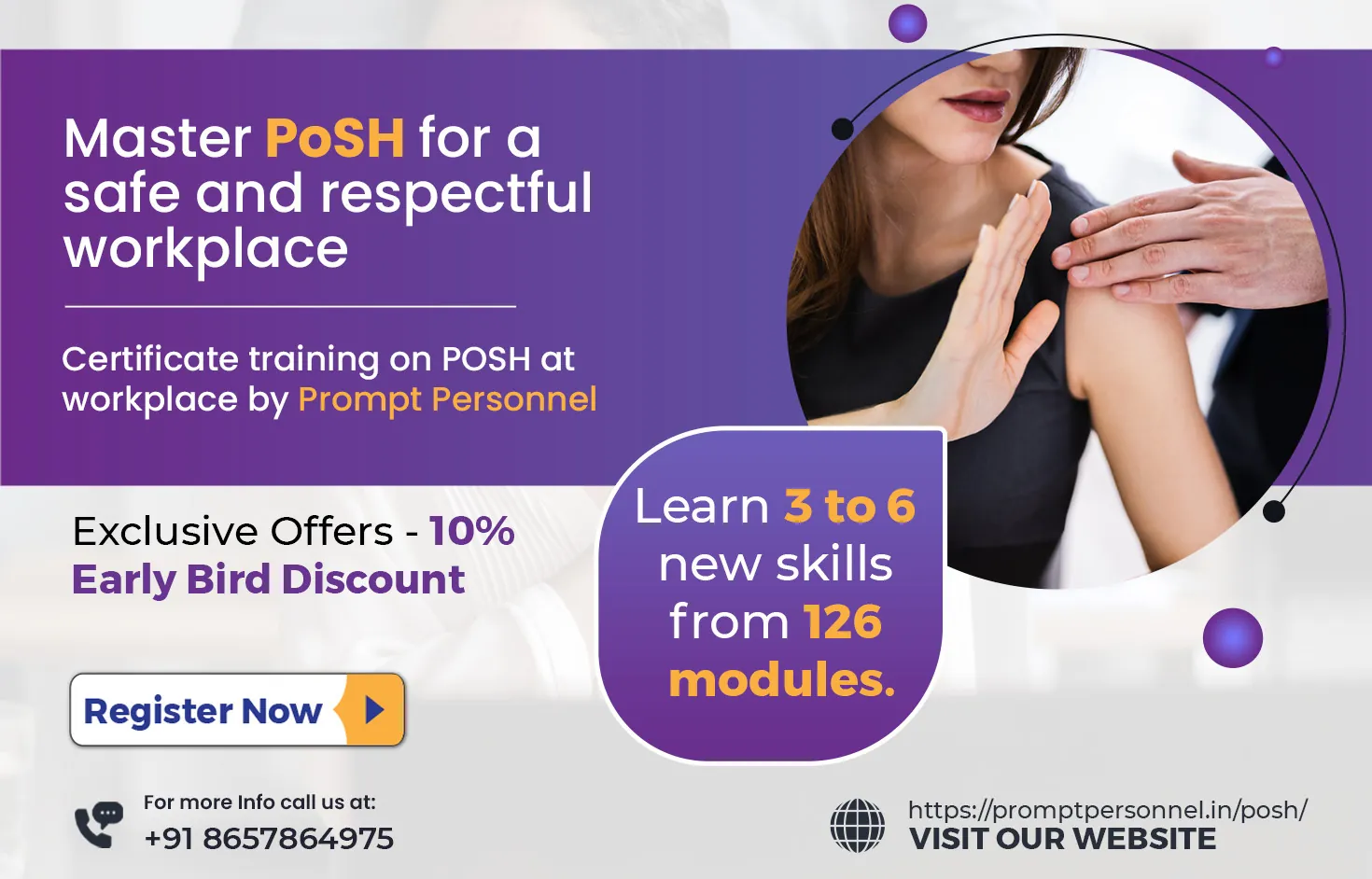
The need for a PoSHCertificate- A PoSH
Certificate showcases proficiency in implementing workplace policies related to preventing sexual harassment. It’s evidence of understanding laws, creating safe environments, and supporting victims. The PoSH Certificate is a government-recognized certification, making it a valuable professional asset. Employers value it for ensuring compliance and promoting a respectful workplace culture. The PoSH Certificate can be added to a resume, highlighting an individual’s commitment to creating a safe and respectful work environment.
Why be a PoSH trainer?
Becoming a certified PoSH trainer offers a rewarding opportunity to make a tangible difference in creating safer workplaces. As a PoSH trainer, you’ll have the chance to educate others on important legal requirements, empower individuals to recognize and address sexual harassment effectively and contribute to building a culture of respect and dignity within organizations. As a PoSH trainer, you play a crucial role in promoting awareness, fostering empathy, and equipping workplaces with the tools needed to prevent and address harassment. Your efforts contribute to creating a more inclusive and harmonious work environment for all.
What you need to do to become a PoSH Trainer
To become a PoSH-certified trainer, you’ll need to complete specialized training programs approved by reputable institutions. These programs cover key areas like understanding the PoSH Act, managing harassment complaints, leading awareness sessions, and ensuring policy implementation. After finishing the training and passing the assessment, you’ll receive certification as a PoSH trainer, enabling you to educate others on preventing and dealing with sexual harassment at work.
Announcing: The Certificate course on PoSH at the workplace!
Join us for a comprehensive training program on the Prevention of Sexual Harassment (PoSH) Act. Our course covers legal essentials, real-life scenarios, and practical strategies for ensuring compliance. Gain the expertise to nurture a secure and respectful work environment.
Why Prompt?
Benefit from our extensive experience in promoting PoSH compliance and safe workplaces nationwide. Let us equip you to cultivate dignity and security within your organization. Our comprehensive PoSH training program covers the legal essentials of the PoSH Act, explores real-life scenarios, and equips you with practical strategies to ensure seamless compliance.
What is a PoSH Certificate?
A PoSH (Prevention of Sexual Harassment) Certificate is a formal document awarded to individuals who complete training on preventing and addressing sexual harassment in the workplace. This certification educates employees, managers, and HR professionals about the legal framework, rights and responsibilities, redressal mechanisms, and preventive measures related to sexual harassment, ensuring a safe and respectful work environment. Prompt Personnel’s PoSH Certificate program includes in-depth training sessions, expert guidance, interactive workshops, and certification to demonstrate a commitment to maintaining a harassment-free workplace.
How to become a PoSH Certified Professional?
To become PoSH certified, individuals must complete a recognized training program on the Prevention of Sexual Harassment, which includes understanding the legal framework, rights and responsibilities, complaint handling procedures, and preventive measures. Prompt Personnel offers a comprehensive PoSH Certificate program with in-depth training sessions led by experienced trainers, interactive workshops, and expert guidance. Upon successful completion, participants receive a PoSH Certificate, demonstrating their commitment to maintaining a safe and respectful workplace.
Who Should Attend?
This program is tailored for HR professionals, compliance officers, legal advisors, and internal committee members. This PoSH program will equip you with the knowledge and strategies to develop robust policies, implement effective grievance redressal mechanisms, and foster a culture of respect and inclusion.
Course Details:
Our program comprises 20 hours of training delivered through weekly sessions, each lasting 2 hours, conveniently scheduled over weekends. Additionally, we offer a focused 4-hour course as part of our comprehensive training offerings.

by Prompt Personnel | May 7, 2019 | Human Resources
Introduction
In such fast and turbulent times in the business environment, employee training programs are no longer viewed as just a luxury but a necessity. This clearly explains why training is important in an organization, as these programs improve individual employee skills while ensuring the overall growth and success of the organization. Companies nurture a culture of continuous employee growth and development by using structured workplace training programs. Skill enhancement, professional development, upskilling initiatives, and systematic training of personnel further equip employees to perform effectively in their roles and adapt to changing industry dynamics.
Organizations that invest in staff development understand the long-term benefits of training and development to organizations, including improved performance, higher retention, better employee satisfaction, and increased productivity. With focused training and development initiatives, companies gain a stronger competitive edge in their respective industries.
In this blog, we will explore the multifaceted benefits of training and development in an organization, for both employees and the organisations that invest in them.
1. Improvement in Employee Performance
One of the most direct outcomes of a training and development program is improving employee performance. Employees who undergo regular training gain confidence in handling tasks more efficiently. Equipped with the right knowledge and skills, they are better prepared to meet workplace challenges and enhance productivity. Training programs help employees refine their role-specific skills, enabling them to contribute more effectively to teams and departments.
Workplace training programs also support professional development by improving problem-solving and decision-making abilities. When employees feel capable and supported, their overall performance improves significantly. For businesses, investing in employee development enhances operational efficiency and delivers measurable performance improvements—one of the keys benefits of training and development to organizations.
2. Addressing Skill Gaps
One of the most critical challenges organisations face today is the presence of skill gaps within the workforce. Structured employee training programs help bridge these gaps by providing employees with access to modern tools, technologies, and industry best practices. This may include technical training, leadership development, or functional skill enhancement through continuous training of personnel.
By addressing skill gaps proactively, organisations not only improve workforce performance but also build agility. Versatile employees can be redeployed into new roles as business needs evolve, strengthening long-term organisational success. In today’s competitive environment, continuous skill upgrading highlights why training is important in an organization and why staff development plays a crucial role in sustained growth.
3. Talent Retention
There is a strong correlation between employee training initiatives and talent retention. Organizations that invest in employee development create a more loyal and engaged workforce. When employees feel valued and see opportunities for growth, they are more likely to remain with the organization over the long term.
Personal and professional growth through training programs reduces employee turnover and increases job satisfaction. Employees involved in ongoing learning feel that the company is invested in their future, which leads to higher engagement levels. Retaining skilled employees not only reduces recruitment costs but also ensures that institutional knowledge and expertise continue to grow internally—one of the significant benefits of training and development in an organization.
4. Adapting to Industry Changes
Rapid technological advancements and market shifts require organisations to continuously prepare their workforce for change. Ongoing employee development through workplace training programs ensures employees stay updated with the latest industry trends, tools, and methodologies.
Industries such as IT, healthcare, and manufacturing experience constant evolution, making training essential to remain relevant. Training programs enhance adaptability and flexibility, enabling employees to grow alongside organisational and industry changes. This adaptability reinforces why training is important in an organization, ensuring businesses remain competitive and responsive to market demands.
5. Improvement in Employee Satisfaction
Training and development programs significantly impact employee satisfaction. Continuous learning opportunities increase engagement and provide employees with a sense of purpose and fulfillment. A satisfied workforce contributes to a positive work culture, higher morale, and improved productivity.
Professional growth and upskilling initiatives help organisations foster a culture of learning and development. When employees feel empowered and supported, they perform better and contribute meaningfully to organisational goals. Employee satisfaction remains a cornerstone of a motivated, loyal, and high-performing workforce—one of the enduring benefits of training and development to organizations.
6. Encouraging Innovation and Creativity
Employee development plays a vital role in fostering innovation within an organization. Employees who continuously learn are more likely to think creatively and propose innovative solutions. Training programs focused on critical thinking, leadership, and problem-solving help cultivate an innovation-driven mindset.
Organisations that prioritise staff development remain progressive and competitive. By nurturing new skills and ideas internally, companies often lead innovation within their industries. Employees feel more confident sharing ideas when they know their growth is supported, reinforcing the broader benefits of training and development in an organization.
7. Supports Succession Planning
Training programs also strengthen succession planning efforts. Organisations that invest in employee development build a strong internal talent pipeline capable of stepping into leadership roles when needed. Leadership training and professional development prepare employees for future responsibilities, ensuring smoother transitions and minimal disruptions.
Investing in long-term employee growth through training ensures future leaders are ready to guide the organisation forward. Effective succession planning enhances organisational stability and continuity, highlighting another key reason why training is important in an organization.
8. Encouraging a Learning Culture
Companies committed to training and development naturally foster a strong learning culture. In such environments, employees actively seek opportunities to improve their skills and performance, benefiting both personal growth and organisational outcomes.
A learning-driven workplace also enhances employer branding, making the organisation more attractive to potential talent. When candidates see a clear commitment to employee growth, they are more likely to choose that organisation. This further demonstrates the long-term benefits of training and development to organizations.
HR Partner for Business Needs: Prompt Personnel
Prompt Personnel Point is a leading provider of HR solutions operating pan-India, offering a comprehensive range of services to meet diverse business needs. With extensive industry expertise and a commitment to excellence, Prompt Personnel ensures efficient HR support across locations, helping organizations strengthen workforce capability through effective management.
Conclusion
In conclusion, employee training and development programs are essential for both short-term performance and long-term organizational success. These initiatives improve individual productivity, bridge skill gaps, enhance retention, and help organizations adapt to rapidly changing business environments. They also promote innovation, support succession planning, and establish a strong learning culture.
By investing in employee development, businesses strengthen their most valuable asset—their people. The clear benefits of training and development in an organization position companies to remain agile, innovative, and competitive in today’s fast-paced business landscape. Organisations that prioritise employee growth are best equipped to achieve sustained success and long-term resilience.

by Prompt Personnel | May 7, 2019 | Human Resources
Human resource outsourcing allows companies to delegate assignments related to human resources (e.g. benefits of management, salaries, recruitment, training, and other management tasks) to a team of skilled HR professionals, instead of recruiting internal HR staff. Companies are now slowly entering the practice of outsourcing human or skilled manpower resources. The majority of companies accept that their employees are their most valuable assets. Managing human resources has now become a critical role in the management of a business. However, for some companies, the various functions of the human resource department are too comprehensive and complicated to maintain. Advantages of outsourcing HR functions:
- Cost savings: The operating costs for HR services are generally very high. Many small companies simply cannot afford these costs and find it more economical to outsource HR functions. Outsourcing HR firms such as HR consultancy firms in Mumbai helps you to reduce your costs and avoid trying to keep non – revenue expenses financially generated.
- Payroll: Compared to the cost of keeping an in – house payroll employee, outsourcing costs are very low. The outsourced company can provide advice on taxation and deduction issues and offer an accounting payroll analysis.
- Risk management: Jobs and labor laws change periodically, and it can be difficult for you to stay up to date on regulations affecting your workplace. Outsourcing companies employ HR professionals who want to keep up to date with state and federal employment laws.
- Efficiency: It is crucial that the workplace must be efficient and productive. The outsourcing of HR functions increases the efficiency of HR systems. The advanced technology of human resources used by outsourcing providers helps improve significant human resources functions, such as payrolls, benefits management, and compliance management.
- Conformity support: This is where many small firms have real problems, particularly with changing laws on recruitment, management of insurance claims and benefits. The biggest problem is that failure to comply can have serious financial implications. Outsourcing a trusted provider such as HR consultancy firms in Mumbai can help you understand these laws and regulations and take action to comply.