by savit | Jul 27, 2026 | Contract Staffing
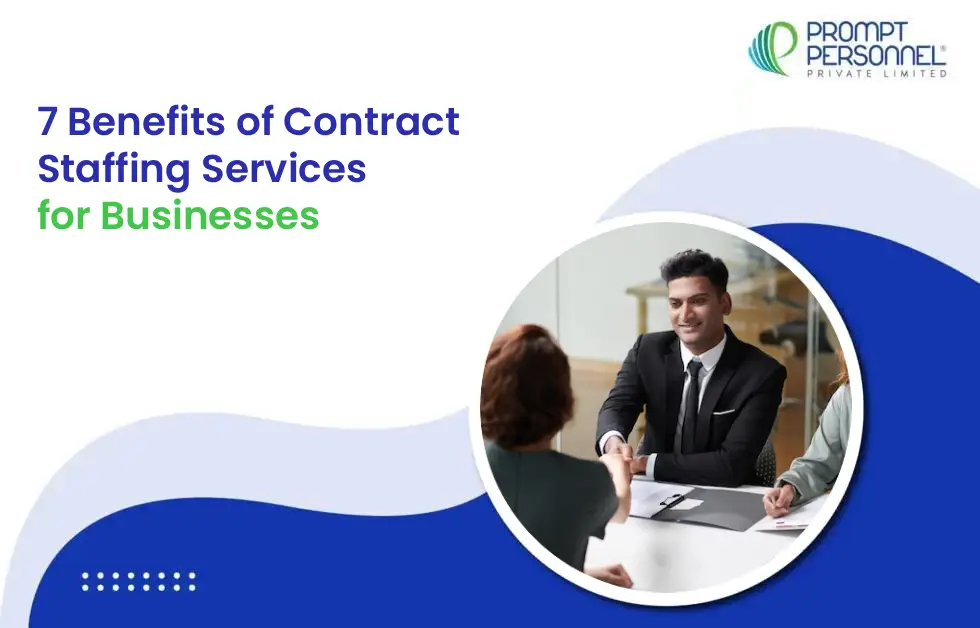
Contract staffing lets businesses hire skilled workers for defined periods through a staffing agency that handles payroll, compliance, and administration. The benefits: faster deployment, lower overhead, flexible scaling, and reduced administrative workload through agency-managed payroll and statutory processes. In a workforce environment where flexibility is increasingly the default, contract staffing is becoming essential infrastructure.
A retail chain opening four new stores before Diwali needs 200 people on the floor within five-weeks. A pharma company has just won a 12-month distribution contract that needs warehouse and logistics staff across three cities, starting next month. An IT firm has an eight-person gap for a six-month product sprint and no intention of carrying that headcount once it’s done.
Three different businesses. One shared problem. A full permanent hiring cycle, job postings, interviews, offer negotiations, onboarding, would either miss the deadline entirely or leave the company holding headcount it doesn’t need six-months later.
This is exactly the gap contract staffing services exist to close. Not as a workaround for when hiring goes wrong, but as a deliberate way of matching your workforce to the actual shape of the work.
Prompt Personnel has been doing this since 1997, working as one of the established contract staffing companies in India, deploying talent across industries on a PAN India basis. Here’s what the model delivers, and why more businesses are building it into how they operate rather than treating it as a stopgap.
What Is Contract Staffing and How Does It Work?
Contract staffing is when a business hires workers through a staffing agency for a defined period, under a written contract. The agency is the employer of record. It handles recruitment, payroll, PF, ESI, and statutory employment administration, while supporting clients with compliance processes in accordance with applicable labour laws. The staffing agency recruits, employs, and deploys the workforce, while the client supervises day-to-day activities and fulfils applicable oversight responsibilities, including verification of statutory compliance where required.
In practice, the process runs in six steps:
- The client shares the requirement. Role, skills needed, duration, and location.
- The agency sources and screens candidates. Using an existing talent pipeline where possible, rather than starting from zero.
- Background verification happens. Address checks, qualification verification, employment history, professional references.
- Onboarding and deployment. The candidate joins, documentation is completed, and work begins.
- The agency manages payroll processing, statutory contributions, and employment administration throughout the engagement while coordinating with the client on applicable compliance requirements. Salary processing, PF and ESI contributions, statutory filings, and related employment administration are managed by the staffing agency, helping reduce the administrative workload for the client’s HR and finance teams while supporting compliance with applicable labour laws.
- The contract concludes. With the option to renew, extend, or convert the worker to a permanent role if the fit is right.
That structure is what makes contract staffing fundamentally different from simply hiring faster. The speed comes from the agency having already done the groundwork before your request ever arrives.
What Are the Real Business Benefits of Contract Staffing?
Faster time-to-deploy
Hiring timelines can vary depending on the role, required skills, location, and the availability of suitable candidates. Contract staffing agencies with established talent pipelines and structured recruitment processes can often reduce the time required to source, screen, verify, and deploy qualified professionals compared to starting the hiring process from scratch. This enables businesses to respond more efficiently to project requirements, seasonal demand, and workforce expansion needs.
More Predictable and Flexible Workforce Costs
Contract staffing helps businesses align workforce costs with actual operational requirements. Since the staffing agency manages payroll processing, statutory contributions, and employment administration for contract employees on its rolls, client organisations can reduce the administrative workload on their HR and finance teams. This allows businesses to plan workforce expenses more predictably while maintaining the flexibility to scale headcount up or down as business needs change.
Specialist Support for Payroll and Statutory Compliance
Managing payroll and statutory employment obligations for a growing workforce requires consistent processes and up-to-date knowledge of labour regulations. Contract staffing agencies provide dedicated support for salary processing, statutory contributions such as PF and ESI, employment records, and other administrative requirements associated with contract employees.
While the staffing agency manages payroll administration and statutory processes for the employees on its rolls, client organisations continue to fulfil applicable responsibilities as the principal employer under Indian labour laws, including oversight and verification where required. This shared approach helps businesses manage workforce administration more efficiently while supporting compliance with applicable legal requirements.
Flexibility to scale up and down
Business requirements rarely remain constant throughout the year. Seasonal demand, expansion into new locations, project-based work, product launches, and temporary operational requirements often create the need for additional manpower without permanently increasing headcount.
Contract staffing gives organisations the flexibility to increase or reduce workforce strength based on business requirements and the agreed contract period. This enables businesses to respond quickly to changing workloads while maintaining operational continuity and managing workforce costs more effectively.
Access to pre-vetted, deployment-ready talent
A good agency isn’t starting the sourcing process the moment your request comes in. Background verification, qualification verification, and reference checks happen upfront, before a candidate even reaches your shortlist. That upfront work is what collapses the usual gap between “we need someone” and “someone is working.”
Lower hiring risk
Contract staffing provides organisations with the flexibility to engage skilled professionals for defined project durations, seasonal requirements, or temporary business needs. This enables businesses to align workforce capacity with operational demand while maintaining continuity across projects and business functions. At the end of the agreed engagement period, organisations can review their workforce requirements and decide whether to extend, renew, or conclude the engagement in accordance with the contractual terms and business needs.
Contract staffing gives organisations flexibility to engage talent for defined project durations or business requirements. If workforce needs change, organisations can review staffing requirements at the end of the agreed engagement period in accordance with contractual terms.
Which Industries Commonly Use Contract Staffing?
Some sectors lean on this model more heavily than others, and the reasons tend to be specific to how each industry actually operates.
| Industry |
Why contract staffing fits |
| Retail |
Seasonal demand, new store launches, festive-period surges |
| E-commerce |
Fulfilment centre scaling, last-mile delivery peaks |
| Manufacturing |
Project-based production lines, plant expansions |
| Logistics |
Warehouse operations, multi-state distribution networks |
| IT |
Project sprints, product builds, specific short-term tech needs |
| BFSI |
Back-office operations, branch expansions, campaign-based staffing |
Beyond these, contract staffing is widely used across Healthcare, Pharma, Telecom, Education, Automobile, Airlines, and BPO, wherever workforce needs shift with projects, seasons, or client demand rather than staying flat year-round.
How Prompt Personnel Delivers Contract Staffing Across India
Prompt Personnel contract staffing services are designed to help businesses build a flexible workforce with efficient hiring, payroll administration and compliance support.
Talent Sourcing & Verification: Every candidate undergoes thorough background verification, including address checks, qualification verification, employment history, and professional references before being presented to clients.
Contract Management: All employment contracts comply with applicable Indian labour laws. A dedicated account manager understands client requirements and matches suitable candidates for the agreed assignment period.
Prompt Personnel manages salary processing, statutory contributions, and employment administration for contract employees on its rolls in accordance with applicable labour laws. We also work closely with clients to support applicable principal employer responsibilities, helping streamline payroll administration, statutory processes, and workforce management throughout the engagement.
PAN-India Staffing: We provide professional staffing (engineers, MBAs, IT professionals) and general staffing (white-collar and blue-collar roles) across major cities in India based on client requirements.
Digital Onboarding: Our mobile app streamlines onboarding and documentation while providing ongoing support to employees deployed at client locations across India.
With 28+ years of experience (since 1997), a PAN-India presence, an extensive business network, and 80% repeat clients, we serve industries including Healthcare, Pharma, Retail, IT, Logistics, Manufacturing, Education, Automobile, Telecom, and BPO.
Build for Flexibility
Contract staffing enables businesses to respond quickly to changing workforce needs, control fixed costs, support compliance, and access skilled talent without the delays of permanent hiring.
Prompt Personnel is a trusted contract staffing company in Mumbai with a strong PAN-India presence, helping businesses hire the right talent with reliable workforce management and administrative support.
Explore Prompt Personnel’s Contract Staffing Services
Contact Our Staffing Team
Frequently Asked Questions
- What is the difference between contract staffing and permanent hiring?
Contract staffing engages workers for a defined period through a staffing agency, which acts as the employer of record for payroll and statutory compliance. Permanent hiring brings someone onto the company’s own payroll indefinitely, with the company carrying full responsibility for compliance, benefits, and administration.
- Who handles PF, ESI, and complianceforcontract staff?
The contract staffing agency does. It manages PF contributions, ESI deposits, statutory filings, and all related compliance obligations for the duration of the contract. The staffing agency manages payroll, statutory contributions and employment administration, while the client continues to fulfil applicable responsibilities as the principal employer under labour laws.
- Can contract employees be converted to permanent roles?
Yes. Many businesses use a contract engagement as a practical way to assess fit before committing to a permanent hire. If performance is strong and the role has ongoing need, the transition to permanent employment can usually be arranged between the client and the staffing agency.
- Is contract staffing suitable for small businesses?
Yes, and often especially so. Smaller businesses frequently lack the internal HR infrastructure to manage recruitment, payroll, and compliance at scale. Working with contract staffing companies gives them access to the same sourcing and compliance capability that larger organisations have, without needing to build it in-house.
- What industries benefit most from contract staffing in India?
Industries with seasonal demand, project-based work, or fluctuating headcount needs benefit most. Retail, e-commerce, Logistics, Manufacturing, IT, and BFSI are among the heaviest users in India, though the model applies wherever workforce needs shift rather than staying constant year-round.
by savit | Jul 23, 2026 | Uncategorized
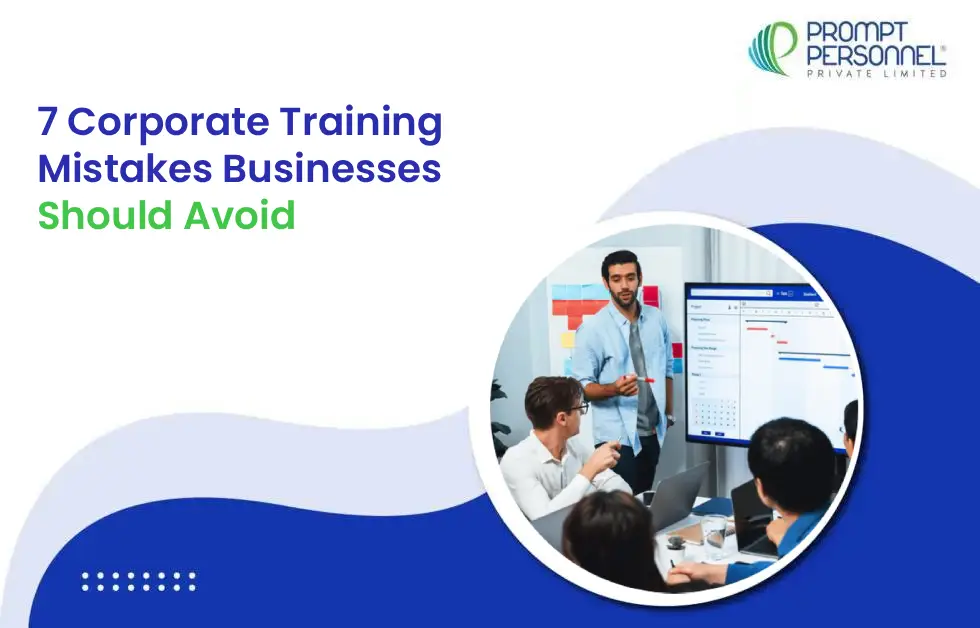
Most corporate training programmes don’t fail because the topic was wrong. They fail because the programme was designed without a clear goal, ran once, treated every employee the same way, and was never measured. These are fixable mistakes. This blog covers seven of the most common ones, and what a better approach looks like.
Every company past a certain size has a training budget line. The money gets spent every year. Sessions happen, attendance sheets get signed, certificates go out. And then, if you ask someone six months later what changed because of it, the honest answer is usually a shrug.
That’s the real problem. Not that training doesn’t work. It’s that the way many businesses approach training can reduce its long-term effectiveness.
Prompt Personnel has spent 28 years building and delivering corporate training programs for employees across industries in India, and the pattern repeats often enough to be worth naming. The same handful of mistakes show up again and again, in companies of every size. None of them are hard to fix once you can see them.
Why Do Most Corporate Training Programmes Underperform?
Because they are often designed around logistical constraints like availability, scheduling, and calendar fit, rather than focusing on desired outcomes. Instead of beginning with questions about what employees should achieve after training, the emphasis is on fitting courses into busy schedules. Even a well-executed course lacking a clear objective will underperform compared to a good one that is centred on a specific, meaningful goal.
The gap between intent and execution here is well documented. According to LinkedIn’s 2025 Workplace Learning Report, 88% of organisations say they’re concerned about retention, and learning tops their list of strategies to address it. Yet only 36% of organisations are identified as “Career Development Champions” in LinkedIn’s 2025 Workplace Learning Report. Most companies know training matters. Far fewer run it in a way that delivers on that belief.
That gap is where the following mistakes live.
Seven Mistakes That Undermine Corporate Training for Employees
- Running training without a business objective
This is the one that sits underneath most of the others. A session gets scheduled because it’s been a while, or because someone in leadership mentioned “the team needs something.” Nobody defines what success looks like before the topic gets chosen.
Without a clear objective, content design becomes difficult, success measurement is unclear, and justification for spending becomes harder next year. Address this initial issue first. Determine what needs to change, then plan backwards from that goal.
- Treating it as a one-off event
According to the World Economic Forum’s Future of Jobs Report 2025, 39% of workers’ existing skill sets are expected to be transformed or become outdated by 2030, highlighting the need for continuous learning and upskilling.
Training has to be continuous, not a calendar entry you tick off once a year. Companies that rely only on occasional training may find it more difficult to keep employee skills current and support long-term development.
- Skipping soft skills for technical training
This one is particularly important in the Indian market. According to Mercer-Mettl’s India Graduate Skill Index 2025, only 42.6% of Indian graduates were considered employable in 2024. The report highlights that employability depends on a combination of technical knowledge, communication skills, critical thinking, teamwork, and other workplace competencies.
Most companies hire for technical competence and stop there. Then they wonder why client escalations drag on, why cross-functional teams don’t collaborate well, why newly promoted managers struggle to lead people. Corporate soft skills training can help address many of these workplace challenges alongside technical development.
- Using the sameprogrammefor every role and level
A company-wide leadership training for all (from intern to director) is useful to 2-3 people in the room. Your first-time shop-floor supervisor requires training that’s 180 degrees different from a director who’s been in place 5 years. Without segmentation by role and level, the session ends up too basic for some and too advanced for others, and genuinely useful for very few.
- No follow-up, no reinforcement
Without reinforcement, employees may retain less of what they learn over time hear in a single session within a day or two unless something reinforces it. A workshop with no follow-up mechanism, no refresher module, no manager check-in, no chance to apply the skill on the job, is an information dump dressed up as development.
This is exactly why the format matters as much as the content. Prompt Personnel’s approach runs training through a Learning Management System with 130+ self-paced courses, so the learning doesn’t end when the session does. Employees can revisit material, take refresher modules, and build on what they learned instead of losing it within the week.
- Not measuring outcomes
Tracking the change process is essential to defend the training expense during the review, and if not documented, improvement in this programme will be impossible too. Assessments at the beginning and after the training, feedback from the manager, as well as a demonstration of results in the job are the very least. And yet most companies do none of them; Without measuring outcomes, it can be difficult to demonstrate the value of training investments.
- Ignoring how peopleactually learntoday
Forcing an entire workforce into a full day of classroom training, when half the team works shifts, sits across different cities, or operates remotely, may reduce the effectiveness of the programme before it starts. The format has to match the workforce, not the other way round.
The India Skills Report 2026 highlights continuing skill gaps across the workforce, reinforcing the need for ongoing learning and development. Flexible learning formats, including instructor-led sessions and self-paced digital modules, can help organizations make training more accessible for employees across different roles and locations.
What Does a Well-Designed Corporate Training Programme Look Like?
Strip away the mistakes above and five things remain constant across programmes that are generally more effective.
A clear business objective sits at the start, not the end. The content is built for the role and level of the people receiving it, not for the whole company at once. Delivery mixes formats: instructor-led where it’s genuinely needed, self-paced and digital where it isn’t. Assessments happen before and after, so improvement is visible rather than assumed. And there’s a reinforcement mechanism built in from day one, not added later as an afterthought.
Many of these improvements can be achieved through careful planning. It’s mostly about doing the planning work before the session gets booked, rather than after.
How Prompt Personnel’s L&D Vertical Addresses These Gaps
Prompt Personnel designs corporate training programmes around clearly defined business objectives, ensuring every programme is aligned with the client’s workforce development goals rather than following a one-size-fits-all approach.
Training is customised to the organisation’s industry, job roles, and employee levels, making the content relevant and practical for different teams. Prompt Personnel delivers corporate training through a blended learning approach, combining customised instructor-led training with LMS-based self-paced courses.
To reinforce learning beyond the classroom, employees have continued access to digital learning resources, while pre- and post-training assessments help measure progress and evaluate programme effectiveness. Dedicated account management ensures smooth coordination throughout programme planning and delivery.
Backed by over 28 years of HR and learning & development experience, Prompt Personnel helps organisations build practical, measurable, and sustainable employee development programmes.
Explore Prompt Personnel’s Corporate Training Programmes
Talk to Prompt Personnel’s L&D Team
Frequently Asked Questions
- What are the most common mistakes in corporate training programmes?
The most frequent ones include running sessions without a clear business objective, treating training as a one-off annual event, neglecting soft skills in favour of technical content, using identical programmes across every role and seniority level, skipping follow-up and reinforcement, and never measuring whether the training actually changed anything.
- Why is corporate soft skills training important for Indian businesses?
Because the employability gap in India is largely a soft skills gap. As per Mercer-Mettl’s India Graduate Skill Index 2025, non-technical shortfalls in communication, critical thinking, and teamwork are the leading reason only 42.6% of Indian graduates were considered employable in 2024. Technical training alone doesn’t close that gap.
- How often should companies run training programmes for employees?
Continuously, rather than as an annual event. Skills change fast enough that a once-a-year session cannot keep pace, particularly in technical and digital roles. A mix of scheduled sessions and always-available self-paced modules works better than a single yearly workshop.
- Can corporate training be delivered online?
Yes, and for many workforces it’s the more practical option. Self-paced digital delivery through a Learning Management System allows employees across different locations, shifts, and time zones to access the same corporate training Programme for employees without everyone needing to be present in one room at the same time.
- How do you measure the effectiveness of a corporate training programme?
Through pre and post-training assessments, manager feedback after the session, and some link to on-the-job performance over the following months. Without these, it’s difficult to know whether a programme worked or simply happened.
by savit | Jul 20, 2026 | labour law advisory
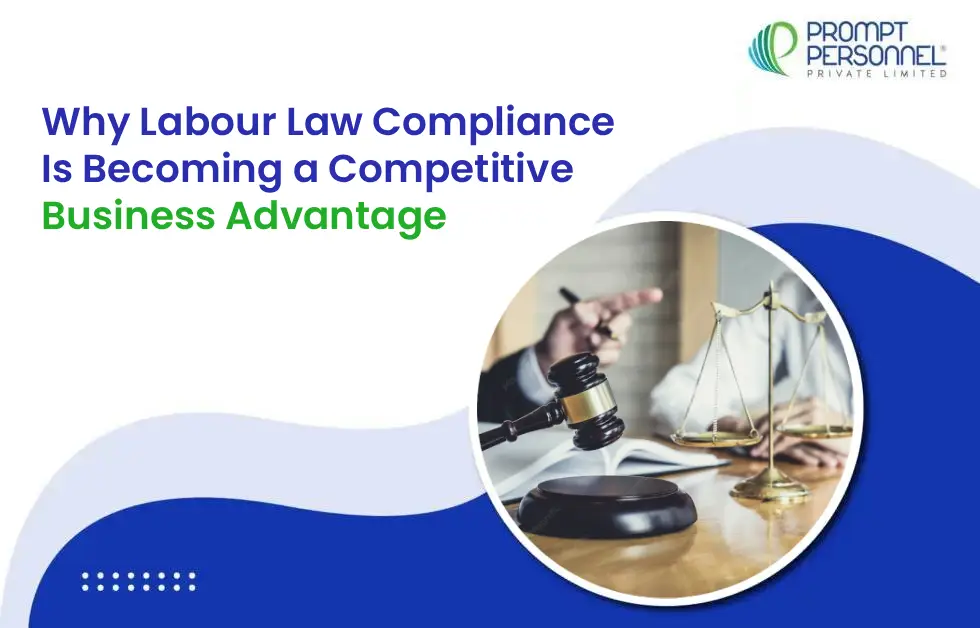
The companies that treat labour law compliance in India as a legal expense are missing the shift. In a landscape shaped by ESG reporting, investor due diligence, digital enforcement, and employee expectations, clean compliance is becoming a signal of operational maturity. It can support stronger talent confidence, smoother business processes, and more predictable operations.
For years, the compliance conversation in Indian businesses started and ended with the same question: what happens if we don’t?
Penalty risk. Inspector visits. Legal notices. The whole framing was defensive. Keep up or get caught. That’s a reasonable way to think about it, but it misses what’s been changing on the other side.
The companies that maintain strong labour law compliance are often better positioned to support smoother due diligence, facilitate expansion into new states, strengthen their employer reputation, and provide greater confidence in governance at board level. Compliance alone does not determine these outcomes, but it helps reduce operational risk and supports more efficient business decisions. The shift isn’t dramatic. It’s structural. As regulatory expectations continue to evolve, businesses with established compliance frameworks are generally better positioned to adapt and support long-term growth.
Prompt Personnel has been a labour law advisor to Indian businesses for 29+ years, operating across 28 states and 8 union territories. What we’re seeing now is a clear pattern: compliance is moving from a back-office obligation to a front-office advantage.
The four Labour Codes came into force on 21 November 2025, consolidating 29 central labour laws into four Codes. As businesses continue to adapt to the new framework, organisations are navigating updated compliance requirements, digital reporting processes, and evolving implementation practices. That moment didn’t just raise the stakes for non-compliance. It widened the gap between companies that had their house in order and those that didn’t. And that gap is where the competitive advantage sits.
How Did Compliance Become a Competitive Advantage?
Because every stakeholder who matters now checks for it.
Investors check before writing a cheque. Large clients check before signing a vendor contract. Prospective employees check before accepting an offer. Regulators check in real time through digital portals. Compliance isn’t invisible infrastructure anymore. It surfaces in ESG assessments, M&A due diligence, SEBI filings, and employer reputation. Companies with clean records move faster. The rest explain delays.
Here’s how that plays out across four specific business levers.
Investor and lender confidence
Capital moves toward companies that can prove governance.
SEBI’s Business Responsibility and Sustainability Reporting (BRSR) framework, mandatory for the top 1,000 listed companies, includes disclosures relating to workforce, employee wellbeing, social security, occupational health and safety, diversity, and other governance-related practices. These structured disclosures are reviewed by investors, analysts, and other stakeholders as part of broader ESG assessments. While labour law compliance is one aspect of good governance, maintaining accurate payroll records, statutory contributions, and compliance documentation can help organisations support these disclosures and demonstrate sound governance practices.
Banks and private equity (PE) firms also conduct compliance reviews as part of their due diligence processes. Well-maintained compliance records can help support a more efficient review process, while compliance gaps may lead to additional queries, requests for documentation, or delays in completing due diligence.
Client acquisition, especially with large enterprises
Large enterprises increasingly audit their vendors’ compliance before onboarding them.
If you’re a logistics company bidding for a contract with a multinational, or a staffing firm being evaluated for a large deployment, your compliance posture is being checked. PF contribution records. ESI coverage. Minimum wage adherence across states. Licence validity. Vendors that maintain accurate and accessible compliance records are better positioned during client evaluations, while gaps may result in additional reviews or clarification requirements.
This matters more now because India’s formal workforce is expanding rapidly. According to an EPFO and Quess Corp workforce trends report, EPFO recorded 139.78 lakh net new subscribers in FY25, its highest ever, more than double the 61 lakh enrolments seen in FY19. Yet 80% of India’s 570 million workers remain in the informal economy. As formalisation accelerates, the compliance records that come with formal employment become more visible, more checkable, and more expected. The companies that can demonstrate they were already there gain a credible edge.
Employer brand and talent attraction
Compliance supports confidence in an organisation’s employment practices.
On-time salary payments, accurate PF contributions, transparent payslips, and appropriate ESI coverage are statutory obligations that reflect well-managed HR processes. Consistently meeting these requirements helps demonstrate responsible employment practices and sound governance. While labour law compliance is one factor influencing an organisation’s employer reputation, maintaining accurate statutory records and fulfilling legal obligations can help reinforce confidence in its employment practices and overall organisational credibility.
Operational speed across states
Expanding into a new state, office, warehouse, or operational location can introduce additional compliance requirements depending on factors such as business activity, workforce size, employee categories, and applicable state regulations. These requirements may include registrations, statutory obligations, licence requirements, minimum wage compliance, reporting responsibilities, and contract labour obligations where applicable.
Businesses with established compliance processes or support from an experienced labour law partner are better positioned to assess applicable requirements, complete necessary formalities, and manage regulatory obligations as they expand. Effective compliance planning helps reduce avoidable delays, supports operational readiness, and enables businesses to focus on growth while meeting applicable legal requirements.
What Changed in 2025 That Accelerated This Shift?
Three things happened in close succession, and together they moved compliance from back office to boardroom.
Compliance processes have become increasingly digital. As the Labour Codes continue to be implemented, businesses are using digital government platforms such as the Shram Suvidha Portal and EPFO systems for registrations, filings, and compliance monitoring. These platforms support regulatory oversight by helping identify issues such as contribution mismatches and delayed filings, alongside existing inspection and enforcement processes.
Compliance entered the Board’s Report. Compliance disclosures have received greater attention in corporate reporting. The Ministry of Corporate Affairs’ July 2025 amendment to the Companies (Accounts) Rules introduced specific disclosure requirements in the Board’s Report relating to PoSH complaints received, disposed of, and pending, as well as compliance with the Maternity Benefit Act. Businesses need to ensure that applicable disclosures are accurately prepared and supported by appropriate records.
ESG scrutiny sharpened. Avtar CC’s 2026 analysis of ESG investment trends in India found that labour practices, supply chain transparency, and community engagement are being scrutinised by investors more aggressively than at any previous point. The report noted that governance quality now has a direct impact on company valuation.
The common thread across all three: compliance used to be checked after the fact, during an inspection or a dispute. Now it’s checked in advance, during hiring, investment, vendor onboarding, and ESG assessment. That advance check is exactly where the competitive advantage lives.
How Prompt Personnel Turns Compliance Into a Business Advantage
Prompt Personnel’s labour law consultancy services are structured around the principle that compliance should work for the business, not just protect it.
Here’s how each service maps to a competitive lever:
- Labour Law Advisory: Amendment tracking, regulatory guidance, experience coordinating with statutory authorities, and support in responding to compliance observations or regulatory communications. The advantage: your leadership stays informed about regulatory changes and compliance requirements.
- Payroll Compliance Management: Support with prescribed registers, periodic returns, inspection-related requirements, minimum wage compliance, and special allowance guidance. The advantage: organisations can improve payroll accuracy, maintain compliance records, and manage statutory obligations more effectively across locations.
- Regulatory Compliance: Licensing and compliance support under applicable labour regulations, including state-specific requirements, relevant central legislations, and the transition framework of the four Labour Codes. This includes support with registrations, documentation, statutory filings, and regulatory obligations applicable to the organisation’s operations, including requirements that may continue under existing laws during the transition period. The advantage: businesses can better navigate evolving compliance requirements and manage regulatory obligations across locations.
- Principal Employer and Vendor Compliance Audit: Verifying contractor remittances, reviewing statutory records and returns, and supporting principal employers in managing contractor compliance obligations. The advantage: organisations can better identify and address potential principal-employer exposure during vendor assessments and compliance reviews.
- Apprenticeship Promotion Schemes (NAPS and NATS): Registration, curriculum facilitation, assessments, DBT implementation, portal filings. The advantage: organisations that meet applicable eligibility criteria and scheme requirements can access government incentives while maintaining compliance with programme obligations.
- Industrial Relations: Support for collective workforce discussions, employee relations matters, separation cases, and grievance management. The advantage: organisations can proactively manage workplace relations and address employee concerns effectively.
Centralised Compliance Dashboard and Labour Law Library: A centralised view of compliance information, documentation, and regulatory updates across locations. The advantage: leadership teams can access organised compliance data and make informed decisions based on available records.
Backed by 29+ years of experience, Prompt Personnel supports businesses with labour law compliance requirements across multiple locations, with capabilities spanning state-specific registrations, regulatory procedures, compliance documentation, and dedicated client support. Where applicable, organisations can leverage Prompt Personnel’s established processes, regional expertise, and compliance management resources to support their operational requirements.
Compliance Is Infrastructure, Not Overhead
The businesses that treat compliance as an annual cost to minimise will keep getting caught out by an environment that’s moved on. The ones that build it into their operating infrastructure, the same way they build finance systems or IT security, will find it opening doors they didn’t expect.
The advantage is quiet. It’s structural. It can help organisations approach due diligence with greater confidence, support vendor evaluations, manage expansion requirements, and build more reliable workforce practices.
Prompt Personnel is a trusted labour law consultancy and one of the most experienced labour law consultants in Mumbai, working with businesses across India that see compliance as a growth enabler, not a cost centre.
➡ Explore Our Labour Law Advisory Services
➡ Talk to Prompt Personnel’s Compliance Team
Frequently Asked Questions
- How doeslabourlaw compliance create a competitive advantage?
Clean compliance speeds up investor due diligence, strengthens vendor onboarding with large clients, builds employer reputation, and enables faster expansion into new states. In a market where compliance records are increasingly visible and routinely checked, the companies that maintain them well move faster than those that don’t.
- What is the link between compliance and ESG reporting in India?
SEBI’s BRSR framework requires the top 1,000 listed companies to disclose information related to workforce practices, social security, employee wellbeing, and governance matters. Labour law compliance is one part of broader ESG assessments, and maintaining accurate records and statutory documentation helps organisations demonstrate responsible business practices.
- Do investors and clients actually checklabourlaw compliance before doing business?
Yes. Banks, PE firms, institutional investors, and large enterprises may review compliance records as part of due diligence and vendor evaluation processes. Maintaining accurate PF, ESI, minimum wage, and licensing records can help organisations respond effectively to compliance reviews, while gaps may require clarification or corrective action.
- How do the fourLabourCodes affect business competitiveness?
The four Labour Codes, which came into force on 21 November 2025, consolidated 29 central labour laws into four Codes covering wages, industrial relations, social security, and occupational safety. As businesses continue to transition to the new framework, digital government platforms are increasingly used for registrations, filings, and compliance monitoring. Organisations that have adapted to the updated requirements and established structured compliance processes are generally better positioned to manage regulatory obligations, particularly in areas such as wage structuring, appointment letters, and social security coverage.
- Why should a growing company invest in alabourlaw advisor?
Because every phase of growth adds compliance obligations: new states, new worker categories, new registrations, and new filing deadlines. A labour law advisor brings the regulatory knowledge, multi-state coverage, and monitoring infrastructure to keep compliance current as the business scales, without the overhead of building it all in-house.
References
According to an EPFO and Quess Corp workforce trends report
https://hr.economictimes.indiatimes.com/news/trends/informal-workforce-moves-towards-formalisation-epfo-enrolment-at-new-high-in-fy25-report/123770014
Shram Suvidha Portal
https://shramsuvidha.gov.in/
Avtar CC’s 2026 analysis of ESG investment trends in India
https://www.avtarcc.com/from-compliance-to-competitive-advantage-esg-investment-trends-shaping-india-in-2026/
by savit | Jul 15, 2026 | HR outsourcing companies in Mumbai
Growth creates HR problems faster than most internal teams can solve them. Hiring slows down when you need it most. Compliance complexity increases as businesses expand into new jurisdictions. Training falls behind. A good HR consultant doesn’t just manage these problems; they keep them from becoming bottlenecks. This blog explains what to look for in the right partner, and where Prompt Personnel fits.
There’s a point in every company’s growth story where the HR function quietly starts to lag behind the business.
It usually doesn’t announce itself. You notice it in the time it takes to fill a role that was “urgent” six weeks ago. In the compliance filing that nobody remembered until the notice arrived. As businesses expand into new jurisdictions, compliance requirements become more complex, making it harder to keep up with statutory obligations, payroll regulations, and labour law changes. In the training that keeps getting pushed to “next quarter.”
None of these are dramatic failures. They’re friction. And friction, at scale, is what slows a business down.
The instinct for most founders and CHROs is to hire more people into the HR team. Sometimes that’s the right call. But increasingly, Indian businesses are finding that the faster, more reliable answer is to bring in a partner who already has the infrastructure in place: the staffing pipelines, the compliance architecture, the training systems, and the multi-state regulatory knowledge. According to IMARC Group, India’s HR outsourcing market reached USD 8.6 billion in 2024 and is projected to grow to USD 13.9 billion by 2033. That trajectory reflects a structural decision, not a passing trend. Companies are choosing partners because growth demands capabilities that take years to build from scratch.
Prompt Personnel has been one of those partners since 1997, working as HR consultants in India across 28 states, 7 major cities, and every major industry vertical. What follows is the framework that makes that partnership work.
What Does the Right HR Consultant Do for a Growing Business?
A good HR consultant takes on the operational weight of hiring, compliance, training, and workforce management so leadership can focus on revenue, product, and expansion. They complement internal HR teams by providing specialised expertise and additional capacity, or they can manage selected HR processes where organisations need external support. Their role is to remove the operational friction that slows business growth.
In practice, that plays out across three stages of growth, each with different demands.
Stage 1: You need more people, fast. This is usually the first wall. The business has grown or a project has landed, and you need 50 associates in four weeks. Internal recruitment teams may not always be able to scale at the pace required, particularly during periods of rapid growth, large-scale hiring, or time-sensitive projects. This is where temporary and permanent staffing capability matters, the ability to source, screen, and deploy at volume without sacrificing quality.
Stage 2: You’re expanding, and compliance is getting complicated. A second state office, a third warehouse, a new category of contract workers. Each expansion may require PF and ESI registrations, Professional Tax registration where applicable, Shops and Establishments licences, state-specific minimum wage compliance, statutory reporting obligations, and other registrations that vary depending on the nature, industry, and scale of the business. The four Labour Codes, implemented on 21 November 2025, introduced another layer of compliance. While businesses continue to transition to the new framework, employers must stay updated on evolving requirements, implementation practices, and regulatory expectations. If compliance falls behind expansion, the penalties catch up eventually.
Stage 3: Your people need to grow with you. This is the one businesses skip most often, and it shows up later as attrition, underperformance, or promotion failures. Training, leadership development, and PoSH compliance aren’t overhead. They’re what keeps the people you already invested in from stalling out or leaving.
These three stages rarely happen in sequence. For a growing company, they tend to happen at once. That’s the case for a partner who can cover all three.
Why Are Indian Businesses Turning to HR Consultants Right Now?
Two numbers frame the answer clearly.
Growing businesses across India are facing increasing HR and compliance complexity as they expand into new markets, hire larger workforces, and navigate evolving labour regulations. As operations scale, managing recruitment, statutory compliance, payroll, and workforce development internally becomes more challenging, prompting many organisations to partner with experienced HR consultants. That’s the demand side.
On the supply side, finding the right people has become harder. ManpowerGroup’s 2026 Talent Shortage Survey found that 82% of Indian employers report difficulty filling roles. The challenge goes beyond sourcing candidates. Businesses also need to assess skills accurately, identify candidates who fit both the role and the organisation, support workforce development, and build talent pipelines that can keep pace with business growth.
Put those together and the logic is straightforward. Hiring speed, compliance coverage, and workforce development all need to happen in parallel. Building all three in-house from zero is slower and costlier than working with a partner who already has them running.
What Should You Look for in the Right HR Consultant?
Not every HR partner is the same, and picking the wrong one creates its own problems. Four things tend to separate the consultants who actually enable growth from the ones who just manage paperwork.
Breadth of services may be an advantage. depending on your business requirements. While many HR consultants specialise in specific areas, Prompt Personnel offers staffing, compliance, learning and development, PoSH compliance, and HR outsourcing under one roof, helping businesses that prefer a single integrated HR partner reduce coordination across multiple vendors.
Multi-state compliance capability. Growing into a second or third state significantly increases your compliance responsibilities. Registration requirements, Professional Tax, labour law reporting, licence renewals, and statutory obligations differ from state to state and may also vary depending on the nature and scale of the business. A consultant should have genuine state-level expertise, experience with state-specific registrations, regulatory procedures, authority-facing documentation, and regional knowledge to effectively support businesses operating across multiple states.
Governance and reporting. A reliable HR consultant should provide clear governance processes, regular reporting, and transparent communication. Well-defined reporting on recruitment progress, compliance activities, workforce metrics, and service performance helps businesses maintain oversight and make informed decisions.
Proven deployment, not advisory alone. There’s a real difference between a firm that advises on hiring and one that can efficiently source, screen, and deploy talent across multiple locations when business needs demand it. The real test is operational capability, not just strategic recommendations.
Client retention rate. This one is underrated. A high repeat business rate tells you more about a partner’s quality than any pitch deck can. If existing clients stay, the work is delivering.
Technology capabilities are equally important. HR consultants often handle sensitive employee and payroll information, so businesses should evaluate the systems used to manage HR processes, data security practices, access controls, and compliance with applicable data protection requirements. Secure technology and reliable reporting help build confidence as operations grow.
How Prompt Personnel Supports Business Growth Across the Full HR Lifecycle
Prompt Personnel was built around the principle that HR should accelerate business growth, not drag behind it. Each service exists to solve a specific growth problem.
Workforce Expansion
Temporary and permanent staffing solutions help businesses recruit, assess, and deploy talent for seasonal demand, project-based hiring, business expansion, and long-term workforce requirements.
Regulatory Compliance
Labour law advisory, statutory compliance, licence management, inspections, audits, and state-specific regulatory support help organisations manage evolving legal obligations across multiple locations.
Employee Capability
Learning and development programmes, leadership training, technical learning, soft skills development, and LMS-based courses help organisations strengthen workforce capability and support long-term growth.
Workplace Governance
End-to-end PoSH compliance services, Internal Committee support, awareness programmes, external member empanelment, case management, and statutory reporting help organisations maintain compliant and respectful workplaces.
HR Operations
HR outsourcing can cover selected HR processes or end-to-end HR operations, depending on business requirements. Services include payroll administration, employee lifecycle management, documentation, background verification, talent management, and industrial relations support.
Industries served include Retail, Manufacturing, e-commerce, Logistics, IT, and BFSI. Prompt Personnel operates from Mumbai, Pune, Kolkata, Hyderabad, Chennai, Delhi, and Bengaluru, with compliance infrastructure supporting organisations across India.
The Right Partner Grows With You
The real test of an HR consultant isn’t how well they handle today’s needs. It’s whether their infrastructure holds up when yours expands. A second office shouldn’t require a second vendor. A seasonal surge shouldn’t break the hiring pipeline. A new compliance obligation shouldn’t send everyone scrambling.
The right partner already has the depth and the geographic spread to handle what’s coming next. They scale when you scale. That’s the difference between a consultant who works for you and one who works with you.
Prompt Personnel is recognized as one of the best HR consultants in India, with deep roots in Mumbai and operational reach across the country. For businesses seeking HR services in Mumbai or reliable HR consultants in Mumbai to support national growth, Prompt brings the breadth, the compliance infrastructure, and the 28-year track record to back it up.
Among the best HR consultants in Mumbai, we’ve built our reputation by treating every client’s growth as our own operational mandate.
Get in Touch with Prompt Personnel
Explore Our Full Range of HR Services
Frequently Asked Questions
- What services should a good HR consultant offer?
At minimum: temporary and permanent staffing, labour law advisory and compliance management, learning and development, PoSH compliance, and HR outsourcing. The best HR consultants in India cover the full lifecycle under one roof, so a growing business doesn’t need to manage multiple vendors for different HR functions.
- Why do growing businesses in India outsource HR?
Because growth creates complexity faster than most internal teams can absorb it. Multi-state compliance, high-volume hiring, training infrastructure, and statutory filings all need to scale in parallel. Building each of these in-house is slower and more expensive than partnering with a consultant who already has them running.
- How do I choose between an HR consultant and building an in-house team?
It depends on your business needs, workforce complexity, and growth plans. Some organisations manage HR primarily in-house, while others work with HR consultants for specialised support such as staffing, compliance, or training. Many businesses use a combination of both approaches.
- Can an HR consultant help withlabourlaw compliance across multiple states?
Yes, and this is one of the strongest reasons to work with one. Each Indian state has its own rules on minimum wages, professional tax, licence renewals, and registration requirements. A capable consultant tracks all of this centrally and manages filings across every jurisdiction the client operates in.
- What industriesbenefit mostfrom working with an HR consultant?
Industries with high-volume hiring, seasonal demand, multi-location operations, or heavy regulatory requirements benefit most. In India, this includes Retail, Manufacturing, e-commerce, Logistics, BFSI, IT, and Infrastructure.
References
- IMARC Group. India Human Resource Outsourcing Market Report, 2026.
https://www.imarcgroup.com/india-human-resource-outsourcing-market
- ManpowerGroup. Global Talent Shortage Survey 2026.
https://go.manpowergroup.com/talent-shortage
by savit | Jul 10, 2026 | POSH Compliance
A PoSH policy tells employees what the rules are. Training is what makes those rules feel real. Without regular, well-designed awareness sessions, policies sit unread, and reporting mechanisms go unused. This blog looks at how PoSH awareness training builds reporting confidence, shifts behaviour, and creates the culture that compliance alone cannot deliver.
Most organisations, if you asked them, could point to a PoSH policy somewhere in their employee handbook. Many could name their IC members without checking. On paper, that looks like readiness.
But here’s the real test. Picture someone seven months into a new job. Still finding their feet, still working out who to trust. Something happens that makes them uncomfortable. Do they know what to do next? Do they believe, genuinely believe, that raising it will be taken seriously and handled fairly?
That confidence doesn’t stem from a policy stored on a shared drive; it arises from training. Confidence is built through participating in sessions that feel genuine rather than purely procedural. It also comes from seeing leadership approach the topic with sincerity, rather than just fulfilling a compliance requirement. The key question for HR leaders today isn’t only whether workplace policies meet legal requirements, but whether employees understand them, trust the reporting process, and feel confident using it when needed. Training can help strengthen that confidence when supported by consistent leadership, clear policies, and effective complaint-handling processes.
Training can help strengthen trust when supported by consistent leadership, clear policies, and effective complaint-handling processes.
Prompt Personnel has spent 28 years working inside Indian workplaces on exactly this question, delivering PoSH training for employees and IC members across industries. What follows is what that experience actually shows about how training shapes culture, not just compliance status.
What Does PoSH Awareness Training Actually Do?
At its core, PoSH awareness training gives employees a better understanding of expected workplace conduct, organisational reporting mechanisms, and the procedures available under the organisation’s PoSH policy, and know exactly what happens if they need to report something. For IC members, it builds the legal and procedural competence to handle a complaint properly, since their role is closer to quasi-judicial than administrative. For managers, it builds the confidence to respond well when someone comes to them first, which happens more often than most people expect.
These are not the same training. And treating them as one generic session is where a lot of programmes fall short.
| Level |
What it covers |
Why it matters |
| All employees |
Rights, boundaries, the reporting process |
Builds shared expectations and the confidence to speak up |
| Managers and team leads |
How to respond when someone raises a concern |
They’re usually the first point of contact; their reaction sets the tone for everything after |
| IC members |
Legal procedure, case handling, documentation |
The committee’s competence decides whether the process holds up under scrutiny |
A well-designed PoSH awareness program treats these as different exercises with different goals. Run the same content for everyone, and neither group gets what they actually need.
Why Does a Policy Without Training Fail to Build Culture?
This is really the heart of it. A document can define what’s acceptable. It cannot make people believe the definition matters, or trust that acting on it will go well for them. Training does three specific things a policy alone cannot.
It builds reporting confidence. According to an analysis by Business Standard, based on data compiled by the Ashoka University Centre for Economic Data and Analysis (CEDA), PoSH complaints across 300 NSE-listed companies increased by 974% between FY14 and FY25. While the data reflects a significant rise in reported complaints, it does not by itself explain the reasons behind the increase. A range of factors—including greater awareness, improved reporting mechanisms, evolving workplace practices, and stronger organisational processes—may have contributed. Regular PoSH awareness training is one of the measures organisations use to help employees understand reporting procedures and workplace expectations.
It makes boundaries visible and shared. A written policy sets a line. Training is what puts that same line in front of an entire workforce at once, using language and examples people actually relate to. When a session works well, people aren’t just told what harassment looks like. They discuss it, see it play out in a scenario, and walk away with a shared understanding rather than a private guess at where the boundary sits.
It signals what leadership actually cares about. Employees read effort. When a company invests real time, budget, and seniority into PoSH awareness training, rather than a rushed session squeezed into onboarding week, people notice the difference. It tells them this is a genuine priority, not a filing requirement being managed quietly in the background.
What Happens When Training Doesn’t Happen?
Not fear mongering here, just what tends to follow when awareness work is skipped or treated as a one-time exercise task.
Employees who were never properly trained in the reporting process often don’t use it when something happens. Concerns end up raised informally, mentioned to a colleague, posted about, or simply left unspoken, rather than going to the IC where they can actually be addressed. That same Business Standard analysis found that around 14% of all registered PoSH cases across those 300 companies remain unresolved. Some complaints remain unresolved for a range of organisational and procedural reasons, highlighting the importance of maintaining effective PoSH governance and timely complaint handling.
Regular refresher training helps Internal Committee (IC) members stay up to date with evolving legal requirements, complaint-handling procedures, and documentation practices. Since July 2025, companies are required to include PoSH disclosures in the Board’s Report, including the number of complaints received, complaints disposed of, and complaints pending for more than 90 days. These reporting requirements reinforce the importance of maintaining well-trained IC members, accurate records, and effective complaint-handling processes as part of an organisation’s overall PoSH governance framework.
None of these are inevitable. It’s what tends to happen by default when training becomes an afterthought.
How Prompt Personnel Builds Workplace Culture Through PoSH Training
Prompt Personnel’s PoSH services are designed to help organisations build awareness, strengthen governance, and support ongoing compliance. Rather than treating PoSH as a one-time activity, the focus is on creating a workplace where employees understand expected conduct, reporting mechanisms, and organisational responsibilities.
Here’s what that looks like in practice:
- Employee Awareness: We deliver self-paced LMS modules and instructor-led classroom or virtual training to help employees understand workplace conduct, reporting procedures, and their responsibilities under the organisation’s PoSH policy.
- Internal Committee (IC) Capability: Specialised training and refresher programmes help IC members strengthen their understanding of legal requirements, complaint handling, documentation, and fair inquiry procedures, while also supporting HR and L&D teams through train-the-trainer programmes.
- End-to-End Compliance Support: We assist organisations with policy development, Internal Committee set-up, external member empanelment, case-handling support, compliance documentation, reporting requirements, and audit preparedness to help maintain effective PoSH governance.
- IC Refresher Training: Helps Internal Committee members stay updated on legal developments, case handling, and documentation requirements.
- PoSH End-to-End Compliance: Covers policy drafting, IC set-up, grievance and case-handling support, external member empanelment, and audit preparedness.
- PoSH Reporting Support: Assistance with PoSH reporting and related compliance documentation in line with applicable requirements.
Every programme is tailored to the organisation’s workforce and delivered by experienced trainers. Backed by 28+ years of HR expertise and 3,500+ employees trained, Prompt Personnel supports organisations across industries with practical PoSH awareness, capability building, and compliance support.
Prompt Personnel’s PoSH Services
Talk to a PoSH Expert
Training Is the Part People Remember
While employees may not always remember every detail of a written policy, well-delivered training sessions often leave a stronger and more lasting impression. People remember how a training session made them feel, whether it was taken seriously, whether the room stayed engaged or checked out halfway through, whether the facilitator answered the awkward question honestly.
That’s the part that can influence workplace behaviour over time. It helps employees better understand expected conduct, recognise inappropriate behaviour, and become more familiar with the reporting process. A well-designed PoSH policy provides the framework, while regular awareness training helps reinforce those expectations through practical discussion and continued engagement. Together, they contribute to building a workplace culture where respect, awareness, and compliance are supported consistently.
Frequently Asked Questions
- What isPoSHawareness training?
PoSH awareness training is a structured programme that educates employees on their rights, responsibilities, and the reporting process under the PoSH Act, 2013. It’s typically delivered separately to general employees, managers, and Internal Committee members, since each group needs different depth and content.
- How doesPoSHtraining support workplace culture?
It turns a written policy into shared, lived understanding. Training builds reporting confidence, gives everyone the same reference point for what’s acceptable, and signals that leadership genuinely cares about the issue rather than treating it as paperwork. Over time, that’s what creates a culture of respect rather than a folder full of documents nobody has opened.
- IsPoSHtraining mandatory for all employees in India?
Yes. Employers are expected to conduct PoSH awareness programmes at regular intervals to promote awareness of the Act and organisational policies. Separately, organisations with ten or more employees are required to constitute an Internal Committee under the PoSH Act, 2013.
- How often shouldPoSHawareness sessions be conducted?
The PoSH Act requires awareness programmes to be conducted at regular intervals. Many organisations choose to conduct annual training as a recommended best practice, with additional sessions whenever needed.
- What is the difference between employeePoSHawareness and IC training?
Employee awareness focuses on recognising harassment, understanding rights, and knowing how to report. IC training goes considerably deeper: legal procedure, evidence handling, confidentiality requirements, and how to conduct a fair inquiry. IC members carry a quasi-judicial responsibility, so their training has to match that weight.
References
- The People’s Board, “Workplace Safety in India: Why Policy Isn’t Enough in 2026,” April 2026.
- Business Standard, analysis based on data from the Ashoka University Centre for Economic Data and Analysis (CEDA), covering annual reports filed by 300 NSE-listed companies between FY14 and FY25.
- Companies are required to disclose in the Board’s Report the number of complaints received, disposed of, and those pending for more than 90 days, making accurate reporting and governance increasingly important.