by Prompt Personnel | Oct 9, 2019 | Human Resources
Objective
The Objective of the Act is to provide protection against sexual harassment of women at workplace and also to prevent and reduce the number of complaints against sexual harassment and other connected and incidental issues.
Origin of POSH Law
The Sexual Harassment of Women at Workplace (Prevention, Prohibition and Redressal) Act, 2013 is a legislative act in India that seeks to protect women from sexual harassment at their place of work. It was passed by the Lok Sabha on 3 September 2012.
Applicability
The Prevention of Sexual Harassment (POSH) at workplace Act is applicable to every workplace, establishment, company or organization employing 10 or more employees (full time, part-time, interns or consultants included) irrespective of the location or nature of the industry. It is applicable across India to all establishments, governments and private. Even domestic women workers are also given protection under the purview of this Act.
Defining Sexual Harassment under POSH
The Act defines sexual harassment quite widely, and also includes ‘quid pro quo’ harassment, such as promises of advancement in return for sex.
Sexual harassment does not have to involve physical contact but could, for example, include sexual remarks, sexually explicit pictures or screensavers and inappropriate advances made directly or via social networking sites.
Prevention of SEXUAL HARASSMENT (POSH)
Sexual Harassment is defined as an unwelcome sexually determined behaviour (whether directly or by implication) such as:
• Physical conduct and advances
• A demand or request for sexual favours or making sexually coloured remarks or
• Showing pornography or
• Any other unwelcome physical, verbal or non-verbal conduct of sexual nature
• The harassment in relation to or connected with any act or behaviour of sexual harassment as follows amount to serious misbehaviour and the same is required to be viewed seriously
• Implied or implicit promise of preferential treatment in her employment or
• Implied or explicit threat about her present or future employment status
Prevention of Sexual Harassment (POSH) at WORKPLACE Act
The Act utilises the concept of the ‘extended workplace.’ In addition to the office of the employer or employee, any place visited by the employee arising out of or during the course of employment, including transportation provided by the employer for the purpose of commuting to and from the place of employment, will also constitute a workplace.
Further, social settings endorsed or financed by the employer are also considered a workplace under POSH law.
Establishing a mechanism to address POSH-related complaints
If an organisation wants to be POSH compliant, it must have a mechanism for employers to address complaints relating to sexual harassment.
This channel is known as the Internal Complaints Committee (ICC) or Internal Committee (IC).
Reporting requirements under POSH Law
The IC must also prepare an annual report for submission to the employer and the local labour district office. This mandatory report must include:
• Number of cases received and resolved
• Number of cases pending for more than 90 days
• Actions taken by the employer
• Number of workshops or awareness programmes undertaken.
There is also an obligation under the Act for the employer to include this POSH law-related annual report in the company’s annual report.

Non-Compliance
Non-compliance to POSH act will result in heavy monetary penalty, additional damages and company license cancellation.
The Ministry of Corporate Affairs has made it mandatory for all private companies to make disclosure of compliance under “POSH Act” through their Annual Board Report.
“Feminism is not about making women stronger. Women are already Strong , it’s about changing the way the world perceives that STRENGTH”
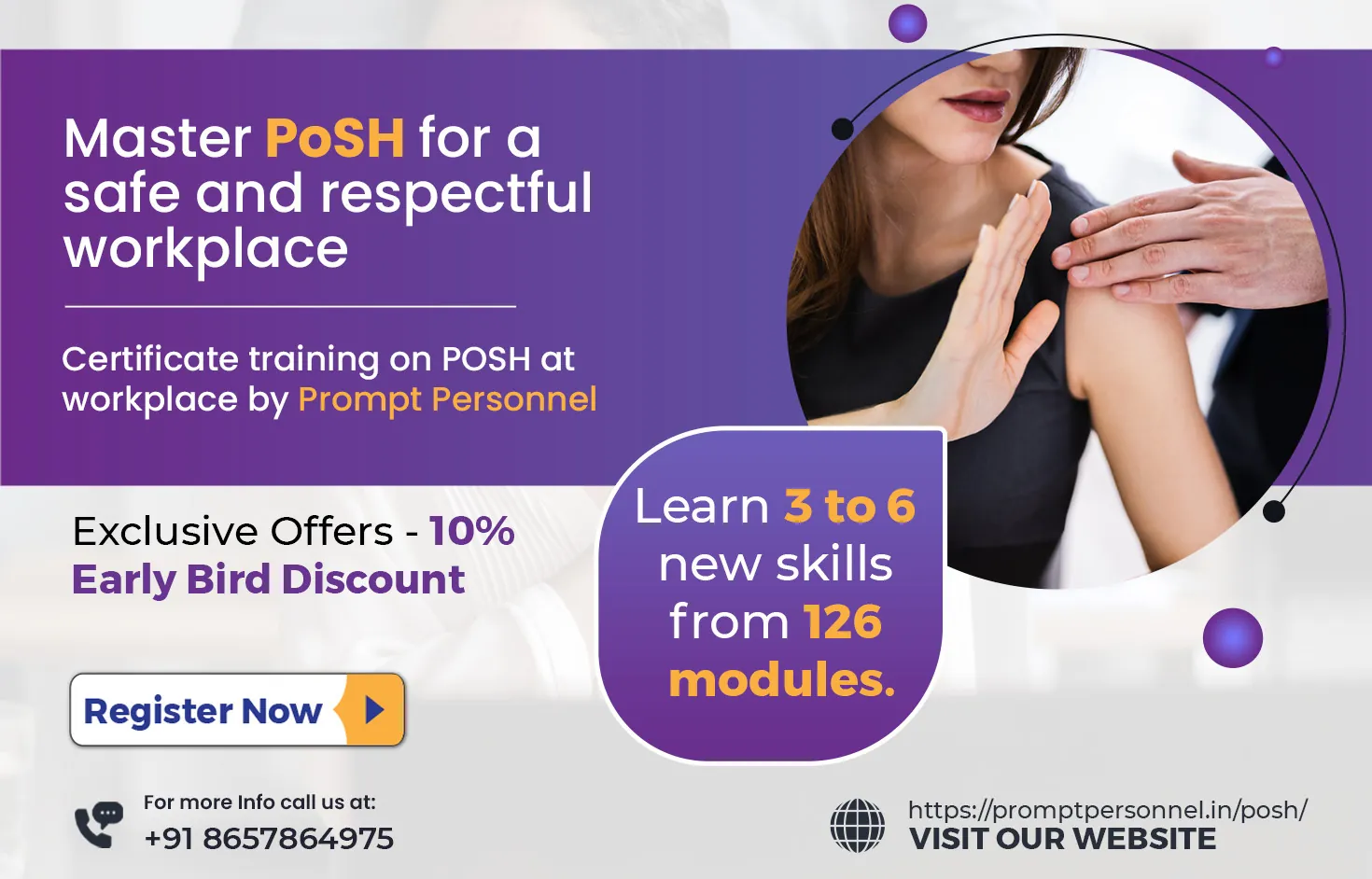
The need for a PoSHCertificate- A PoSH
Certificate showcases proficiency in implementing workplace policies related to preventing sexual harassment. It’s evidence of understanding laws, creating safe environments, and supporting victims. The PoSH Certificate is a government-recognized certification, making it a valuable professional asset. Employers value it for ensuring compliance and promoting a respectful workplace culture. The PoSH Certificate can be added to a resume, highlighting an individual’s commitment to creating a safe and respectful work environment.
Why be a PoSH trainer?
Becoming a certified PoSH trainer offers a rewarding opportunity to make a tangible difference in creating safer workplaces. As a PoSH trainer, you’ll have the chance to educate others on important legal requirements, empower individuals to recognize and address sexual harassment effectively and contribute to building a culture of respect and dignity within organizations. As a PoSH trainer, you play a crucial role in promoting awareness, fostering empathy, and equipping workplaces with the tools needed to prevent and address harassment. Your efforts contribute to creating a more inclusive and harmonious work environment for all.
What you need to do to become a PoSH Trainer
To become a PoSH-certified trainer, you’ll need to complete specialized training programs approved by reputable institutions. These programs cover key areas like understanding the PoSH Act, managing harassment complaints, leading awareness sessions, and ensuring policy implementation. After finishing the training and passing the assessment, you’ll receive certification as a PoSH trainer, enabling you to educate others on preventing and dealing with sexual harassment at work.
Announcing: The Certificate course on PoSH at the workplace!
Join us for a comprehensive training program on the Prevention of Sexual Harassment (PoSH) Act. Our course covers legal essentials, real-life scenarios, and practical strategies for ensuring compliance. Gain the expertise to nurture a secure and respectful work environment.
Why Prompt?
Benefit from our extensive experience in promoting PoSH compliance and safe workplaces nationwide. Let us equip you to cultivate dignity and security within your organization. Our comprehensive PoSH training program covers the legal essentials of the PoSH Act, explores real-life scenarios, and equips you with practical strategies to ensure seamless compliance.
What is a PoSH Certificate?
A PoSH (Prevention of Sexual Harassment) Certificate is a formal document awarded to individuals who complete training on preventing and addressing sexual harassment in the workplace. This certification educates employees, managers, and HR professionals about the legal framework, rights and responsibilities, redressal mechanisms, and preventive measures related to sexual harassment, ensuring a safe and respectful work environment. Prompt Personnel’s PoSH Certificate program includes in-depth training sessions, expert guidance, interactive workshops, and certification to demonstrate a commitment to maintaining a harassment-free workplace.
How to become a PoSH Certified Professional?
To become PoSH certified, individuals must complete a recognized training program on the Prevention of Sexual Harassment, which includes understanding the legal framework, rights and responsibilities, complaint handling procedures, and preventive measures. Prompt Personnel offers a comprehensive PoSH Certificate program with in-depth training sessions led by experienced trainers, interactive workshops, and expert guidance. Upon successful completion, participants receive a PoSH Certificate, demonstrating their commitment to maintaining a safe and respectful workplace.
Who Should Attend?
This program is tailored for HR professionals, compliance officers, legal advisors, and internal committee members. This PoSH program will equip you with the knowledge and strategies to develop robust policies, implement effective grievance redressal mechanisms, and foster a culture of respect and inclusion.
Course Details:
Our program comprises 20 hours of training delivered through weekly sessions, each lasting 2 hours, conveniently scheduled over weekends. Additionally, we offer a focused 4-hour course as part of our comprehensive training offerings.

by Prompt Personnel | May 7, 2019 | Human Resources
Introduction
In such fast and turbulent times in the business environment, employee training programs are no longer viewed as just a luxury but a necessity. This clearly explains why training is important in an organization, as these programs improve individual employee skills while ensuring the overall growth and success of the organization. Companies nurture a culture of continuous employee growth and development by using structured workplace training programs. Skill enhancement, professional development, upskilling initiatives, and systematic training of personnel further equip employees to perform effectively in their roles and adapt to changing industry dynamics.
Organizations that invest in staff development understand the long-term benefits of training and development to organizations, including improved performance, higher retention, better employee satisfaction, and increased productivity. With focused training and development initiatives, companies gain a stronger competitive edge in their respective industries.
In this blog, we will explore the multifaceted benefits of training and development in an organization, for both employees and the organisations that invest in them.
1. Improvement in Employee Performance
One of the most direct outcomes of a training and development program is improving employee performance. Employees who undergo regular training gain confidence in handling tasks more efficiently. Equipped with the right knowledge and skills, they are better prepared to meet workplace challenges and enhance productivity. Training programs help employees refine their role-specific skills, enabling them to contribute more effectively to teams and departments.
Workplace training programs also support professional development by improving problem-solving and decision-making abilities. When employees feel capable and supported, their overall performance improves significantly. For businesses, investing in employee development enhances operational efficiency and delivers measurable performance improvements—one of the keys benefits of training and development to organizations.
2. Addressing Skill Gaps
One of the most critical challenges organisations face today is the presence of skill gaps within the workforce. Structured employee training programs help bridge these gaps by providing employees with access to modern tools, technologies, and industry best practices. This may include technical training, leadership development, or functional skill enhancement through continuous training of personnel.
By addressing skill gaps proactively, organisations not only improve workforce performance but also build agility. Versatile employees can be redeployed into new roles as business needs evolve, strengthening long-term organisational success. In today’s competitive environment, continuous skill upgrading highlights why training is important in an organization and why staff development plays a crucial role in sustained growth.
3. Talent Retention
There is a strong correlation between employee training initiatives and talent retention. Organizations that invest in employee development create a more loyal and engaged workforce. When employees feel valued and see opportunities for growth, they are more likely to remain with the organization over the long term.
Personal and professional growth through training programs reduces employee turnover and increases job satisfaction. Employees involved in ongoing learning feel that the company is invested in their future, which leads to higher engagement levels. Retaining skilled employees not only reduces recruitment costs but also ensures that institutional knowledge and expertise continue to grow internally—one of the significant benefits of training and development in an organization.
4. Adapting to Industry Changes
Rapid technological advancements and market shifts require organisations to continuously prepare their workforce for change. Ongoing employee development through workplace training programs ensures employees stay updated with the latest industry trends, tools, and methodologies.
Industries such as IT, healthcare, and manufacturing experience constant evolution, making training essential to remain relevant. Training programs enhance adaptability and flexibility, enabling employees to grow alongside organisational and industry changes. This adaptability reinforces why training is important in an organization, ensuring businesses remain competitive and responsive to market demands.
5. Improvement in Employee Satisfaction
Training and development programs significantly impact employee satisfaction. Continuous learning opportunities increase engagement and provide employees with a sense of purpose and fulfillment. A satisfied workforce contributes to a positive work culture, higher morale, and improved productivity.
Professional growth and upskilling initiatives help organisations foster a culture of learning and development. When employees feel empowered and supported, they perform better and contribute meaningfully to organisational goals. Employee satisfaction remains a cornerstone of a motivated, loyal, and high-performing workforce—one of the enduring benefits of training and development to organizations.
6. Encouraging Innovation and Creativity
Employee development plays a vital role in fostering innovation within an organization. Employees who continuously learn are more likely to think creatively and propose innovative solutions. Training programs focused on critical thinking, leadership, and problem-solving help cultivate an innovation-driven mindset.
Organisations that prioritise staff development remain progressive and competitive. By nurturing new skills and ideas internally, companies often lead innovation within their industries. Employees feel more confident sharing ideas when they know their growth is supported, reinforcing the broader benefits of training and development in an organization.
7. Supports Succession Planning
Training programs also strengthen succession planning efforts. Organisations that invest in employee development build a strong internal talent pipeline capable of stepping into leadership roles when needed. Leadership training and professional development prepare employees for future responsibilities, ensuring smoother transitions and minimal disruptions.
Investing in long-term employee growth through training ensures future leaders are ready to guide the organisation forward. Effective succession planning enhances organisational stability and continuity, highlighting another key reason why training is important in an organization.
8. Encouraging a Learning Culture
Companies committed to training and development naturally foster a strong learning culture. In such environments, employees actively seek opportunities to improve their skills and performance, benefiting both personal growth and organisational outcomes.
A learning-driven workplace also enhances employer branding, making the organisation more attractive to potential talent. When candidates see a clear commitment to employee growth, they are more likely to choose that organisation. This further demonstrates the long-term benefits of training and development to organizations.
HR Partner for Business Needs: Prompt Personnel
Prompt Personnel Point is a leading provider of HR solutions operating pan-India, offering a comprehensive range of services to meet diverse business needs. With extensive industry expertise and a commitment to excellence, Prompt Personnel ensures efficient HR support across locations, helping organizations strengthen workforce capability through effective management.
Conclusion
In conclusion, employee training and development programs are essential for both short-term performance and long-term organizational success. These initiatives improve individual productivity, bridge skill gaps, enhance retention, and help organizations adapt to rapidly changing business environments. They also promote innovation, support succession planning, and establish a strong learning culture.
By investing in employee development, businesses strengthen their most valuable asset—their people. The clear benefits of training and development in an organization position companies to remain agile, innovative, and competitive in today’s fast-paced business landscape. Organisations that prioritise employee growth are best equipped to achieve sustained success and long-term resilience.

by Prompt Personnel | May 7, 2019 | Human Resources
Human resource outsourcing allows companies to delegate assignments related to human resources (e.g. benefits of management, salaries, recruitment, training, and other management tasks) to a team of skilled HR professionals, instead of recruiting internal HR staff. Companies are now slowly entering the practice of outsourcing human or skilled manpower resources. The majority of companies accept that their employees are their most valuable assets. Managing human resources has now become a critical role in the management of a business. However, for some companies, the various functions of the human resource department are too comprehensive and complicated to maintain. Advantages of outsourcing HR functions:
- Cost savings: The operating costs for HR services are generally very high. Many small companies simply cannot afford these costs and find it more economical to outsource HR functions. Outsourcing HR firms such as HR consultancy firms in Mumbai helps you to reduce your costs and avoid trying to keep non – revenue expenses financially generated.
- Payroll: Compared to the cost of keeping an in – house payroll employee, outsourcing costs are very low. The outsourced company can provide advice on taxation and deduction issues and offer an accounting payroll analysis.
- Risk management: Jobs and labor laws change periodically, and it can be difficult for you to stay up to date on regulations affecting your workplace. Outsourcing companies employ HR professionals who want to keep up to date with state and federal employment laws.
- Efficiency: It is crucial that the workplace must be efficient and productive. The outsourcing of HR functions increases the efficiency of HR systems. The advanced technology of human resources used by outsourcing providers helps improve significant human resources functions, such as payrolls, benefits management, and compliance management.
- Conformity support: This is where many small firms have real problems, particularly with changing laws on recruitment, management of insurance claims and benefits. The biggest problem is that failure to comply can have serious financial implications. Outsourcing a trusted provider such as HR consultancy firms in Mumbai can help you understand these laws and regulations and take action to comply.

by Prompt Personnel | May 7, 2019 | Human Resources
The best temporary staffing companies such as Prompt Personnel are capable of offering end to end solutions for your temporary or flexible staffing needs. This is how these companies can help reduce your costs, manage your workforce, and also make you a lot more productive than what you were before. The best thing about companies such as these is that they enjoy a commendable presence in India and the experience they have in this domain is extensive, to say the least. This is how they make sure that you get the maximum possible benefits from the service that you provide to them.
Innovative solutions
The HR and staffing solutions in Mumbai that they offer to you are innovative and smart, to say the least. As has been said already, these companies have branches at all the major cities in India such as the following:
-
Mumbai
-
Delhi
-
Bangalore
-
Chennai
-
Kolkata
-
Hyderabad
How can temporary staffing help you?
There are so many ways in which acquiring temporary staff can be beneficial for an organization. When you do so you bring down the resource allocation-related expenses and you also have the added flexibility to deploy people for the time period that you see fit. Yet another major benefit of such services is that you get enough scope to review how well these temporary employees are performing and on the basis of that you can choose the best to work in your company for a permanent basis.
Help with professional staffing
The staffing companies in Mumbai that we are talking about over here are capable of providing you with employees who are highly skilled and thus extremely proficient in the role that you need them to play. If you are a manufacturing unit that needs technicians and engineers these companies can arrange that for you; if you need software engineers for the IT industry they can help you and they can also get you resources who hold professional degrees such as MBA. The thing with these organizations is that they work for all the prominent sectors and the workforce that they provide is capable of dealing with all your needs and requirements as an organization.
Help with white-collar general staffing
If you need assistance with white-collar jobs and general staffing, you can be sure that these companies would be able to help you as well. If you need people in your organization with general and basic skills you can be sure that you would get that from them as well. They normally offer graduates to work in these roles – these professionals are capable of providing support-related functions in each and every kind of working environment.
Help with blue-collar general staffing
Just like meeting your white-collar general staffing needs these companies are capable of meeting your blue-collar general staffing requirements as well. In this context, they provide you with undergraduates who work on minimum wages. Apart from this, they are capable of providing professionals for managed services as well

by Prompt Personnel | May 7, 2019 | Human Resources
With the help of temporary staffing companies in India, you can now be in a great position when it comes to saving overhead costs as such in your organization. These days, there are a number of organizations that are offering flexible and temporary staffing solutions in Mumbai of the highest order. With the help of the services that they provide, you can now restrict your business expenses, manage their workforce-related requirements, and enhance your overall productivity as well. The best part of their services is that you can do it in a highly efficient and effective manner. There are now several top-notch names in India as far as this particular segment is concerned.
They enjoy a commendable presence in India and much of this is because of the extensive background that they have in this particular regard. It is thanks to such experience that they ensure that you are able to derive the maximum possible rewards. The HR solutions that they provide are smart and innovative, to say the least. It also needs to be mentioned that these companies have offices in all the major cities of India such as the following:
-
Mumbai
-
Delhi
-
Bangalore
-
Chennai
-
Kolkata
-
Hyderabad
How does the acquisition of temporary staff help you?
There are significant benefits to be had by hiring temporary staff members. It can bring down the costs incurred in areas such as resource allocation and also enables you to be flexible with regards to deployment of human resources as and when you need to do so. One of the biggest benefits in these cases is that you have more space to assess these employees in your unique work environment. It is on the basis of this assessment that you would then be able to recruit that person on a permanent basis.
Professional staffing
Normally the professionals who are offered by these companies happen to be highly skilled and they are also extremely proficient in the type of role that they are being asked to play, albeit on a temporary basis. In most cases, they offer professionals such as engineers as well as technicians who work in manufacturing units. They can also supply software engineers for the IT companies as well as MBAs and holders of other professional degrees for other sectors. These companies provide services to all the important sectors out there and have professionals for almost all kinds of jobs.
General staffing
As far as general staffing is concerned they can offer both white-collar and blue-collar employees. In the white-collar sector, they offer professionals who have all the requisite general skills that you may need for your business. These people are usually graduates who are capable of providing support functions in all sorts of office working environments. In terms of blue collar jobs, these organizations cater primarily to the manufacturing sector. In these cases, you are basically looking at undergraduates who work on minimum wages. Apart from that, they are also capable of providing managed services

by Prompt Personnel | May 7, 2019 | Human Resources
Every company that employs a certain number of people comes under the ambit of the labour laws of India. You would be amazed to know that there are more than 20 different labour laws that are applicable to all companies. Some of these laws are :
-
Shops & Commercial Establishments Act
-
Contract Labour Act
-
Minimum Wages Act
-
Employees Compensation Act
-
Payment of Wages Act
-
Payment of Gratuity Act
-
Sexual Harassment of Women At Workplace Act
The above list is just an indicative one, but it gives us an idea of the myriad aspects of a company’s functioning these laws cover. It is a cumbersome job for any company to keep track of whether all its departments are complying with all relevant aspects of the labour laws. This is called labour law compliance, and it is a source of a lot of heartburn and anxiety for companies, so that they do not fall foul of the law.
The human resource department within a company can be expected to keep track of compliance and handle all labour law audits. But that might not always be a great idea, primarily due to the following reasons :
-
Human resources might not have complete access to and expertise of all the current updates to labour law legislation
-
They might have access to local support groups and local wisdom which can help in the correct interpretation of labour laws in the local context
-
During statutory audits, the human resource department might not have adequate bandwidth to handle the extra workload
This is the reason why many companies appoint an external agency or firm as their labour law advisor. This move can have several advantages, some of which are listed below :
-
Having the in-house team handle its own compliance assessment could result in several clashes of interest. Having the compliance assessed by and handled by an external agency would result in good governance practices.
-
The internal human resource team would have to handle labour law compliance along with all other functions. This might result in some lapses which could cause loss of reputation as well as financial losses. Entrusting an external agency with complete responsibility would make them completely responsible and ensure that the quality of compliance is maintained.
-
Because the entire job would be done by an external agency, therefore the company wouldn’t need to hire additional manpower to handle labour law compliance. This would reduce the labour costs and overheads for the company.
-
Because the adherence to labour laws would be completely handled by an external agency, therefore the human resource team would be able to devote more time and energy to other strategic initiatives in the area of human resources.
Because of all the above reasons, it makes much more sense for a company or business house to entrust the important job of labour law compliance to an expert agency instead of loading the in-house human resource department with this job. There are several good companies who would be able to take up this responsibility.