

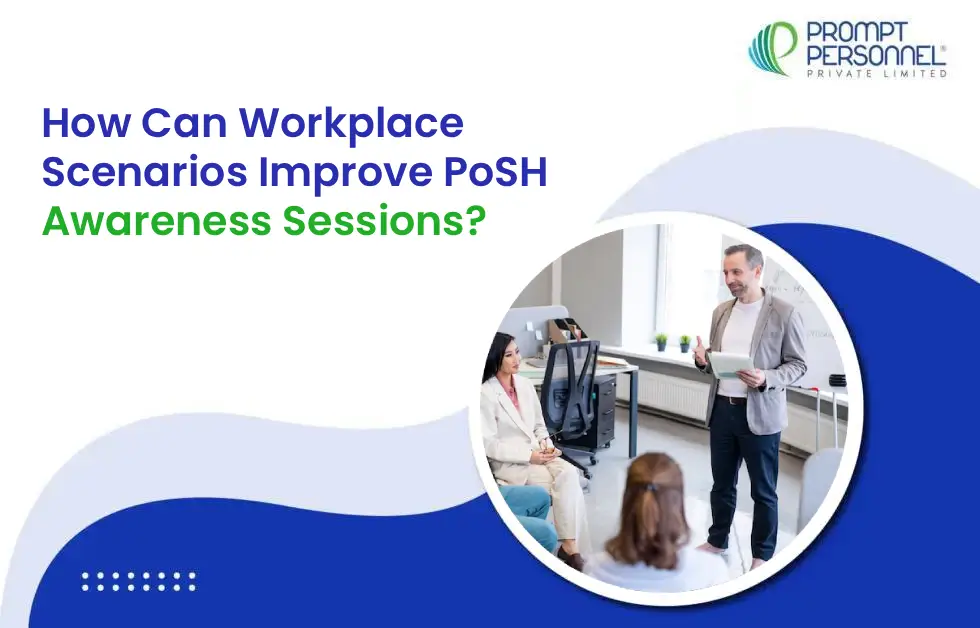
Most PoSH awareness sessions communicate the law clearly but may not always change behaviour. The reason is often the format: abstract definitions instead of situations employees recognise. Workplace scenarios, drawn from the everyday grey areas people actually navigate, can help sessions move from information delivery to genuine understanding. This blog looks at how that works in practice.
A well-run PoSH awareness training session will typically cover the legal definitions, the reporting process, the role of the Internal Committee, and the rights and responsibilities of employees under the Act. That’s a solid foundation. And in most cases, the content itself isn’t what falls short.
The question is what happens three months later, when someone in the room faces an ambiguous situation at work and has to decide whether it crosses a line, whether to say something, and how. That’s a different kind of knowledge. It’s not about recalling a definition. It’s about recognising a moment.
Scenarios are what bridge that gap. They take the legal content and place it inside situations that feel familiar, specific, and sometimes uncomfortable enough that people engage rather than observe. Prompt Personnel, with 29+ years of experience delivering PoSH training for employees across Indian workplaces, designs its sessions around this principle. Here’s why it matters and how it works.
What Limits the Impact of a Standard PoSH Awareness Session?
Most sessions are built around the right content. The definitions are accurate. The Act is explained. The complaint process is outlined. For baseline awareness, this approach works. Employees leave the session knowing what the PoSH Act is and what the organisation’s policy says.
Where things get harder is in the application. Knowing the legal definition of harassment is one thing. Recognising it in a real interaction, particularly when the behaviour is ambiguous rather than overt, is a different skill. Deciding what to do about it requires a third layer: confidence in the process and trust that using it will lead somewhere.
The gap between structural compliance and actual employee understanding is well documented. According to a Stratefix Consulting and NHRD study, as reported by SME Futures, around 56% of respondents were not aware of the PoSH Act, with only a small proportion clearly understanding the reporting mechanisms available to them. This despite the finding that over 90% of Indian companies have constituted an Internal Committee. The infrastructure exists. The awareness often doesn’t reach deep enough to change how people behave.
This is the space workplace scenarios are designed to address. Not by replacing the legal content, but by giving people a way to practise applying it before the real situation arrives.
How Do Workplace Scenarios Strengthen What Employees Take Away?
Three specific ways scenarios tend to shift the outcome of a session.
They bring the grey areas into the room. Most workplace harassment doesn’t arrive as an obvious violation. It sits in moments that feel ambiguous: a remark that could be a joke or something more, a pattern of personal questions from a manager that hasn’t quite crossed a line yet, a social media interaction that blurs the boundary between professional and personal. Scenarios take these ambiguous moments and put them in front of participants for structured discussion. The value is in the discussion itself, because it forces people to draw the line in real time rather than in theory.
They help build reporting confidence through practice. One of the most common reasons concerns go unraised is uncertainty. Did this actually count? What happens if I report it? Will it be taken seriously? A scenario that walks employees through the experience of deciding whether to report, and what the process looks like from the complainant’s perspective, can help reduce that uncertainty. It doesn’t guarantee that someone will report. But it makes the process familiar rather than foreign, which is a meaningful shift.
They give managers and IC members applied experience, not just rules. Managers are often the first people an employee speaks to when something feels wrong. Their response in that moment shapes whether the concern goes further or goes quiet. IC members carry a quasi-judicial responsibility that demands procedural precision and interpersonal sensitivity at the same time. Neither role can be performed well from a policy document alone. Scenario-based training lets these groups practise the specific conversations and decisions they’re most likely to face.
What Do Effective Workplace Scenarios Look Like in Practice?
The best scenarios reflect situations employees can genuinely imagine encountering. They work because they feel real, not because they illustrate extreme cases.
Everyday ambiguity in team interactions. A colleague repeatedly comments on someone’s appearance in a way that’s framed as friendly but feels intrusive. A team lead insists on one-on-one meetings outside office hours without a clear work reason. A group chat joke that most people laugh at but one person finds targeted. These scenarios don’t have obvious answers, which is exactly what makes them useful. The discussion surfaces where people’s interpretations differ and helps participants understand why the boundary exists.
Digital and hybrid workplace situations. A late-night personal message from a manager on a work messaging platform. Inappropriate reactions to a colleague’s social media post. Comments during a video call that might not be made in a physical meeting room. The PoSH Act’s definition of “workplace” under Section 2(o) covers digital and remote work settings, but many employees don’t realise this. Scenarios set in these contexts can help close that awareness gap.
Bystander situations. An employee notices a colleague becoming visibly uncomfortable in meetings with a particular senior. Another overhears a conversation that sounds inappropriate but isn’t sure if it’s their place to say something. Bystander scenarios are particularly useful because they give participants a framework for when and how to intervene, or when to escalate.
IC perspective: receiving and handling complaints. For IC members specifically, scenarios that simulate receiving a complaint sensitively, managing confidentiality when the respondent is in a senior position, conducting interviews without leading questions, and handling a situation where the complainant requests withdrawal mid-inquiry. These are procedural decisions with real consequences, and rehearsing them in a training environment is substantially more effective than reading about them.
How Prompt Personnel Structures Scenario-Based PoSH Awareness Training
Prompt Personnel’s PoSH services are built to move participants from knowing the law to being able to apply it in situations that matter. The offering is structured around four delivery formats, each integrating scenarios appropriate to the audience.
PoSH Awareness (LMS). Self-paced digital modules with embedded scenarios, quizzes, and reflection questions. This format builds a consistent baseline of awareness across a distributed workforce and gives employees the flexibility to learn at their own pace.
PoSH Awareness Training (instructor-led and virtual live sessions). Built around case studies, role-play, and interactive discussion. This is typically the format where the scenario-based approach has the most visible impact, because participants discuss, debate, and respond in real time rather than reading passively.
IC Refresher Training. Focused sessions for Internal Committee members covering procedural updates, case-handling practice, and inquiry-management scenarios. Designed to keep IC members current and prepared for the specific situations they may need to handle.
PoSH Master Class (Train the Trainer). Equips internal HR and L&D professionals to design and deliver scenario-based sessions independently, so that PoSH awareness programmes become a sustained internal capability rather than a once-a-year external engagement.
Each programme is customised to the client’s specific workplace context. A corporate office, a manufacturing floor, and a hybrid team each present different scenarios and dynamics, and the training reflects that. With 29+ years of HR expertise, certified trainers, and a pan-India delivery capability, Prompt Personnel works as a trusted PoSH consultant for organisations that want their awareness sessions to translate into changed understanding and behaviour.
Explore Prompt Personnel’s PoSH Services
A Session People Remember Is a Session That Works
The point of PoSH compliance is not attendance. It’s whether someone, months after the session, recognises an ambiguous moment at work and knows how to respond. Scenarios are what make that recognition more likely. They give abstract definitions a shape people can hold on to.
The format is the variable that most organisations have the most control over. Legal content is largely fixed by the Act. But how that content is delivered, whether through a slide deck or through a discussion that puts people inside the situation, is a design choice. And it’s the design choice that tends to determine whether a session was useful or simply completed.
Frequently Asked Questions
- What is scenario-basedPoSHawareness training?
It’s a training approach that places participants inside realistic workplace situations rather than relying on definitions and slides alone. Employees discuss, respond to, and analyse scenarios that reflect the kinds of interactions they might encounter at work, helping them practise recognition and decision-making in a low-stakes environment.
- Why are workplace scenarios more effective than lecture-basedPoSHsessions?
Scenarios engage participants actively and require them to apply the legal content to a specific situation. This tends to improve recall and understanding because the learning is tied to a recognisable context rather than presented as abstract information. Adults generally learn and retain more when content is directly relevant to their experience.
- What kinds of scenarios should aPoSHawareness session include?
Effective sessions typically include scenarios covering everyday team interactions, digital and hybrid workplace situations, bystander situations, and IC-specific case-handling exercises. The scenarios should reflect ambiguous, real-world situations rather than extreme or obvious cases, since the grey areas are where most uncertainty exists.
- How often shouldPoSHawareness training include scenario-based content?
The PoSH Act requires employers to conduct awareness programmes at regular intervals but does not prescribe a specific annual frequency. Scenario-based content is most effective when included in each scheduled session, whether that’s during onboarding, periodic refreshers, or dedicated training days, so that employees build applied understanding over time.
- Can scenario-basedPoSHtraining be delivered online?
Yes. Virtual instructor-led sessions can incorporate scenarios through live discussion, polls, breakout rooms, and facilitated role-play. LMS-based modules can embed interactive scenarios with decision points and feedback. The key is that the format remains participatory rather than passive, regardless of whether delivery is in-person or virtual.
References
- SME Futures — “PoSH on paper, silence in practice: When ICCs exist but justice doesn’t in workplaces,” April 2026, citing a Stratefix Consulting and NHRD study finding that around 56% of respondents were not aware of the PoSH Act.
- FICCI-EY Workplace Survey, as cited in the same SME Futures article (over 90% of Indian companies report having constituted an Internal Committee).


